Kimura Yu, Seki Tatsunori, Chujo Keisuke, Murata Toshiki, Sakurai Tomoaki, Miyata Satoshi, Inoue Hiroyasu, Ito Nobuyasu
SoftBank Corporation, Tokyo, Japan.
Graduate School of Information Science, University of Hyogo, Kobe, Japan.
Sci Rep. 2025 Jan 7;15(1):1081. doi: 10.1038/s41598-024-82962-y.
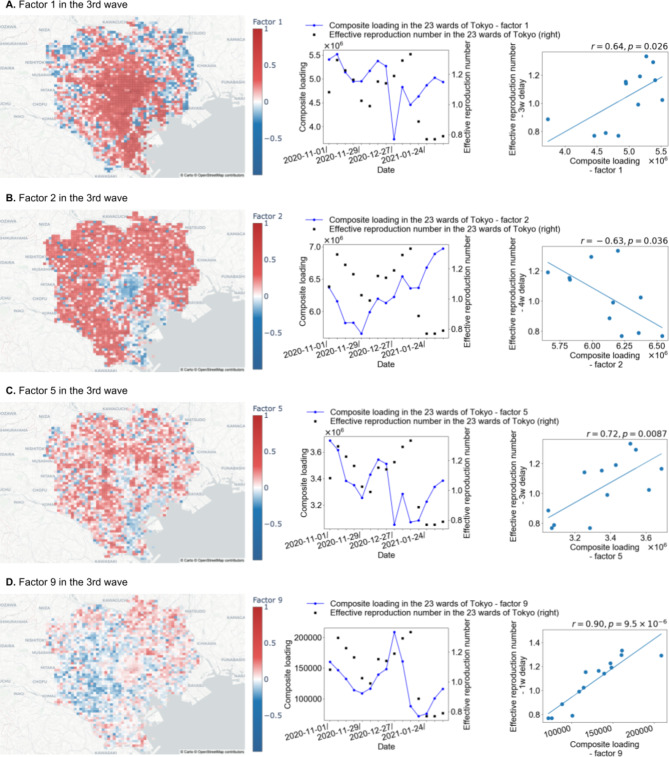
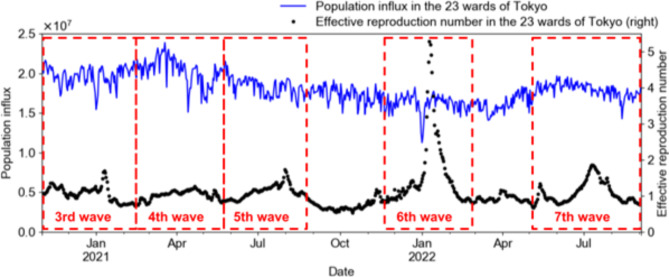
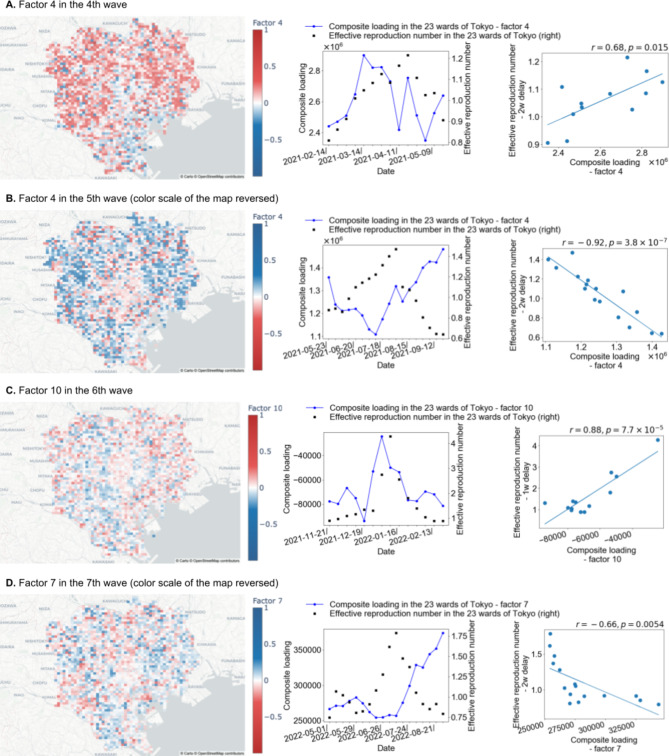
We analyse the relationship between population influx and the effective reproduction number in the 23 wards of Tokyo during the COVID-19 pandemic to estimate hotspots of infection. We identify some patterns of population influx via factor analysis and estimate specific areas as infection-related hotspots by focusing on influx patterns that are highly correlated with the effective reproduction number. As a result, several influx patterns are assumed to be directly related to the subsequent spread of the infection. This analytical method has the potential to detect unknown hotspots related to pandemics in the future.
我们分析了新冠疫情期间东京23个区的人口流入与有效繁殖数之间的关系,以估计感染热点地区。我们通过因子分析确定了一些人口流入模式,并通过关注与有效繁殖数高度相关的流入模式,将特定区域估计为与感染相关的热点地区。结果表明,几种流入模式被认为与随后的感染传播直接相关。这种分析方法有潜力在未来检测出与大流行病相关的未知热点地区。