Nobori Tatsuya, Monell Alexander, Lee Travis A, Sakata Yuka, Shirahama Shoma, Zhou Jingtian, Nery Joseph R, Mine Akira, Ecker Joseph R
Plant Biology Laboratory, The Salk Institute for Biological Studies, La Jolla, CA, USA.
Genomic Analysis Laboratory, The Salk Institute for Biological Studies, La Jolla, CA, USA.
Nature. 2025 Feb;638(8049):197-205. doi: 10.1038/s41586-024-08383-z. Epub 2025 Jan 8.
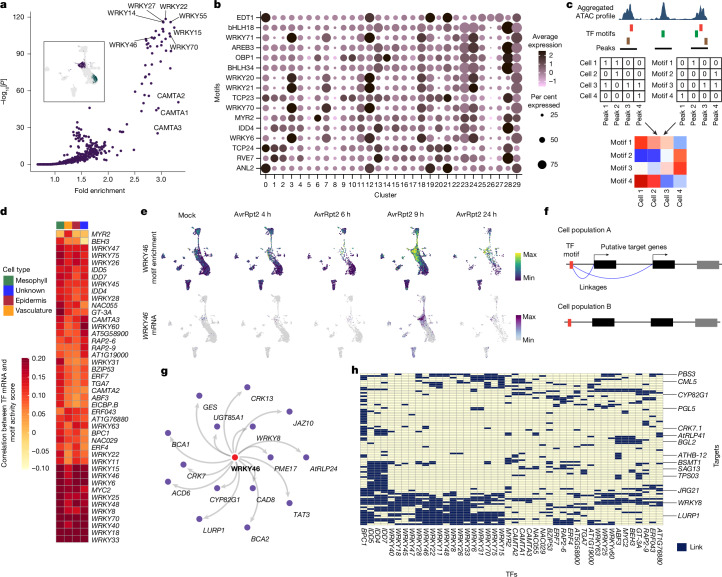
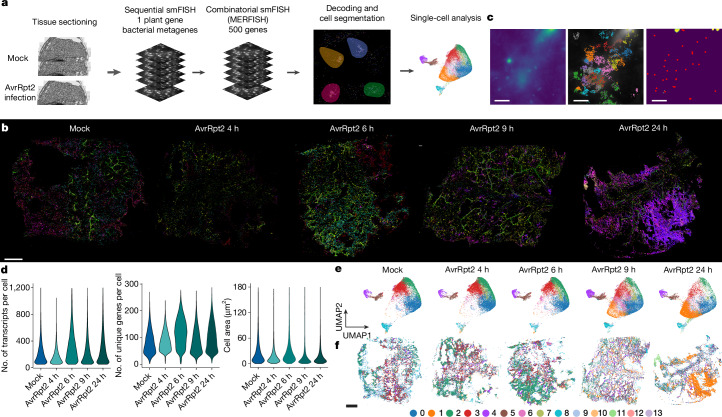
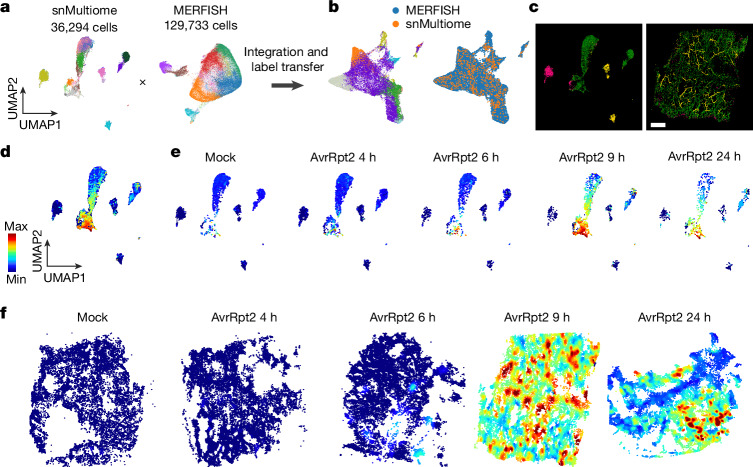
Plants lack specialized and mobile immune cells. Consequently, any cell type that encounters pathogens must mount immune responses and communicate with surrounding cells for successful defence. However, the diversity, spatial organization and function of cellular immune states in pathogen-infected plants are poorly understood. Here we infect Arabidopsis thaliana leaves with bacterial pathogens that trigger or supress immune responses and integrate time-resolved single-cell transcriptomic, epigenomic and spatial transcriptomic data to identify cell states. We describe cell-state-specific gene-regulatory logic that involves transcription factors, putative cis-regulatory elements and target genes associated with disease and immunity. We show that a rare cell population emerges at the nexus of immune-active hotspots, which we designate as primary immune responder (PRIMER) cells. PRIMER cells have non-canonical immune signatures, exemplified by the expression and genome accessibility of a previously uncharacterized transcription factor, GT-3A, which contributes to plant immunity against bacterial pathogens. PRIMER cells are surrounded by another cell state (bystander) that activates genes for long-distance cell-to-cell immune signalling. Together, our findings suggest that interactions between these cell states propagate immune responses across the leaf. Our molecularly defined single-cell spatiotemporal atlas provides functional and regulatory insights into immune cell states in plants.
植物缺乏专门的可移动免疫细胞。因此,任何遇到病原体的细胞类型都必须启动免疫反应,并与周围细胞进行通信以实现成功防御。然而,人们对病原体感染植物中细胞免疫状态的多样性、空间组织和功能了解甚少。在这里,我们用触发或抑制免疫反应的细菌病原体感染拟南芥叶片,并整合时间分辨的单细胞转录组、表观基因组和空间转录组数据来识别细胞状态。我们描述了细胞状态特异性的基因调控逻辑,该逻辑涉及转录因子、假定的顺式调控元件以及与疾病和免疫相关的靶基因。我们发现,在免疫活性热点的交汇处出现了一种罕见的细胞群体,我们将其命名为初级免疫应答细胞(PRIMER细胞)。PRIMER细胞具有非经典的免疫特征,以前未表征的转录因子GT-3A的表达和基因组可及性就是例证,该转录因子有助于植物抵抗细菌病原体。PRIMER细胞被另一种细胞状态(旁观者细胞)包围,后者激活用于长距离细胞间免疫信号传导的基因。总之,我们的研究结果表明,这些细胞状态之间的相互作用在叶片中传播免疫反应。我们在分子水平上定义的单细胞时空图谱为植物免疫细胞状态提供了功能和调控方面的见解。