Chaves Andrea, Mendoza Hugo, Herrera Angel, Pacheco-Zapata Mitsuri, López-Pérez Andrés M, Fernández Adriana, Arguello-Sáenz Milena, Arnal Audrey, Suzán Gerardo
Departamento de Etología, Fauna Silvestre y Animales de Laboratorio, Facultad de Medicina Veterinaria y Zootecnia, Universidad Nacional Autónoma de México, Ciudad Universitaria, Av. Universidad #3000, Mexico City, 04510, D.F, Mexico.
Institute of Research and Education in Nutrition and Health (INCIENSA), La Union, San Diego, Cartago, 42250, Costa Rica.
One Health Outlook. 2025 Jan 9;7(1):3. doi: 10.1186/s42522-024-00120-w.
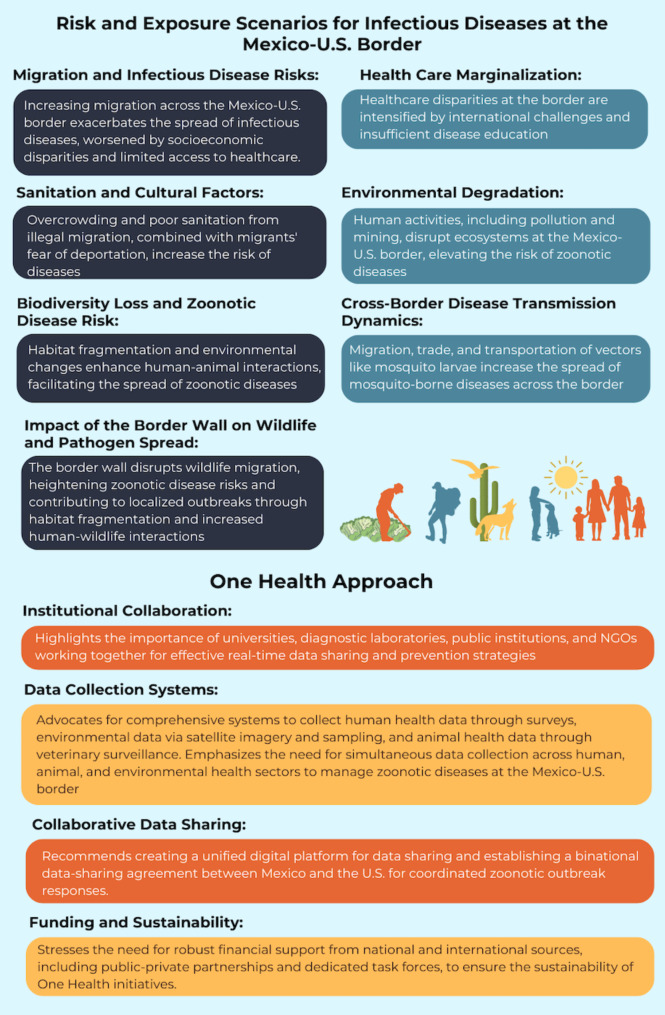
The emerging risks facing humanity have highlighted the need to address and prevent challenges through multilateral preventive strategies. The Mexico-United States (US) border is a region with great biological biodiversity and both countries shared a similar history and intense socioeconomic, and cultural interrelationships. Also, it has an extraordinary ecological contrast, resulting in an enormous biological diversity in a broad Nearctic-Neotropical transition zone. This dynamic region has important disparities due to the lack of bilateral strategies to face emerging issues (e.g., infectious diseases) in an integrated and holistic approach. In this context, we describe the various socio-ecosystemic contexts of the shared border and present different diseases transmitted, and different zoonoses that affect ecosystemic public health that must be addressed under collaborative schemes that can develop preventive policies under the One Health approach with emphasis on the Mexican zone. We describe the social determinants of health issues for the border, but we add ecological contexts infrequently studied in classical epidemiological approaches. Strategies towards One Health require international and multidisciplinary approaches that strengthen diagnostic capabilities, recognizing social, and environmental challenges. Recognizing these aspects will allow the establishment of joint monitoring, prevention, and mitigation strategies with benefits for both countries.
人类面临的新出现风险凸显了通过多边预防战略应对和预防挑战的必要性。墨西哥与美国边境地区拥有丰富的生物多样性,两国有着相似的历史以及密切的社会经济和文化联系。此外,该地区存在显著的生态差异,在广阔的新北区 - 新热带区过渡地带形成了极为丰富的生物多样性。由于缺乏以综合和整体方式应对新出现问题(如传染病)的双边战略,这一充满活力的地区存在重大差距。在此背景下,我们描述了共同边境的各种社会生态背景,介绍了传播的不同疾病以及影响生态系统公共卫生的不同人畜共患病,这些都必须在协作框架下加以应对,以便在“同一健康”方法下制定预防政策,重点关注墨西哥地区。我们描述了边境地区健康问题的社会决定因素,但还补充了经典流行病学方法中很少研究的生态背景。“同一健康”战略需要国际和多学科方法来加强诊断能力,同时认识到社会和环境挑战。认识到这些方面将有助于制定对两国都有益的联合监测、预防和缓解战略。