Wang Ning, Ma Feifei, Song Huijuan, He Ningning, Zhang Huanteng, Li Jianguo, Liu Qiang, Xu Chang
School of Basic Medicine Sciences, Shandong Second Medical University, Weifang, China.
Tianjin Key Laboratory of Radiation Medicine and Molecular Nuclear Medicine, Institute of Radiation Medicine, State Key Laboratory of Advanced Medical Materials and Devices, Chinese Academy of Medical Science and Peking Union Medical College, Tianjin, China.
Cell Transplant. 2025 Jan-Dec;34:9636897241311019. doi: 10.1177/09636897241311019.
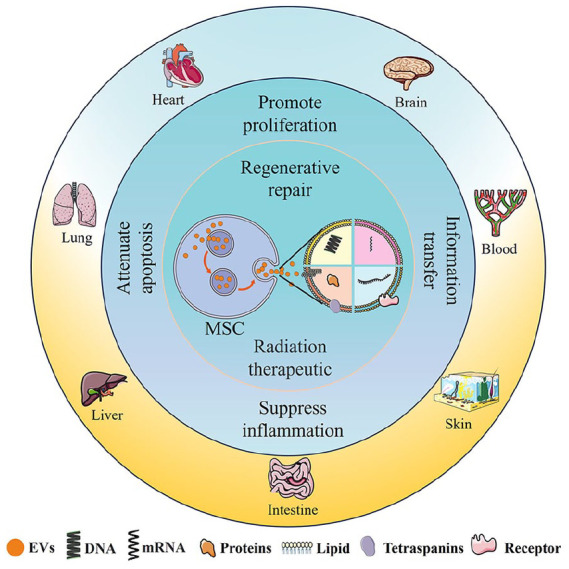
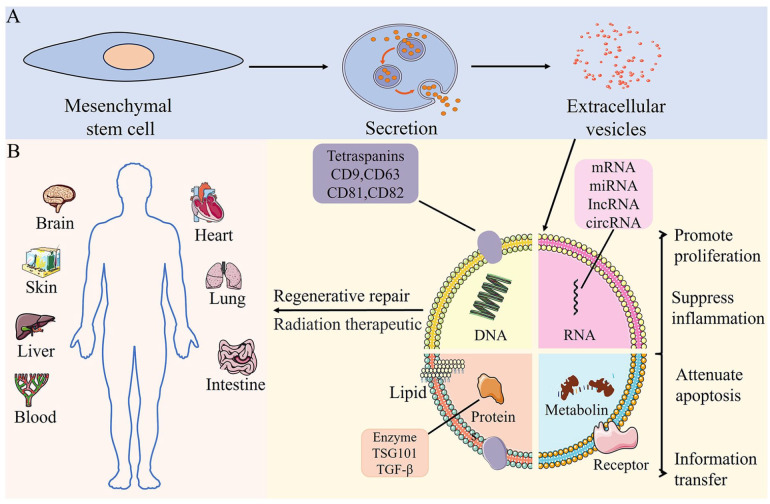
Tissue repair is an extremely crucial part of clinical treatment. During the course of disease treatment, surgery, chemotherapy, and radiotherapy cause tissue damage. On the other hand, Normal tissue from accidental or therapeutic exposure to high-dose radiation can cause severe tissue damage. There is an urgent need for developing medical countermeasures against radiation injury for tissue repair. Tissue repair involves the regeneration, proliferation, differentiation, and migration of tissue cells; imbalance of local tissue homeostasis, progressive chronic inflammation; decreased cell activity and stem cell function; and wound healing. Although many clinical treatments are currently available for tissue repair, they are expensive. The long recovery time and some unavoidable complications such as cell damage and the inflammatory reaction caused by radiotherapy have led to unsatisfactory results. Extracellular vesicles (EVs) derived from mesenchymal stem cells (MSCs) have similar tissue repair functions as MSCs. In tissue damage, EVs can be used as an alternative to stem cell therapy, thereby avoiding related complications such as immunological rejection. EVs play a major role in regulating tissue damage, anti-inflammation, pro-proliferation, and immune response, thus providing a diversified and efficient solution for the repair of disease- and radiotherapy-induced tissue damage. This article reviews the research progress of mesenchymal stem cell-derived EVs in promoting the repair of tissue including heart, lung, liver, intestine, skin, blood system, central nervous system, and tissue damage caused by radiotherapy, thereby aiming to offer new directions and ideas for the radiotherapy and regenerative applications.
组织修复是临床治疗中极其关键的一部分。在疾病治疗过程中,手术、化疗和放疗会导致组织损伤。另一方面,意外或治疗性暴露于高剂量辐射下的正常组织也会造成严重的组织损伤。迫切需要开发针对辐射损伤的医学对策以促进组织修复。组织修复涉及组织细胞的再生、增殖、分化和迁移;局部组织稳态失衡、进行性慢性炎症;细胞活性和干细胞功能下降;以及伤口愈合。尽管目前有许多临床治疗方法可用于组织修复,但它们成本高昂。较长的恢复时间以及一些不可避免的并发症,如放疗引起的细胞损伤和炎症反应,导致治疗效果不尽人意。间充质干细胞(MSC)衍生的细胞外囊泡(EV)具有与MSC相似的组织修复功能。在组织损伤中,EV可作为干细胞治疗的替代方法,从而避免免疫排斥等相关并发症。EV在调节组织损伤、抗炎、促增殖和免疫反应中发挥着重要作用,从而为疾病和放疗引起的组织损伤修复提供了一种多样化且高效的解决方案。本文综述了间充质干细胞衍生的EV在促进心脏、肺、肝脏、肠道、皮肤、血液系统、中枢神经系统等组织修复以及放疗引起的组织损伤修复方面的研究进展,旨在为放疗和再生应用提供新的方向和思路。