Department of Orthopaedics, First Affiliated Hospital, Dalian Medical University, Dalian, Liaoning, Chin.
Dalian Medical University, Dalian, Liaoning, China.
Cell Transplant. 2020 Jan-Dec;29:963689720908500. doi: 10.1177/0963689720908500.
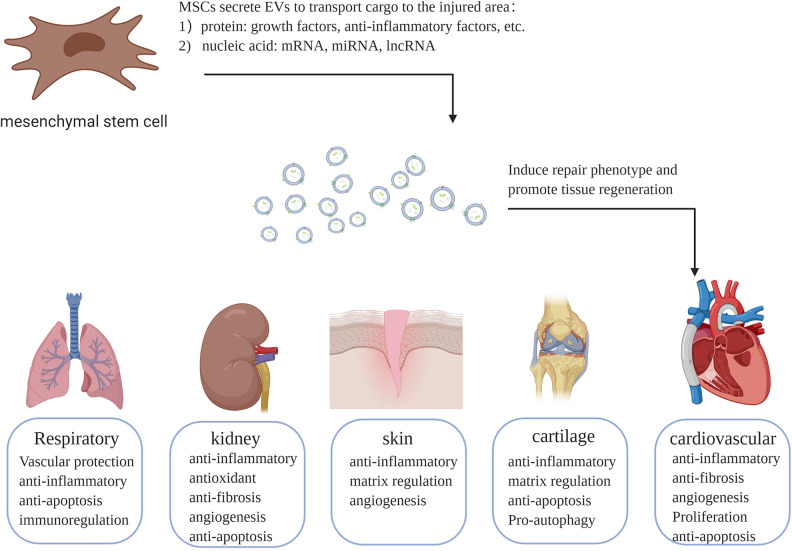
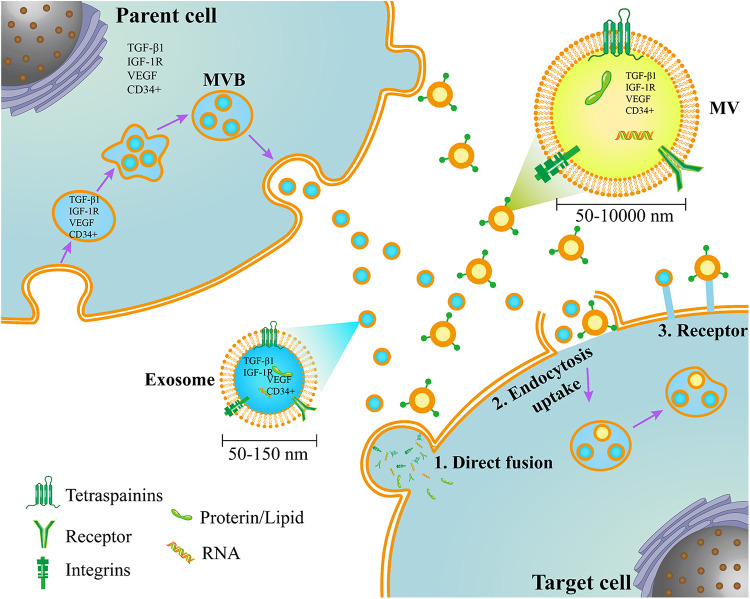
Mesenchymal stem cells (MSCs) are multipotent stem cells that have attracted increasing interest in the field of regenerative medicine. Previously, the differentiation ability of MSCs was believed to be primarily responsible for tissue repair. Recent studies have shown that paracrine mechanisms play an important role in this process. MSCs can secrete soluble molecules and extracellular vesicles (EVs), which mediate paracrine communication. EVs contain large amounts of proteins and nucleic acids, such as mRNAs and microRNAs (miRNAs), and can transfer the cargo between cells. The cargoes are similar to those in MSCs and are not susceptible to degradation due to the protection of the EV bimolecular membrane structure. MSC-EVs can mimic the biological characteristics of MSCs, such as differentiation, maturation, and self-renewal. Due to their broad biological functions and their ability to transfer molecules between cells, EVs have been intensively studied by an increasing number of researchers with a focus on therapeutic applications, especially those of EVs secreted by MSCs. In this review, we discuss MSC-derived EVs and their therapeutic potential in tissue regeneration.
间充质干细胞(MSCs)是多能干细胞,在再生医学领域引起了越来越多的关注。以前,MSCs 的分化能力被认为是组织修复的主要原因。最近的研究表明,旁分泌机制在这个过程中起着重要作用。MSCs 可以分泌可溶性分子和细胞外囊泡(EVs),介导旁分泌通讯。EVs 含有大量的蛋白质和核酸,如 mRNAs 和 microRNAs(miRNAs),并可以在细胞间传递货物。这些货物与 MSCs 中的货物相似,由于 EV 双分子膜结构的保护,不易降解。MSC-EVs 可以模拟 MSCs 的生物学特性,如分化、成熟和自我更新。由于其广泛的生物学功能以及在细胞间传递分子的能力,EVs 已被越来越多的研究人员深入研究,重点是治疗应用,特别是 MSCs 分泌的 EVs。在这篇综述中,我们讨论了 MSC 衍生的 EVs 及其在组织再生中的治疗潜力。