Xu Tong Bill, Mostafavi Armin, Boot Walter R, Czaja Sara, Kalantari Saleh
Human Centered Design Department, Cornell University, Ithaca, New York, USA.
Division of Geriatrics and Palliative Medicine, Weill Cornell Medicine, New York, New York, USA.
Innov Aging. 2024 Dec 12;9(1):igae099. doi: 10.1093/geroni/igae099. eCollection 2025.
This study evaluates the feasibility of virtual reality (VR) wayfinding training with aging adults and assesses the impact of the training on wayfinding performance.
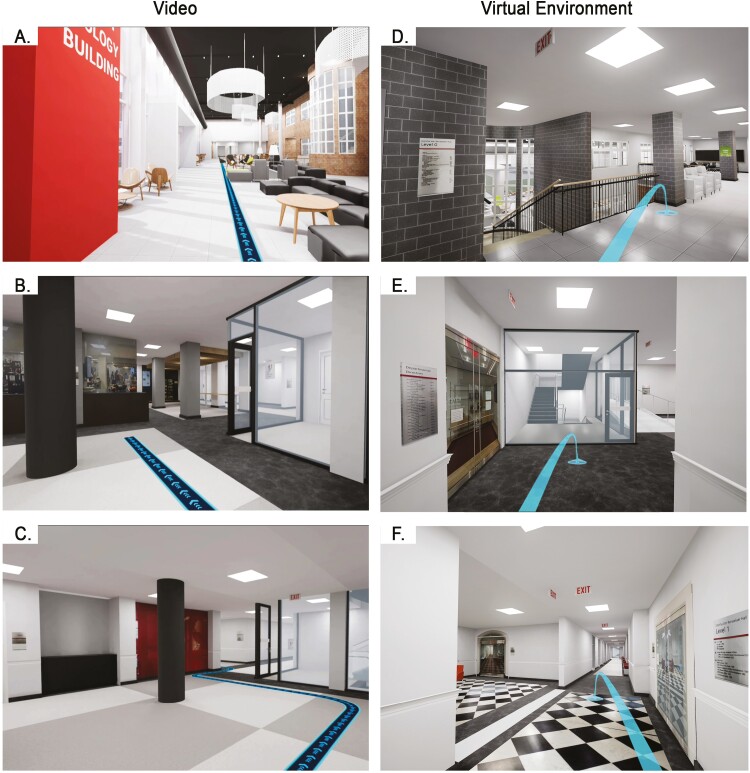
49 participants were recruited using a convenience sample approach. Wayfinding tasks were conducted by 3 participant groups: active VR training, passive video training, and no training, assigned randomly. The training featured 5 tasks in a digital version of a real building. Post-training assessments used 10 tasks in this same building, half of the tasks familiar from the training and half new. The study was double-blinded, with each intervention lasting 10 min. The primary outcomes include the Distance Traveled and Duration for each wayfinding task, with a fixed 10-min limit.
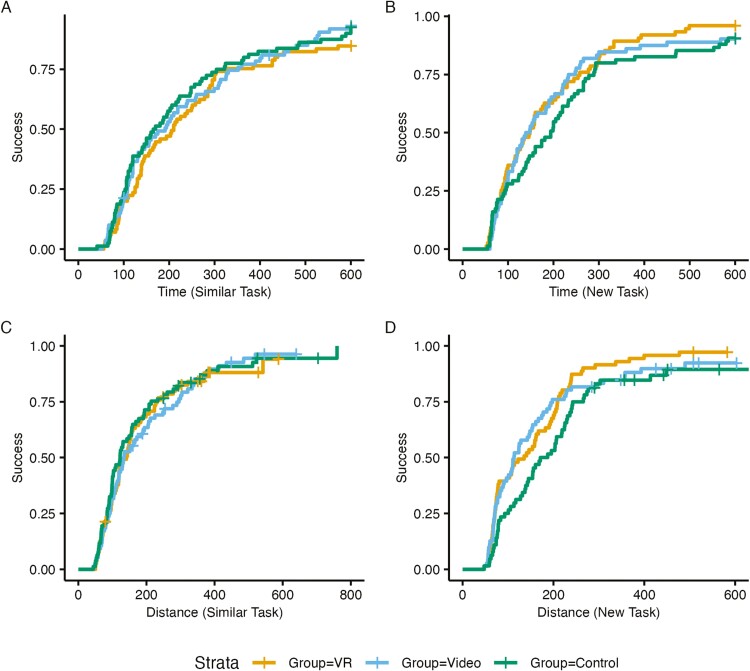
Participants in the VR group reported moderate usability and a high sense of Self Location in the environment with respect to the training intervention. No significant differences were found in performance for the first group of similar wayfinding tasks; however, in the subsequent set of new tasks the VR group significantly outperformed the Control group. This suggests a possible spatial learning effect across multiple exposures (VR training followed by similar task). No adverse effects were reported during or post intervention.
This study provides preliminary evidence that VR training can help to improve wayfinding performance in older adults with no reported adverse effects.
本研究评估虚拟现实(VR)寻路训练应用于老年人的可行性,并评估该训练对寻路表现的影响。
采用便利抽样法招募了49名参与者。寻路任务由3个参与者组进行:主动VR训练组、被动视频训练组和无训练组,随机分配。训练内容为在真实建筑的数字版本中进行5项任务。训练后评估在同一建筑中使用10项任务,其中一半任务与训练中熟悉的任务相同,另一半为新任务。该研究采用双盲设计,每次干预持续10分钟。主要结果包括每个寻路任务的行进距离和持续时间,限时10分钟。
VR组参与者报告称,就训练干预而言,该训练具有中等可用性,且在环境中的自我定位感较高。在第一组相似寻路任务的表现上未发现显著差异;然而,在随后的一组新任务中,VR组的表现明显优于对照组。这表明多次接触(VR训练后进行相似任务)可能存在空间学习效应。干预期间或干预后均未报告不良反应。
本研究提供了初步证据,表明VR训练有助于提高老年人的寻路表现,且未报告不良反应。