Alexandrova Margarita
Department of Medical Physics and Biophysics, Medical University-Pleven, Pleven, Bulgaria.
J Med Life. 2024 Nov;17(11):963-977. doi: 10.25122/jml-2024-0284.
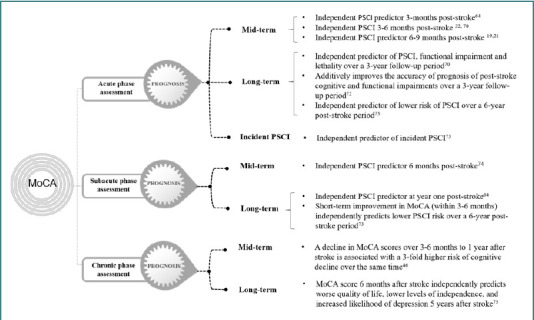
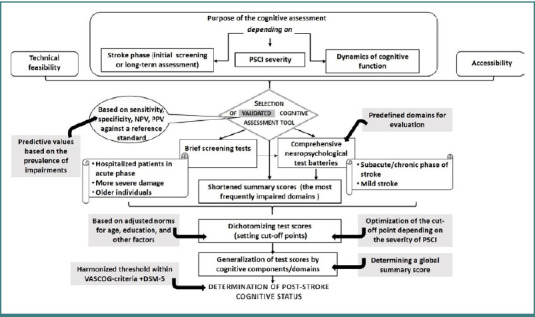
With advances in scientific and clinical knowledge, stroke has evolved from a major cause of death to a chronic condition affecting the daily lives of sufferers, their relatives, and society. Post-stroke cognitive impairment (PSCI) is common even among individuals with good neurological recovery. When deciding on interventions aimed to improve the life quality of post-stroke patients, identifying those at high risk of cognitive decline proves crucial. Given the complexity of PSCI assessment, this narrative review discusses the feasibility of developing standardized criteria for selecting cognitive instruments. Potential approaches for establishing harmonized procedures for post-stroke cognitive assessment are presented depending on how the cognitive impairment is defined, the cognitive domains examined, the methods used to generalize cognitive data by components/domains, and their normalization against standardized normative samples. The prognostic value of cognitive assessment to identify patients at high risk of PSCI, functional dependence, and poor survival is also discussed. Implementing harmonized criteria for assessing the cognitive status of stroke patients could reduce the now considerable heterogeneity between studies and serve as a reliable basis for determining the prevalence and predicting the occurrence/aggravation of PSCI.
随着科学和临床知识的进步,中风已从主要死因演变为一种影响患者及其亲属日常生活以及社会的慢性疾病。即使在神经功能恢复良好的个体中,中风后认知障碍(PSCI)也很常见。在决定采取旨在提高中风后患者生活质量的干预措施时,识别那些认知功能下降风险高的患者至关重要。鉴于PSCI评估的复杂性,本叙述性综述讨论了制定选择认知评估工具的标准化标准的可行性。根据认知障碍的定义方式、所检查的认知领域、按组成部分/领域概括认知数据的方法以及将其与标准化常模样本进行标准化的方法,提出了建立中风后认知评估统一程序的潜在方法。还讨论了认知评估对识别PSCI高风险、功能依赖和低生存率患者的预后价值。实施评估中风患者认知状态的统一标准可以减少目前研究之间相当大的异质性,并为确定PSCI的患病率以及预测其发生/加重提供可靠依据。