Wei Ting, Lai Wangsheng, Chen Qian, Sun Chenjian
CAS Key Laboratory for Quantitative Engineering Biology, Shenzhen Institute of Synthetic Biology, Shenzhen Institutes of Advanced Technology, Chinese Academy of Sciences, Shenzhen 518055, China.
University of Chinese Academy of Sciences, Beijing 100049, China.
Int J Mol Sci. 2024 Dec 30;26(1):250. doi: 10.3390/ijms26010250.
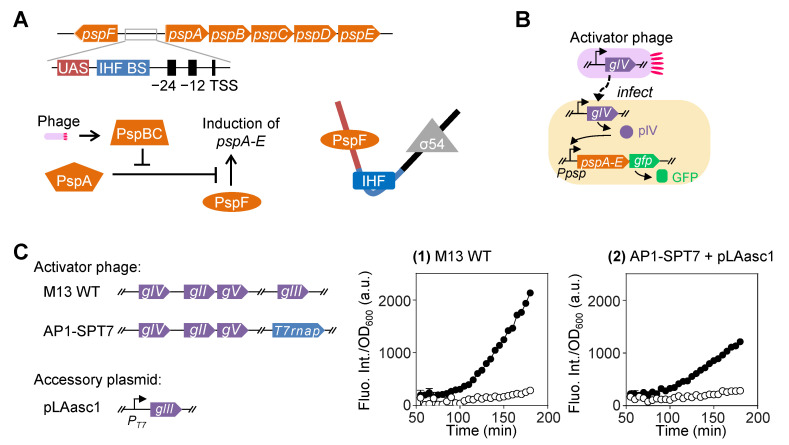
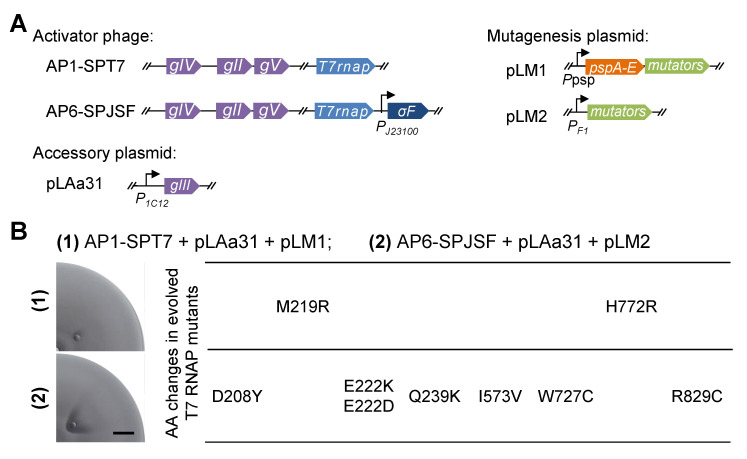
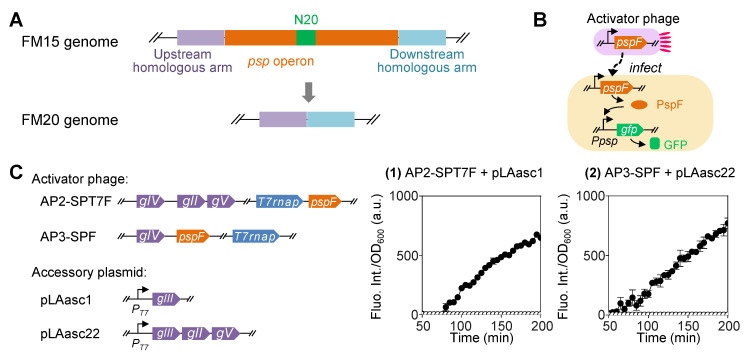
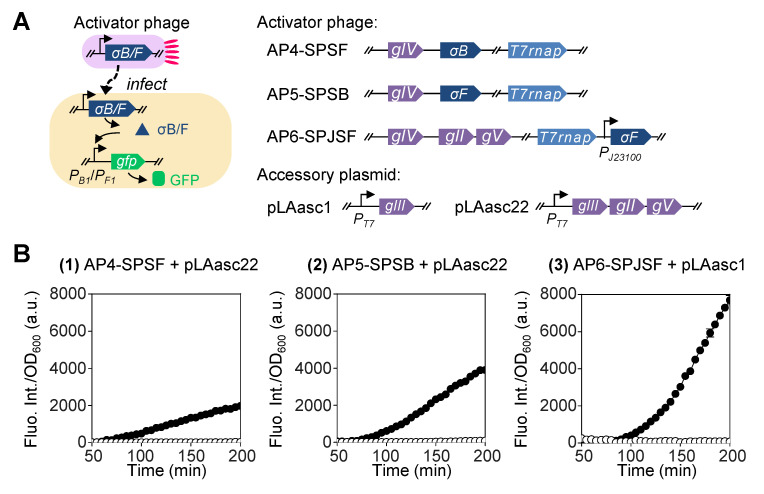
Recently, we developed a spatial phage-assisted continuous evolution (SPACE) system. This system utilizes chemotaxis coupled with the growth of motile bacteria during their spatial range expansion in soft agar to provide fresh host cells for iterative phage infection and selection pressure for preserving evolved genes of interest carried by phage mutants. Controllable mutagenesis activated only in a subpopulation of the migrating cells is essential in this system to efficiently generate mutated progeny phages from which desired individuals are selected during the directed evolution process. But, the widely adopted small molecule-dependent inducible system could hardly fulfill this purpose because it always affects all cells homogeneously. In this study, we developed a phage infection-induced gene expression system using modified () phage shock protein operon or sigma factors from . Results showed that this system enabled efficient control of gene expression upon phage infection with dynamic output ranges from small to large using combinations of different engineered phages and corresponding promoters. This system was incorporated into SPACE to function as a phage infection-induced mutagenesis module and successfully facilitated the evolution of T7 RNA polymerase, which generated diverse mutants with altered promoter recognition specificity. We expect that phage infection-induced gene expression system could be further extended to more applications involving partial induction in a portion of a population and targeted induction in specific strains among a mixed bacterial community, which provides an important complement to small molecule-dependent inducible systems.
最近,我们开发了一种空间噬菌体辅助连续进化(SPACE)系统。该系统利用趋化作用以及运动性细菌在软琼脂中进行空间范围扩展时的生长,为迭代噬菌体感染提供新鲜宿主细胞,并为保留噬菌体突变体携带的感兴趣的进化基因提供选择压力。在该系统中,仅在迁移细胞的亚群中激活的可控诱变对于在定向进化过程中有效地产生突变后代噬菌体至关重要,从这些突变后代噬菌体中可以选择出所需的个体。但是,广泛采用的小分子依赖性诱导系统很难实现这一目的,因为它总是均匀地影响所有细胞。在本研究中,我们利用修饰的()噬菌体休克蛋白操纵子或来自的σ因子开发了一种噬菌体感染诱导的基因表达系统。结果表明,该系统能够在噬菌体感染时有效控制基因表达,通过组合不同的工程噬菌体和相应启动子,可实现从小到动态输出范围的基因表达。该系统被整合到SPACE中,作为噬菌体感染诱导的诱变模块,并成功促进了T7 RNA聚合酶的进化,产生了具有改变的启动子识别特异性的多种突变体。我们期望噬菌体感染诱导的基因表达系统能够进一步扩展到更多应用中,包括在群体的一部分中进行部分诱导以及在混合细菌群落中的特定菌株中进行靶向诱导,这为小分子依赖性诱导系统提供了重要补充。