CAS Key Laboratory for Quantitative Engineering Biology, Shenzhen Institute of Synthetic Biology, Shenzhen Institutes of Advanced Technology, Chinese Academy of Sciences, Shenzhen, China.
University of Chinese Academy of Sciences, Beijing, China.
Mol Syst Biol. 2022 Sep;18(9):e10934. doi: 10.15252/msb.202210934.
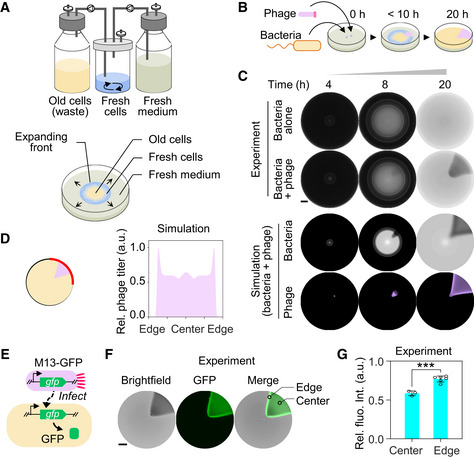
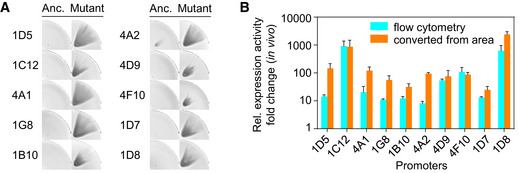
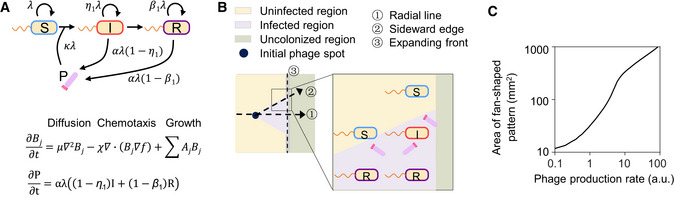
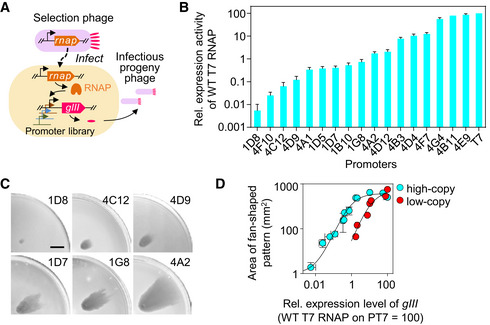
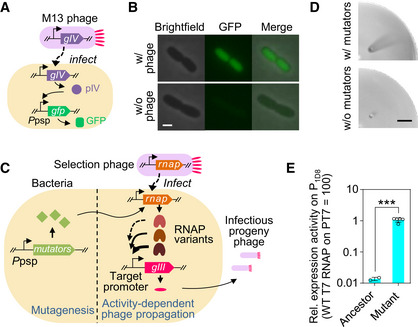
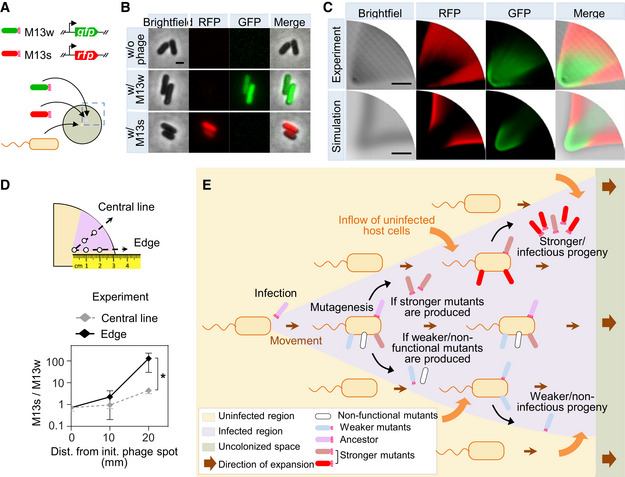
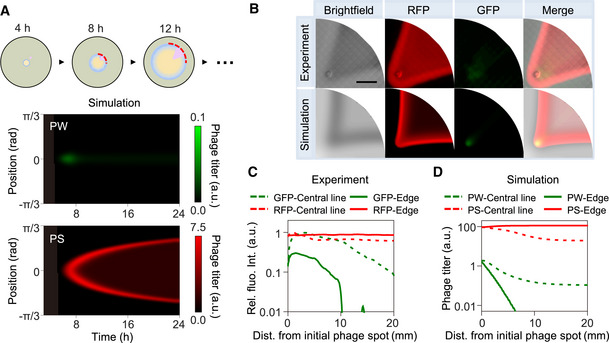
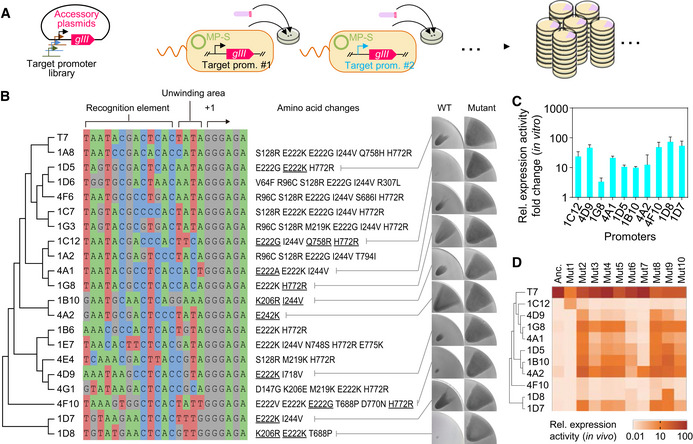
Current strategies to improve the throughput of continuous directed evolution technologies often involve complex mechanical fluid-controlling system or robotic platforms, which limits their popularization and application in general laboratories. Inspired by our previous study on bacterial range expansion, in this study, we report a system termed SPACE for rapid and extensively parallelizable evolution of biomolecules by introducing spatial dimensions into the landmark phage-assisted continuous evolution system. Specifically, M13 phages and chemotactic Escherichia coli cells were closely inoculated onto a semisolid agar. The phages came into contact with the expanding front of the bacterial range, and then comigrated with the bacteria. This system leverages competition over space, wherein evolutionary progress is closely associated with the production of spatial patterns, allowing the emergence of improved or new protein functions. In a prototypical problem, SPACE remarkably simplified the process and evolved the promoter recognition of T7 RNA polymerase (RNAP) to a library of 96 random sequences in parallel. These results establish SPACE as a simple, easy to implement, and massively parallelizable platform for continuous directed evolution in general laboratories.
当前提高连续定向进化技术通量的策略通常涉及复杂的机械流体控制系统或机器人平台,这限制了它们在一般实验室中的推广和应用。受我们之前关于细菌范围扩张的研究的启发,在本研究中,我们通过在具有里程碑意义的噬菌体辅助连续进化系统中引入空间维度,报告了一种称为 SPACE 的系统,用于快速和广泛并行的生物分子进化。具体来说,M13 噬菌体和趋化性大肠杆菌细胞被紧密接种到半固体琼脂上。噬菌体与细菌范围的扩展前沿接触,然后与细菌共迁移。该系统利用空间竞争,其中进化进展与空间模式的产生密切相关,从而产生改进或新的蛋白质功能。在一个原型问题中,SPACE 显著简化了过程,并将 T7 RNA 聚合酶(RNAP)的启动子识别平行进化到 96 个随机序列的文库中。这些结果确立了 SPACE 作为一般实验室中连续定向进化的一种简单、易于实施和大规模并行化的平台。