Park Joonhong, Kim Dong Yun, Gee Heon Yung, Yu Hee Chul, Yang Jae Do, Hwang Shin, Choi YoungRok, Lee Jae Geun, Rhu Jinsoo, Choi Donglak, You Young Kyoung, Ryu Je Ho, Nah Yang Won, Kim Bong-Wan, Kim Dong-Sik, Cho Jai Young, Group The Korean Organ Transplantation Registry Kotry Study
Department of Laboratory Medicine, Jeonbuk National University College of Medicine and Hospital, Jeonju 54907, Republic of Korea.
Research Institute of Clinical Medicine of Jeonbuk National University-Biomedical Research Institute of Jeonbuk National University Hospital, Jeonju 54907, Republic of Korea.
Int J Mol Sci. 2024 Dec 30;26(1):259. doi: 10.3390/ijms26010259.
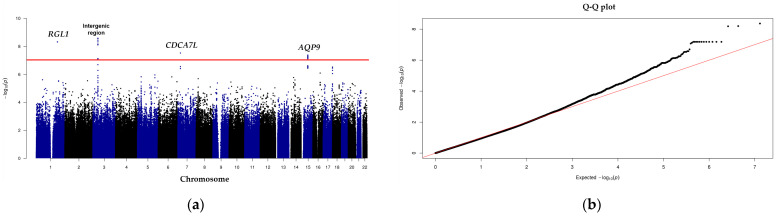
This study utilized a genome-wide association study (GWAS) to investigate the genetic variations linked to the risk of hepatitis B virus (HBV) reactivation in patients who have undergone liver transplantation (LT), aiming to enhance understanding and improve clinical outcomes. Genotyping performed on a selected patients from the Korean Organ Transplantation Registry (KOTRY) data using high-throughput platforms with the Axiom Korea Biobank array 1.1. The discovery cohort included 21 patients who experienced HBV reactivation (cases) and 888 patients without HBV reactivation (controls) following LT. The replication cohort consisted of 5 patients with HBV reactivation (cases) and 312 patients without HBV reactivation (controls) after LT. Additive logistic regression analysis was conducted using PLINK software ver 1.9, with adjustments for age and gender. The GWAS findings from the discovery cohort were validated using the replication cohort. The GWAS identified several single-nucleotide polymorphisms (SNPs) in the , , and genes that were significantly linked to HBV reactivation after LT, with genome-wide significance thresholds set at < 10. Down-regulation of cDNAs was observed in primary duck hepatocytes infected with duck HBV. Overexpression of was found to promote hepatocellular carcinoma cell proliferation and colony formation, whereas knocking down CDCA7L inhibited these processes. Additionally, the absence of AQP9 triggered immune and inflammatory responses, leading to mild and scattered liver cell pyroptosis, accompanied by compensatory liver cell proliferation. This study provides critical insights into the genetic factors influencing HBV reactivation after LT, identifying significant associations with SNPs in , , and . These findings hold promise for developing predictive biomarkers and personalized management strategies to improve outcomes for HBV-infected LT recipients.
本研究利用全基因组关联研究(GWAS)来调查肝移植(LT)患者中与乙型肝炎病毒(HBV)再激活风险相关的基因变异,旨在增进理解并改善临床结局。使用Axiom Korea生物样本库阵列1.1的高通量平台,对从韩国器官移植登记处(KOTRY)数据中选取的患者进行基因分型。发现队列包括21例LT后发生HBV再激活的患者(病例组)和888例未发生HBV再激活的患者(对照组)。复制队列由5例LT后发生HBV再激活的患者(病例组)和312例未发生HBV再激活的患者(对照组)组成。使用PLINK软件1.9版进行加性逻辑回归分析,并对年龄和性别进行了调整。发现队列的GWAS结果通过复制队列进行了验证。GWAS在 、 和 基因中鉴定出几个单核苷酸多态性(SNP),这些SNP与LT后HBV再激活显著相关,全基因组显著性阈值设定为 < 10。在感染鸭HBV的原代鸭肝细胞中观察到 cDNA的下调。发现 的过表达促进肝癌细胞增殖和集落形成,而敲低CDCA7L则抑制这些过程。此外,AQP9的缺失引发免疫和炎症反应,导致轻度散在的肝细胞焦亡,同时伴有代偿性肝细胞增殖。本研究为影响LT后HBV再激活的遗传因素提供了关键见解,并确定了与 、 和 中SNP的显著关联。这些发现有望开发预测性生物标志物和个性化管理策略,以改善HBV感染的LT受者的结局。