Dopelt Keren, Houminer-Klepar Nourit
Department of Public Health, Ashkelon Academic College, Ashkelon 78211, Israel.
Nutrients. 2025 Jan 3;17(1):180. doi: 10.3390/nu17010180.
Social media platforms have become integral to daily life and increasingly disseminate health, nutrition, and food information. While these platforms can offer evidence-based nutrition education and meal planning guidance, a significant portion of content promotes unrealistic beauty standards and unhealthy weight-loss practices, potentially contributing to disordered eating behaviors. The increasing prevalence of disordered eating, characterized by abnormal eating behaviors and attitudes, has become a global public health concern. This study examines whether social media consumption correlates with disordered eating symptoms in Israeli college students.
A cross-sectional study was conducted among college students at Ashkelon Academic College in Israel. The questionnaire assessed demographics, social media usage (platforms used, frequency, and content followed), body satisfaction, and disordered eating symptoms, measured via the Eating Attitudes Test (EAT-26).
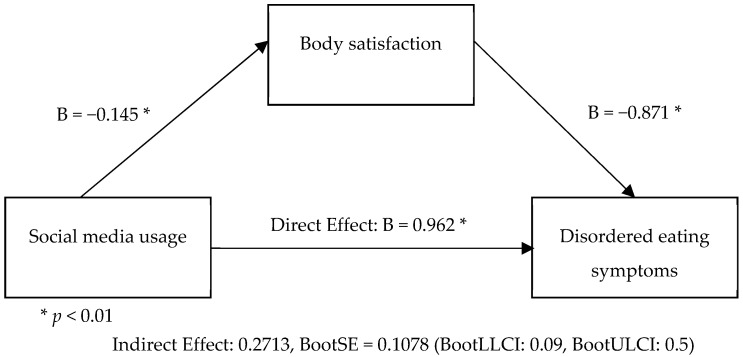
The study sample comprised 580 students (73% were female and 27% were male) with a mean age of 27.87 years. Participants predominantly used multiple social media platforms, with a majority following food-, eating-, and health-related content. Despite having a normal BMI, a substantial number of participants reported body dissatisfaction. The results indicated a positive correlation between social media use and disordered eating symptoms. Individuals who frequently engaged with food-related content on social media exhibited higher levels of disordered eating. Moreover, body satisfaction emerged as a significant mediator in the relationship between social media use and disordered eating symptoms.
The findings of this study support the growing body of evidence linking social media use to disordered eating behaviors among young adults. Developing targeted interventions that promote media literacy and foster body positivity is essential. Additionally, future research should explore the long-term effects of social media on eating behaviors and the effectiveness of different prevention strategies.
社交媒体平台已成为日常生活中不可或缺的一部分,越来越多地传播健康、营养和食品信息。虽然这些平台可以提供基于证据的营养教育和膳食计划指导,但很大一部分内容宣扬不切实际的审美标准和不健康的减肥做法,可能导致饮食失调行为。以异常饮食行为和态度为特征的饮食失调患病率不断上升,已成为全球公共卫生问题。本研究调查了以色列大学生使用社交媒体是否与饮食失调症状相关。
在以色列阿什凯隆学术学院的大学生中进行了一项横断面研究。问卷评估了人口统计学特征、社交媒体使用情况(使用的平台、频率和关注的内容)、身体满意度以及通过饮食态度测试(EAT - 26)测量的饮食失调症状。
研究样本包括580名学生(73%为女性,27%为男性),平均年龄为27.87岁。参与者主要使用多个社交媒体平台,大多数人关注与食物、饮食和健康相关的内容。尽管身体质量指数(BMI)正常,但仍有相当数量的参与者表示对自己的身体不满意。结果表明社交媒体使用与饮食失调症状之间存在正相关。经常在社交媒体上接触与食物相关内容的个体表现出更高水平的饮食失调。此外,身体满意度在社交媒体使用与饮食失调症状之间的关系中是一个重要的中介因素。
本研究结果支持了越来越多的证据表明,社交媒体使用与年轻人的饮食失调行为有关。制定有针对性的干预措施以提高媒体素养并促进身体积极态度至关重要。此外,未来的研究应探讨社交媒体对饮食行为的长期影响以及不同预防策略的有效性。