Maya Viejo José David, Navarro Ros Fernando M
Centro de Salud de Camas, Santa Maria de Gracia 54, 41900 Camas, Spain.
Centro de Salud Malilla, Carrer de Malilla 52D, Quatre Carreres, 46026 Valencia, Spain.
J Clin Med. 2024 Dec 24;14(1):22. doi: 10.3390/jcm14010022.
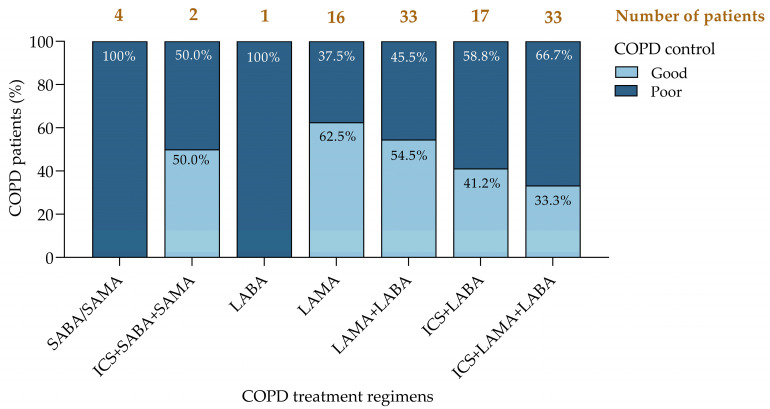
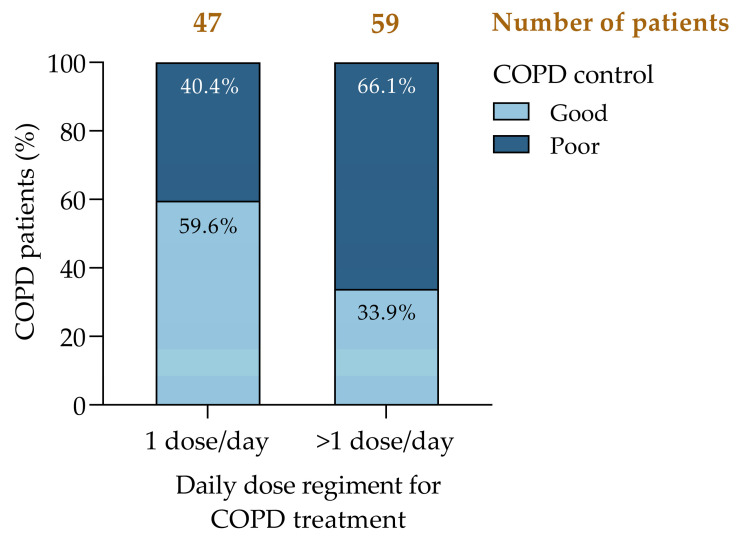
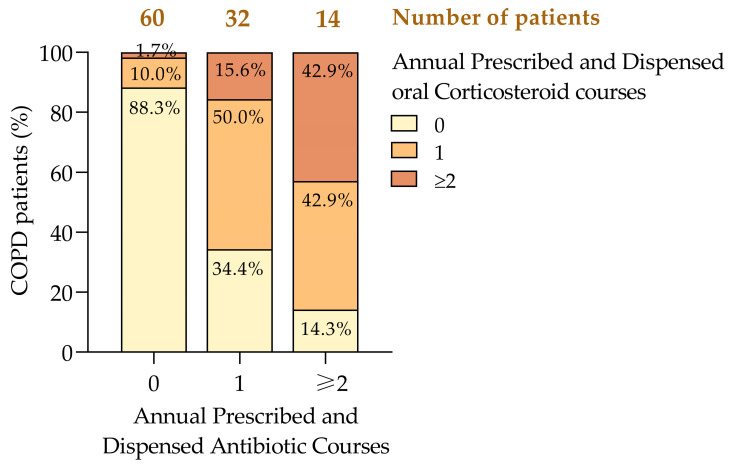
Chronic obstructive pulmonary disease (COPD) remains a critical global health challenge, characterized by high morbidity, mortality, and healthcare costs. Current guidelines may overlook patients who present with only one moderate exacerbation or with frequent short-acting beta-agonist (SABA) use. Building on findings from the Seleida study, this research refines the criteria for poor COPD control to include these patients, aiming to improve early identification of high-risk cases in primary care. A retrospectiveand multicenter study is conducted using data from 110 COPD patients in Spain. Poor control is redefined as having at least one moderate exacerbation or as using three or more SABA inhalers annually. Key predictors, such as SABA/short-acting muscarinic antagonist (SAMA) inhalers and antibiotic prescriptions, are identified using logistic regression and LASSO regularization to enhance predictive accuracy. The model achieves a good predictive performance, with an AUC-ROC of 0.978, sensitivity of 92.86%, and specificity of 87.50%. Key predictors reliably identify high-risk patients, enabling timely interventions. This study demonstrates a statistically significant association between once-daily inhaler therapies and better COPD control compared to multiple daily doses, supported by chi-square analysis ( = 0.008) and binary logistic regression ( = 0.018). Nevertheless, the variable 'daily inhalation frequency' (1 vs. >1 inhalation/day) was excluded from the final model to prevent overfitting. By refining the criteria for COPD control to include patients with at least one moderate exacerbation or frequent SABA use, this model provides a practical tool for early risk stratification in primary care, particularly in resource-limited settings. Early identification of high-risk patients can reduce hospitalizations and healthcare costs, supporting a proactive approach to COPD management. Further validation in larger cohorts is essential to confirm its broader applicability.
慢性阻塞性肺疾病(COPD)仍然是一项严峻的全球健康挑战,其特点是发病率高、死亡率高以及医疗成本高。当前的指南可能会忽略仅出现一次中度加重或频繁使用短效β受体激动剂(SABA)的患者。基于Seleida研究的结果,本研究细化了COPD控制不佳的标准,将这些患者纳入其中,旨在改善初级保健中高危病例的早期识别。使用来自西班牙110名COPD患者的数据进行了一项回顾性多中心研究。将控制不佳重新定义为至少有一次中度加重或每年使用三个或更多SABA吸入器。使用逻辑回归和LASSO正则化来识别关键预测因素,如SABA/短效毒蕈碱拮抗剂(SAMA)吸入器和抗生素处方,以提高预测准确性。该模型具有良好的预测性能,曲线下面积(AUC-ROC)为0.978,敏感性为92.86%,特异性为87.50%。关键预测因素能够可靠地识别高危患者,从而实现及时干预。本研究表明,与每日多次给药相比,每日一次吸入疗法与更好的COPD控制之间存在统计学上的显著关联,这得到了卡方分析(P = 0.008)和二元逻辑回归(P = 0.018)的支持。然而,为防止过度拟合,最终模型中排除了“每日吸入频率”变量(每天1次吸入与每天>1次吸入)。通过细化COPD控制标准,将至少有一次中度加重或频繁使用SABA的患者纳入其中,该模型为初级保健中的早期风险分层提供了一个实用工具,特别是在资源有限的环境中。早期识别高危患者可以减少住院次数和医疗成本,支持对COPD管理采取积极主动的方法。在更大的队列中进行进一步验证对于确认其更广泛的适用性至关重要。