Liu Mengguo
Department of Dermatology, Huashan Hospital, Fudan University, Shanghai, China.
An Bras Dermatol. 2025 Mar-Apr;100(2):300-307. doi: 10.1016/j.abd.2024.01.010. Epub 2025 Jan 10.
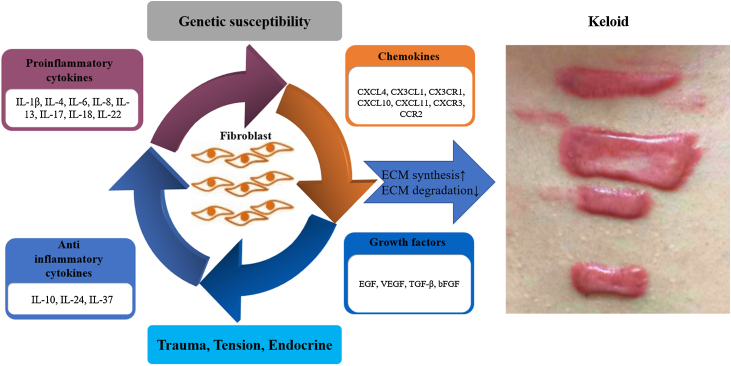
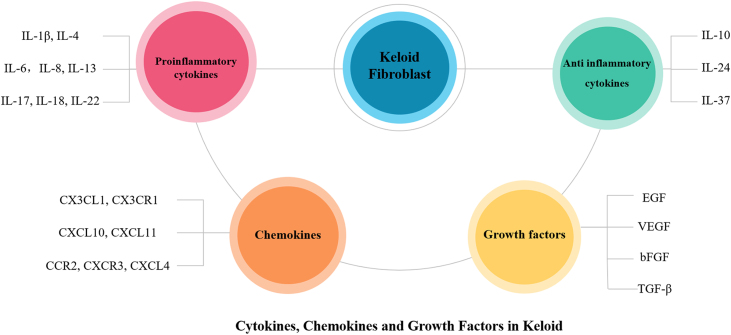
Keloid is a common fibrotic disease, which is difficult to treat. It often causes itching and pain, which greatly disturbs patients in their work and daily life and causing difficulties in social interaction. Its pathogenesis is not clear, but may be related to several aspects: genetic susceptibility, environmental, immunological and endocrine factors, trauma and tension. The central point of its pathogenesis is the excessive proliferation of fibroblasts, with excessive synthesis and secretion of extracellular matrix such as collagen. However, the cause of fibroblast excessive proliferation and differentiation is not clear. Immune abnormalities may play an important role, with cytokines, chemokines, growth factors, and other important immune molecules acting on fibroblasts. This paper presents a detailed and comprehensive literature review on this subject.
瘢痕疙瘩是一种常见的纤维化疾病,难以治疗。它常引起瘙痒和疼痛,极大地困扰患者的工作和日常生活,并给社交互动带来困难。其发病机制尚不清楚,但可能与几个方面有关:遗传易感性、环境、免疫和内分泌因素、创伤和紧张。其发病机制的核心是成纤维细胞过度增殖,伴有胶原蛋白等细胞外基质的过度合成和分泌。然而,成纤维细胞过度增殖和分化的原因尚不清楚。免疫异常可能起重要作用,细胞因子、趋化因子、生长因子和其他重要免疫分子作用于成纤维细胞。本文对此主题进行了详细而全面的文献综述。