Zhang Wen, He Jiarong, Zhao Fang, Pan Jing, Wen Jiefu, Jiang Lijun, Zhang Mingming
Department of Neurosurgery, The Second Xiangya Hospital, Central South University, Changsha, Hunan, PR China.
Department of Nephrology, Yiyang Central Hospital affiliated, University of South China, Yiyang, Hunan, PR China.
Heliyon. 2024 Dec 15;11(1):e40902. doi: 10.1016/j.heliyon.2024.e40902. eCollection 2025 Jan 15.
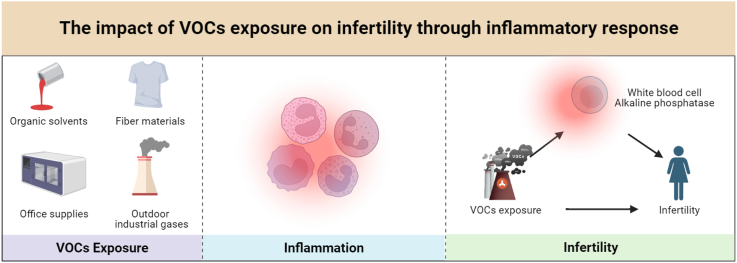
Growing evidence suggests that environmental pollutants exert a detrimental impact on female fertility. Among these pollutants, volatile organic compounds (VOCs), easily encountered in the environment, have garnered significant attention as prevalent airborne contaminants. Nevertheless, a definitive consensus regarding the association between VOCs and the incidence of infertility remains elusive.
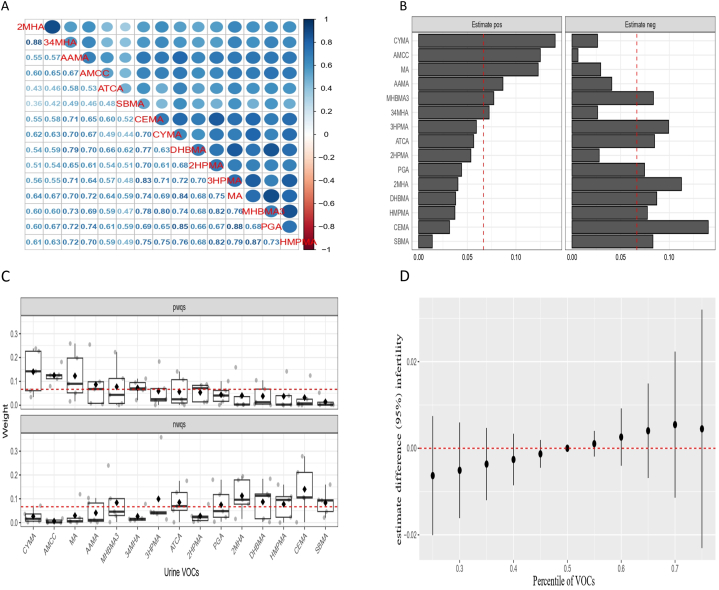
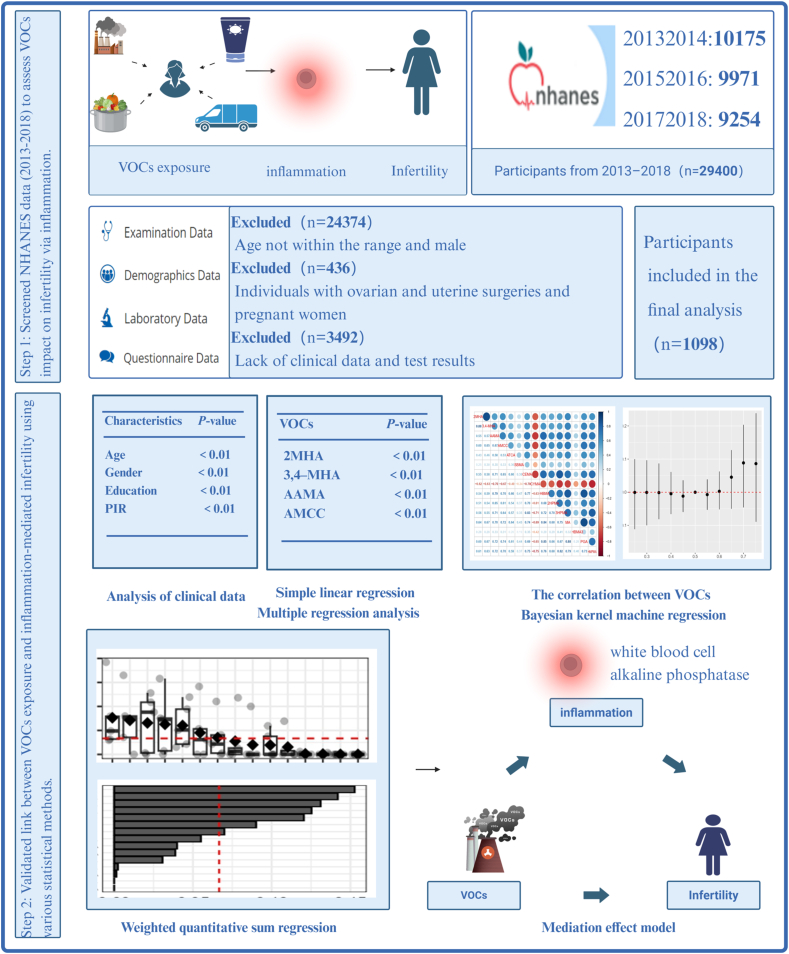
Conducted as a cross-sectional study, this research utilized data from three survey cycles of the NHANES program spanning from 2013 to 2018. The objective was to delve into the relationship between volatile organic compounds and the prevalence of infertility. The definition of infertility relied upon information derived from the reproductive health questionnaire. In order to comprehensively explore this relationship, various analytical models, including logistic regression, weighted quantile sum (WQS), and Bayesian kernel-machine regression (BKMR), were employed.
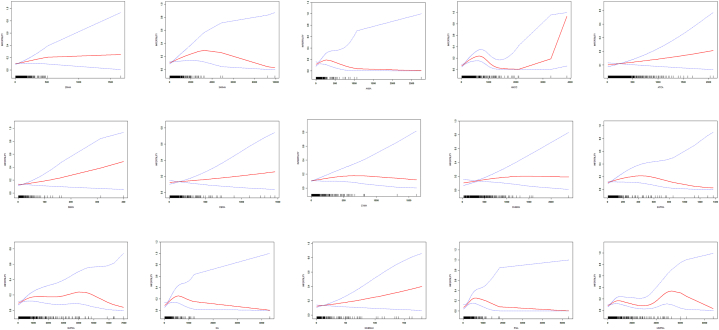
A total of 1098 participants, 120 in the infertility group and 978 in the control group, were included. All 15 volatile organic compounds showed higher concentrations in the infertility group's urine. Multivariate regression revealed that the highest AMCC (N-acetyl-S-(N-methylcarbamoyl)-L-cysteine) and CYMA (2-hydroxyethyl mercapturic acid) quartiles associated with significant infertility increases, approximately 191 % and 128 %, respectively, versus the lowest quartile (OR for AMCC = 2.91; 95%CI: 1.33, 6.37; OR for CYMA = 2.28; 95%CI: 1.01, 5.15). This emphasizes AMCC and CYMA's role in infertility, supported by WQS and BKMR studies. Inflammation mediates AMCC's impact on infertility, enhancing our understanding of volatile organic compounds and reproductive health.
The study highlights the correlation between VOCs exposure, notably AMCC and CYMA, and infertility. It identifies inflammation as a mediating factor connecting AMCC to infertility.
越来越多的证据表明,环境污染物会对女性生育能力产生不利影响。在这些污染物中,挥发性有机化合物(VOCs)在环境中很容易遇到,作为普遍存在的空气污染物已受到广泛关注。然而,关于VOCs与不孕症发病率之间的关联尚未达成明确共识。
本研究为横断面研究,利用了2013年至2018年美国国家健康与营养检查调查(NHANES)项目三个调查周期的数据。目的是深入探究挥发性有机化合物与不孕症患病率之间的关系。不孕症的定义依据生殖健康问卷中的信息。为了全面探究这种关系,采用了多种分析模型,包括逻辑回归、加权分位数和(WQS)以及贝叶斯核机器回归(BKMR)。
共纳入1098名参与者,其中不孕症组120人,对照组978人。所有15种挥发性有机化合物在不孕症组尿液中的浓度均较高。多变量回归显示,与最低四分位数相比,最高四分位数的N - 乙酰 - S -(N - 甲基氨基甲酰)- L - 半胱氨酸(AMCC)和2 - 羟乙基巯基尿酸(CYMA)与不孕症显著增加相关,分别约为191%和128%(AMCC的比值比=2.91;95%置信区间:1.33,6.37;CYMA的比值比=2.28;95%置信区间:1.01,5.15)。WQS和BKMR研究支持了AMCC和CYMA在不孕症中的作用。炎症介导了AMCC对不孕症的影响,增进了我们对挥发性有机化合物与生殖健康的理解。
该研究强调了接触VOCs,尤其是AMCC和CYMA,与不孕症之间的相关性。它确定炎症是连接AMCC与不孕症的中介因素。