Saito Motoo, McDonald Katya A, Grier Alex K, Meghwani Himanshu, Rangel-Moreno Javier, Becerril-Villanueva Enrique, Gamboa-Dominguez Armando, Bruno Jennifer, Beck Christopher A, Proctor Richard A, Kates Stephen L, Schwarz Edward M, Muthukrishnan Gowrishankar
The Center for Musculoskeletal Research, Department of Orthopedics, University of Rochester Medical Center, Rochester, NY, USA.
Department of Microbiology and Immunology, University of Rochester Medical Center, Rochester, NY, USA.
bioRxiv. 2024 Dec 31:2024.12.30.630837. doi: 10.1101/2024.12.30.630837.
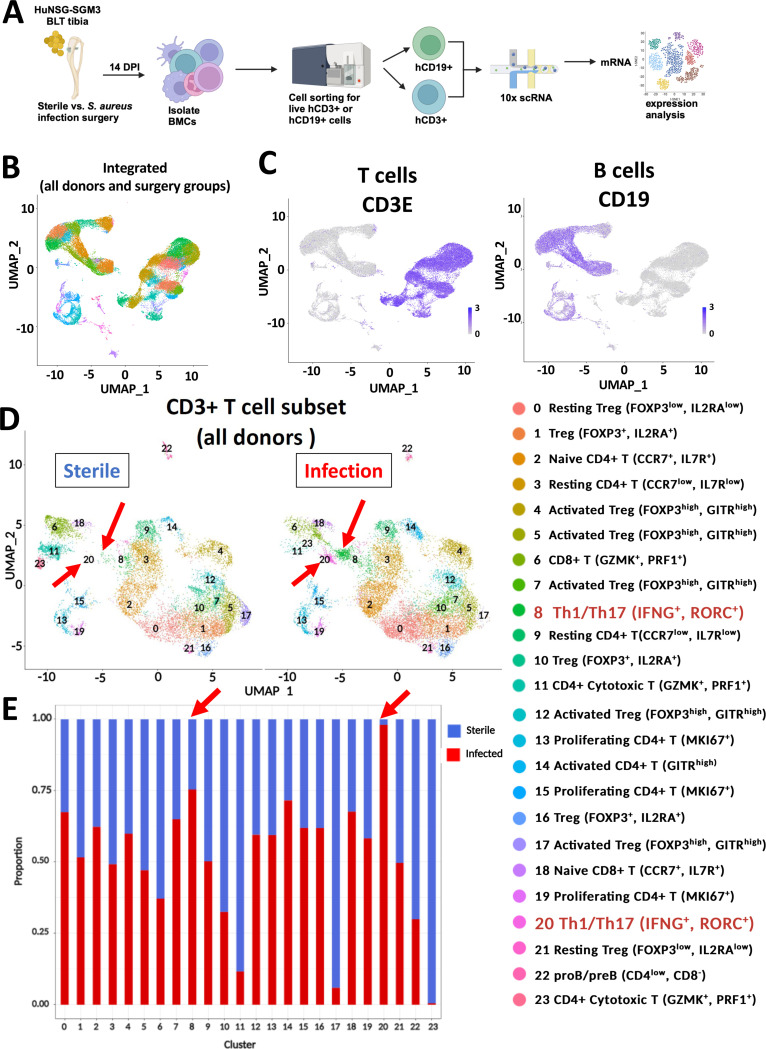
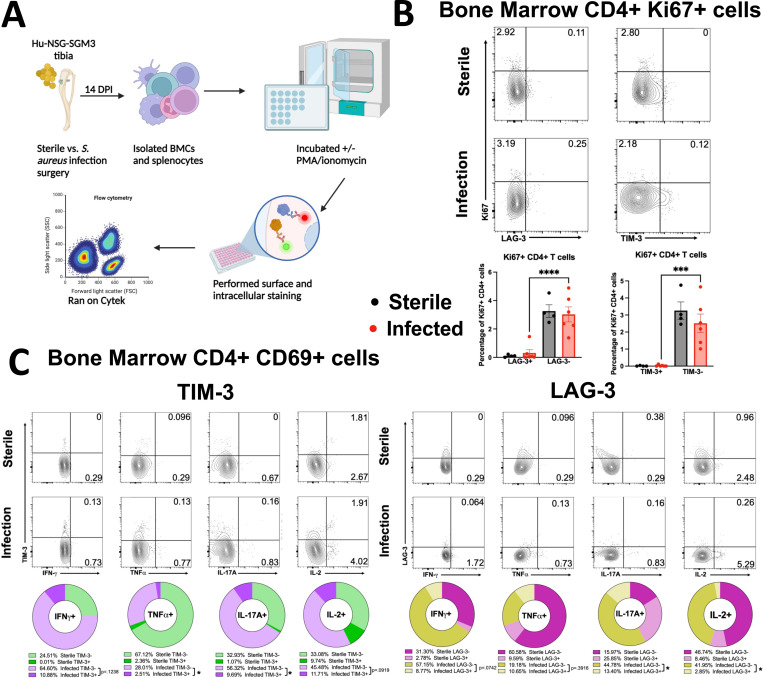
prosthetic joint infections (PJIs) are broadly considered incurable, and clinical diagnostics that guide conservative vs. aggressive surgical treatments don't exist. Multi-omics studies in a humanized NSG-SGM3 BLT mouse model demonstrate human T cells: 1) are remarkably heterogenous in gene expression and numbers, and 2) exist as a mixed population of activated, progenitor-exhausted, and terminally-exhausted Th1/Th17 cells with increased expression of immune checkpoint proteins (LAG3, TIM-3). Importantly, these proteins are upregulated in the serum and the bone marrow of PJI patients. A multiparametric nomogram combining high serum immune checkpoint protein levels with low proinflammatory cytokine levels (IFN-γ, IL-2, TNF-α, IL-17) revealed that TIM-3 was highly predictive of adverse disease outcomes (AUC=0.89). Hence, T cell impairment in the form of immune checkpoint expression and exhaustion could be a functional biomarker for PJI disease outcome, and blockade of checkpoint proteins could potentially improve outcomes following surgery.
人工关节感染(PJI)通常被认为是无法治愈的,而且目前不存在指导保守治疗与积极手术治疗的临床诊断方法。在人源化NSG-SGM3 BLT小鼠模型中进行的多组学研究表明,人类T细胞:1)在基因表达和数量上具有显著的异质性,2)以活化的、祖细胞耗竭的和终末耗竭的Th1/Th17细胞混合群体的形式存在,且免疫检查点蛋白(LAG3、TIM-3)的表达增加。重要的是,这些蛋白在PJI患者的血清和骨髓中上调。将高血清免疫检查点蛋白水平与低促炎细胞因子水平(IFN-γ、IL-2、TNF-α、IL-17)相结合的多参数列线图显示,TIM-3对不良疾病结局具有高度预测性(AUC=0.89)。因此,以免疫检查点表达和耗竭形式出现的T细胞损伤可能是PJI疾病结局的功能性生物标志物,阻断检查点蛋白可能会潜在地改善手术后的结局。