Pfister Jason A, Agostini Lorenzo, Bournonville Lorène, Sankaralingam Prabhu, Bell Zachary G, Hamel Virginie, Guichard Paul, Biertümpfel Christian, Mizuno Naoko, O'Connell Kevin F
Laboratory of Biochemistry and Genetics, National Institutes of Diabetes and Digestive and Kidney Diseases, National Institutes of Health, Bethesda, MD, USA.
Laboratory of Structural Cell Biology, National Heart, Lung, and Blood Institute, National Institutes of Health, Bethesda, MD, USA.
bioRxiv. 2024 Oct 4:2024.10.03.616528. doi: 10.1101/2024.10.03.616528.
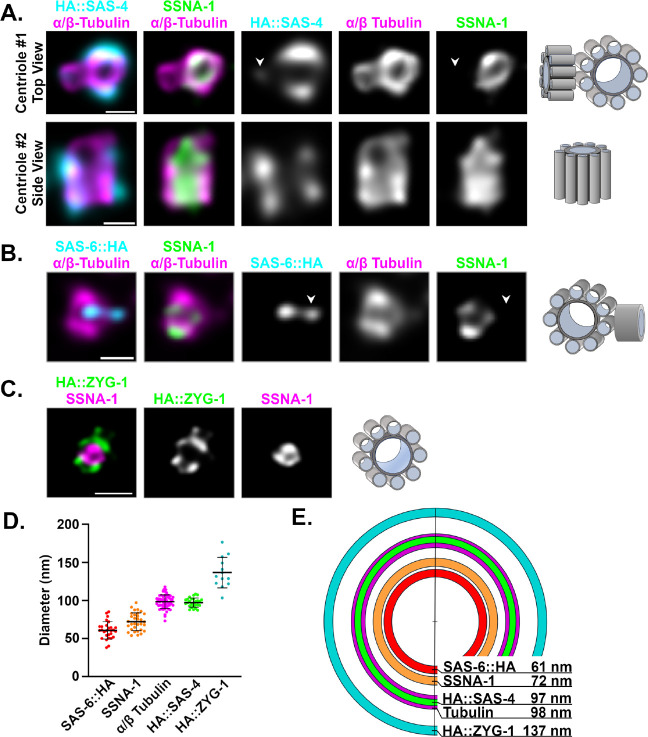
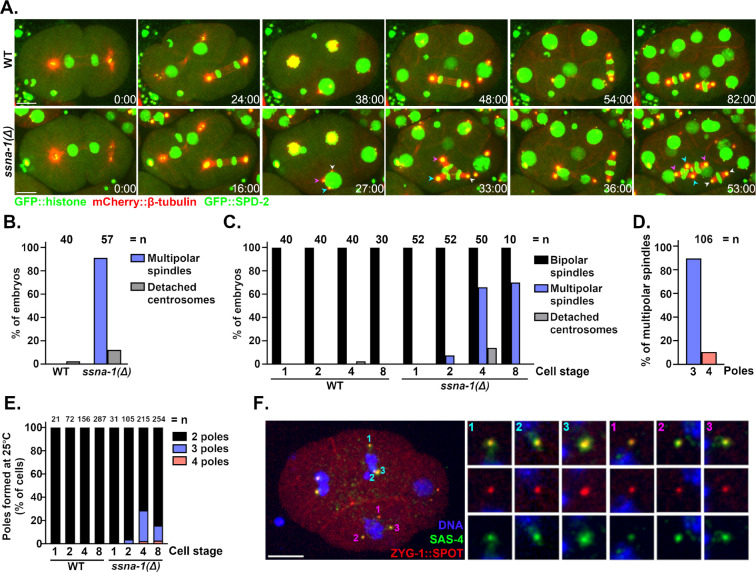
Centrioles play central roles in ciliogenesis and mitotic spindle assembly. Once assembled, centrioles exhibit long-term stability, a property essential for maintaining numerical control. How centriole stability is achieved and how it is lost in certain biological contexts are still not completely understood. In this study we show that SSNA-1, the ortholog of Sjogren's Syndrome Nuclear Antigen 1, is a centriole constituent that localizes close to the microtubule outer wall, while also exhibiting a developmentally regulated association with centriole satellite-like structures. A complete deletion of the gene results in an embryonic lethal phenotype marked by the appearance of extra centrioles and spindle poles. We show that SSNA-1 genetically interacts with the centriole stability factor SAS-1 and is required post assembly for centriole structural integrity. In SSNA-1's absence, centrioles assemble but fracture leading to extra spindle poles. However, if the efficiency of cartwheel assembly is reduced, the absence of SSNA-1 results in daughter centriole loss and monopolar spindle formation, indicating that the cartwheel and SSNA-1 cooperate to stabilize the centriole during assembly. Our work thus shows that SSNA-1 contributes to centriole stability during and after assembly, thereby ensuring proper centriole number.
中心粒在纤毛发生和有丝分裂纺锤体组装中发挥着核心作用。一旦组装完成,中心粒就表现出长期稳定性,这是维持数量控制所必需的特性。目前仍未完全了解中心粒稳定性是如何实现的,以及在某些生物学背景下它是如何丧失的。在本研究中,我们发现干燥综合征核抗原1的直系同源物SSNA-1是一种中心粒成分,定位于微管外壁附近,同时也与中心粒卫星样结构表现出发育调控的关联。该基因的完全缺失会导致胚胎致死表型,其特征是出现额外的中心粒和纺锤体极。我们表明,SSNA-1与中心粒稳定性因子SAS-1发生遗传相互作用,并且在组装后对于中心粒结构完整性是必需的。在没有SSNA-1的情况下,中心粒能够组装但会断裂,导致额外的纺锤体极出现。然而,如果轮辐组装效率降低,缺乏SSNA-1会导致子中心粒丢失和单极纺锤体形成,这表明轮辐和SSNA-1在组装过程中协同作用以稳定中心粒。因此,我们的工作表明,SSNA-1在组装期间和之后有助于中心粒的稳定性,从而确保中心粒数量合适。