Kassa Yezbie, Amare Agmas, Nega Tayachew, Alem Teferi, Gedefaw Mohammed, Chala Bilhate, Freyer Bernhard, Waldmann Beatriz, Fentie Tarekegn, Mulu Tewodros, Adgo Taddesse, Ayalew Gizachew, Adugna Marelign, Tibebe Dessie
College of Natural and Computational Sciences, University of Gondar, P.O. Box 196, Gondar, Ethiopia.
Institutes of Technology, University of Gondar, P.O.BOX 196, Gondar, Ethiopia.
Sci Rep. 2025 Jan 13;15(1):1820. doi: 10.1038/s41598-024-84729-x.
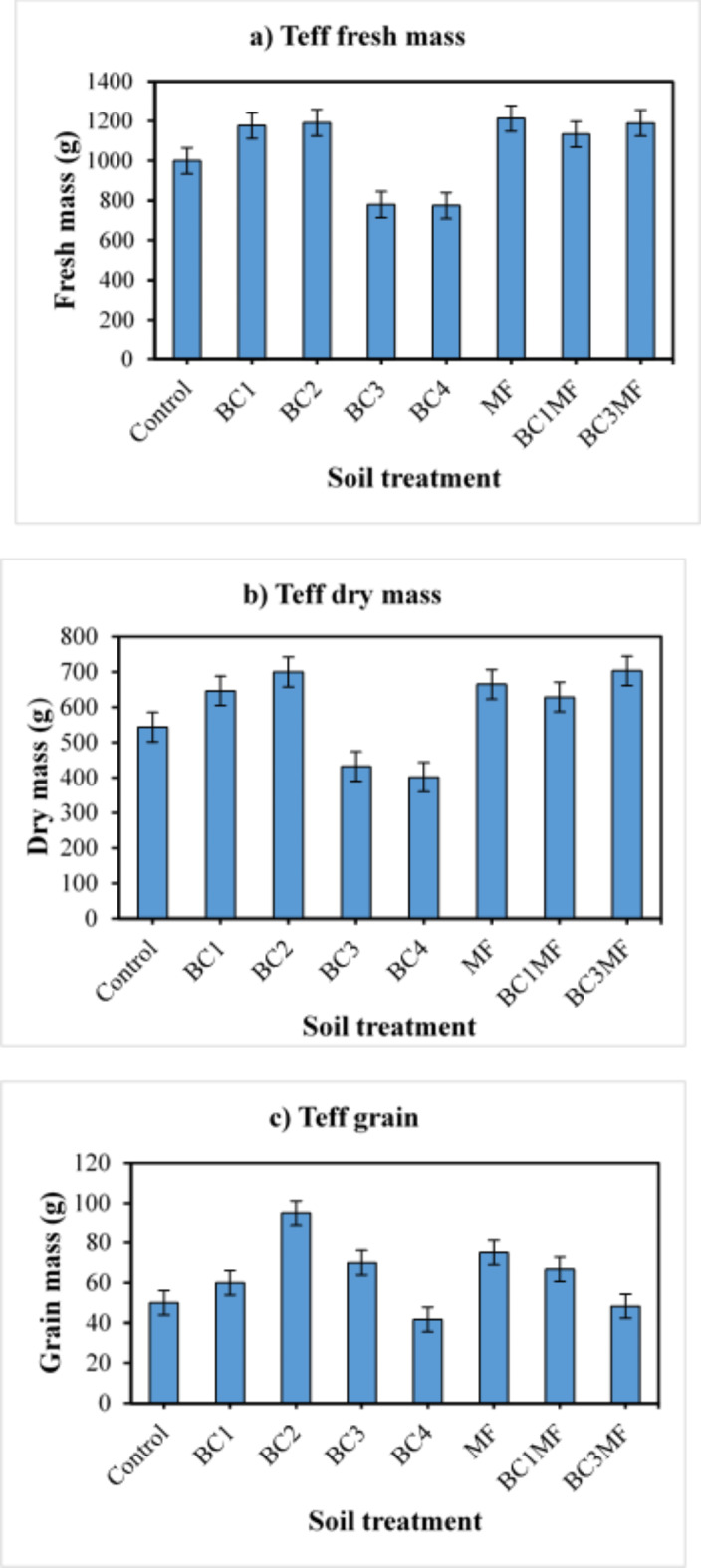
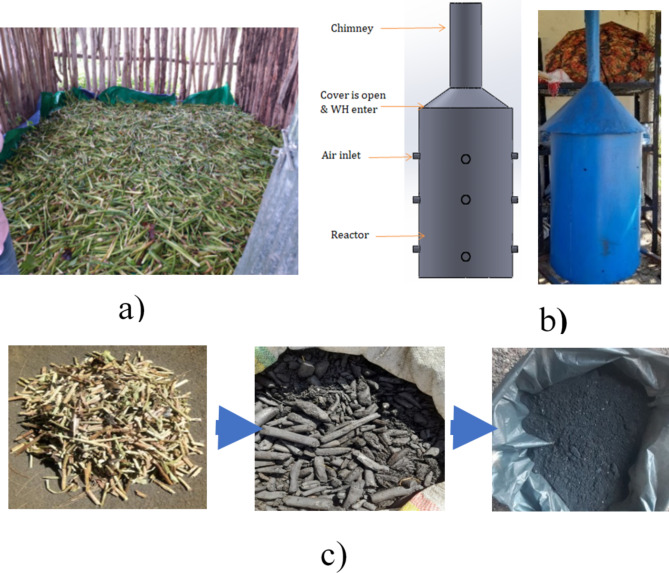
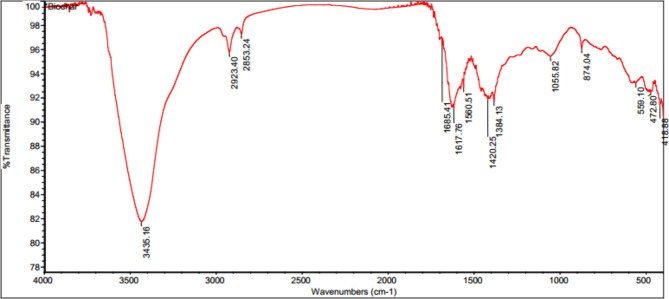
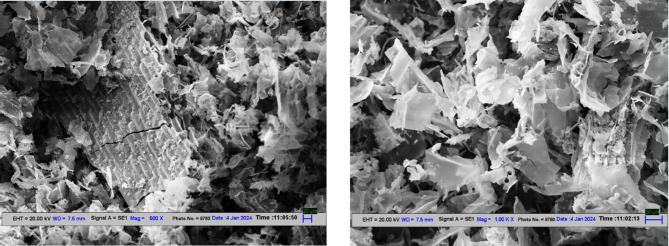
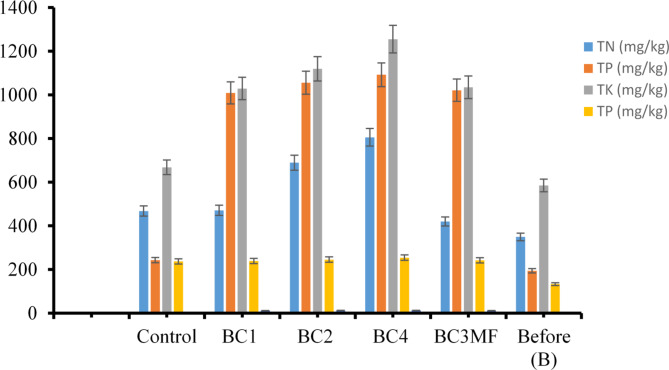
The conversion of water hyacinth into biochar offers a sustainable solution to mitigate its proliferation and enhances its potential as a soil amendment for agriculture. This study examined the physicochemical properties of water hyacinth biochar (WHBC) and its impact on soil fertility. Water hyacinth (Eichhornia crassipes) was pyrolyzed at 300 °C for 40 minute with restricted airflow (2-3 m/s), producing biochar with desirable properties and a yield of 44.6%. WHBC exhibited a pH of 8.11 ± 0.91, electrical conductivity of 18.70 ± 1.15 mS/cm, and nutrient contents including TN (0.69 ± 0.10%), TP (8.80 ± 0.01%), OC (13.95 ± 0.65%), C/N ratio (20.22 ± 0.95), S (0.34 ± 0.03%), and metallic nutrients (Ca, Mg, K). Heavy metals (Fe, Mn, Cu, Ni, Cd, Pb, Cr, Zn) were within permissible limits for biochar. Soil amended with 2500 kg/ha WHBC (BC2) produced comparable Teff crop yields (fresh mass: 1191.67 ± 428.44 g, dry mass: 700.00 ± 248.34 g, grain yield: 95.00 ± 39.69 g) to those with mineral fertilizers and mixed amendments. Fourier Transform Infrared (FTIR) and Scanning Electron Microscopy (SEM) revealed significant structural changes in WHBC, enhancing its pore structure and surface morphology. These results demonstrate the potential of WHBC as an effective soil amendment to improve agricultural sustainability and soil fertility.
将凤眼莲转化为生物炭为缓解其扩散提供了一种可持续的解决方案,并增强了其作为农业土壤改良剂的潜力。本研究考察了凤眼莲生物炭(WHBC)的理化性质及其对土壤肥力的影响。在气流受限(2 - 3米/秒)的条件下,将凤眼莲(凤眼莲属)在300℃热解40分钟,制得性能良好、产率为44.6%的生物炭。WHBC的pH值为8.11±0.91,电导率为18.70±1.15毫西门子/厘米,养分含量包括总氮(0.69±0.10%)、总磷(8.80±0.01%)、有机碳(13.95±0.65%)、碳氮比(20.22±0.95)、硫(0.34±0.03%)和金属养分(钙、镁、钾)。生物炭中的重金属(铁、锰、铜、镍、镉、铅、铬、锌)含量在允许范围内。用2500千克/公顷的WHBC(BC2)改良的土壤,其黍稷作物产量(鲜质量:1191.67±428.44克,干质量:700.00±248.34克,籽粒产量:95.00±39.69克)与施用矿物肥料和混合改良剂的土壤相当。傅里叶变换红外光谱(FTIR)和扫描电子显微镜(SEM)显示,WHBC的结构发生了显著变化,其孔隙结构和表面形态得到了改善。这些结果表明,WHBC作为一种有效的土壤改良剂,在提高农业可持续性和土壤肥力方面具有潜力。