Nakano Shoma, Sasaki Motoharu, Nakaguchi Yuji, Kamomae Takeshi, Sakuragawa Kanako, Yamaji Yuto, Ikushima Hitoshi
School of Health Sciences, Tokushima University, Tokushima, Tokushima 770-8503, Japan.
Graduate School of Biomedical Sciences, Tokushima University, Tokushima, Tokushima 770-8503, Japan.
Tech Innov Patient Support Radiat Oncol. 2024 Dec 13;33:100297. doi: 10.1016/j.tipsro.2024.100297. eCollection 2025 Mar.
This study aims to compare treatment plans created using RapidPlan and PlanIQ for twelve patients with prostate cancer, focusing on dose uniformity, dose reduction to organs at risk (OARs), plan complexity, and dose verification accuracy. The goal is to identify the tool that demonstrates superior performance in achieving uniform target dose distribution and reducing OAR dose, while ensuring accurate dose verification.
Dose uniformity in the planning target volume, excluding the rectum, and dose reduction in the OARs (the rectum and bladder) were assessed. The validation included point-dose measurements with an ionization chamber dosimeter and gamma analysis of dose distributions. Monitor units were calculated to evaluate plan complexity.
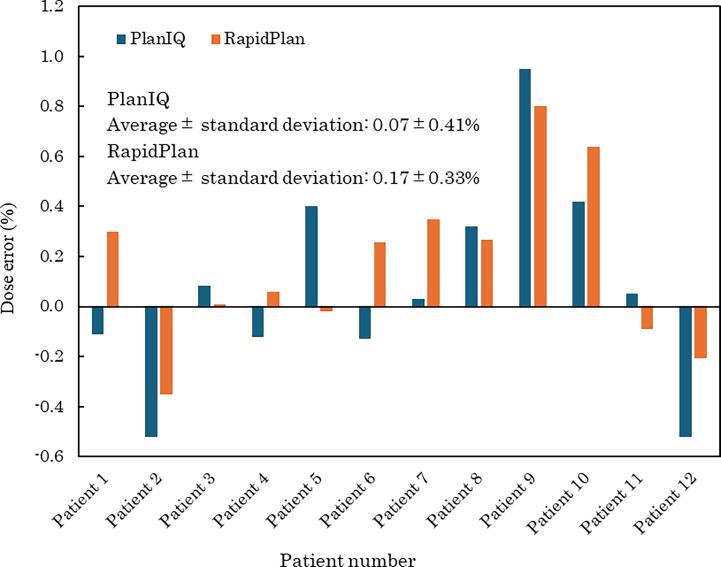
PlanIQ provided superior dose uniformity, with improvements in the dose homogeneity index compared with RapidPlan. RapidPlan was more effective in reducing OAR doses, particularly in the rectum, with significant reductions at various dose levels. Dose verification showed no significant differences between the two tools. However, PlanIQ showed a smaller mean difference between the calculated and measured doses and a slightly better dose distribution match with less variability than RapidPlan.
RapidPlan was more effective at reducing OAR doses, whereas PlanIQ achieved better dose uniformity and lower plan complexity. Both tools performed similarly in terms of dose verification accuracy, with PlanIQ showing a slight advantage in dose-distribution matching. The choice of planning tool depends on the primary treatment goal, whether it is to reduce the OAR doses or improve the target dose uniformity.
本研究旨在比较使用RapidPlan和PlanIQ为12例前列腺癌患者制定的治疗计划,重点关注剂量均匀性、对危及器官(OARs)的剂量降低、计划复杂性和剂量验证准确性。目标是确定在实现均匀靶区剂量分布和降低OARs剂量方面表现更优的工具,同时确保剂量验证的准确性。
评估计划靶区内(不包括直肠)的剂量均匀性以及OARs(直肠和膀胱)的剂量降低情况。验证包括使用电离室剂量仪进行点剂量测量以及对剂量分布进行伽马分析。计算监测单位以评估计划复杂性。
PlanIQ提供了更优的剂量均匀性,与RapidPlan相比,剂量均匀性指数有所改善。RapidPlan在降低OARs剂量方面更有效,尤其是在直肠,在不同剂量水平上均有显著降低。剂量验证显示两种工具之间无显著差异。然而,PlanIQ在计算剂量与测量剂量之间的平均差异较小,并且与RapidPlan相比,剂量分布匹配稍好,变异性更小。
RapidPlan在降低OARs剂量方面更有效,而PlanIQ实现了更好的剂量均匀性和更低的计划复杂性。两种工具在剂量验证准确性方面表现相似,PlanIQ在剂量分布匹配方面略有优势。规划工具的选择取决于主要治疗目标,即降低OARs剂量还是提高靶区剂量均匀性。