Alya Fania Putri, Hendrawati Sri, Mediani Henny Suzana
Master of Nursing Study Program, Faculty of Nursing, Universitas Padjadjaran, Sumedang, West Java, Indonesia.
Department of Pediatric Nursing, Faculty of Nursing, Universitas Padjadjaran, Sumedang, West Java, Indonesia.
Psychol Res Behav Manag. 2025 Jan 9;18:39-53. doi: 10.2147/PRBM.S488905. eCollection 2025.
Cancer diagnosis and treatment can have severe psychological impacts on children that can affect various aspects of their emotional, social and cognitive functioning. Many children with cancer experience long-term psychological distresses. The psychological well-being (PWB) is a critical aspect of their overall health. Understanding the factors that influence their psychological state can help in developing effective interventions to support them.
This scoping review aimed to identify and summarize the factors associated with PWB among children with cancer.
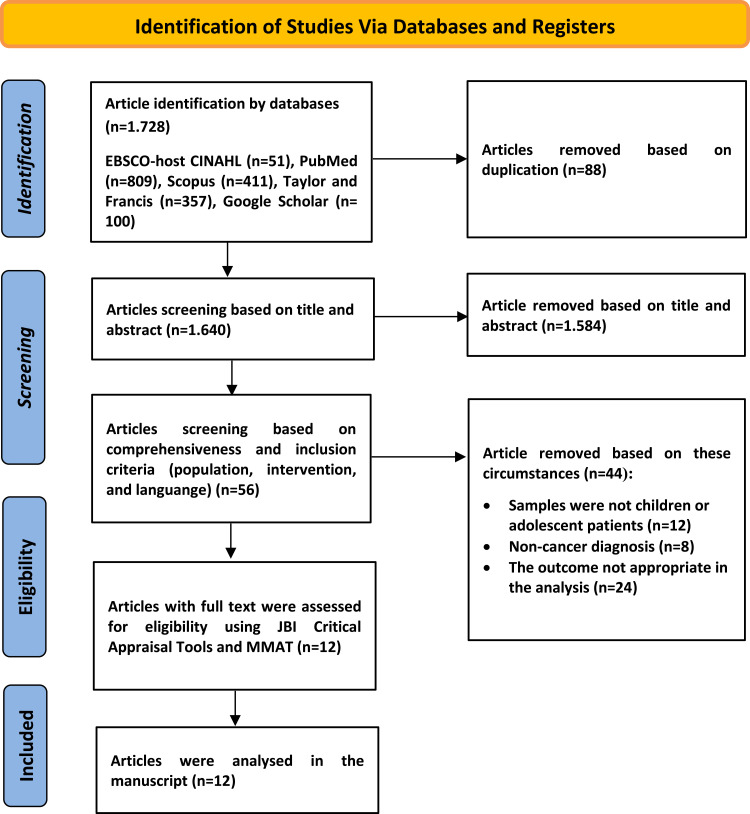
This study applied a scoping review using the guidelines outlined in the PRISMA Extension for Scoping Reviews (PRISMA-ScR). A comprehensive literature search was conducted across multiple databases, including PubMed, CINAHL, Taylor and Francis, and Scopus. Inclusion criteria were included by keywords Psychological well-being OR Psychological AND Children OR Child OR Pediatric OR Childhood AND Adolescent OR Teenagers OR Youth AND Cancer OR Neoplasms OR Tumors OR Malignancy OR Cancer Survivors AND predictor OR factors OR determinant. Studies were included if they investigated psychological well-being in children (aged 0-18 years) with cancer. The Arksey and O'Malley framework for scoping reviews guided the methodology, including study selection, data extraction, and thematic analysis. The quality of the evidence was evaluated using the Joanna Briggs Institute (JBI) and the Mixed Methods Appraisal Tool (MMAT) critical appraisal checklist.
12 articles met the inclusion criteria and were included in the review. The factors most frequently reported in several categories are age (sociodemographic), psychological function (individual factors), age at diagnosis (health and history), parent attachment and school status (environmental factors).
This review found several aspects that describe the PWB of the articles reviewed. These aspects consist of anxiety, depression, distress, well-being, and self-esteem. From these aspects, many predictors were obtained, which were classified into four categories of factors related to the PWB of children with cancer.
癌症的诊断和治疗会对儿童产生严重的心理影响,进而影响其情绪、社交和认知功能的各个方面。许多患癌儿童会经历长期的心理困扰。心理健康是他们整体健康的关键方面。了解影响他们心理状态的因素有助于制定有效的干预措施来支持他们。
本范围综述旨在识别和总结与患癌儿童心理健康相关的因素。
本研究采用《系统综述与Meta分析扩展版(PRISMA)范围综述指南》(PRISMA-ScR)进行范围综述。在多个数据库中进行了全面的文献检索,包括PubMed、CINAHL、泰勒与弗朗西斯以及Scopus。纳入标准包括关键词“心理健康”或“心理”以及“儿童”或“孩子”或“儿科”或“童年”以及“青少年”或“青少年”或“青年”以及“癌症”或“肿瘤”或“肿瘤”或“恶性肿瘤”或“癌症幸存者”以及“预测因素”或“因素”或“决定因素”。如果研究调查了0至18岁患癌儿童的心理健康,则纳入研究。范围综述的阿克赛和奥马利框架指导了该方法,包括研究选择、数据提取和主题分析。使用乔安娜·布里格斯研究所(JBI)和混合方法评估工具(MMAT)批判性评估清单对证据质量进行评估。
12篇文章符合纳入标准并被纳入综述。在几个类别中最常报告的因素是年龄(社会人口统计学)、心理功能(个体因素)、诊断年龄(健康和病史)、父母依恋和学校状况(环境因素)。
本综述发现了一些描述所审查文章中心理健康的方面。这些方面包括焦虑、抑郁、困扰、幸福感和自尊。从这些方面获得了许多预测因素,这些因素被分为与患癌儿童心理健康相关的四类因素。