Hernández-Mejías Ángel D, Shimozono Alexander M, Hazra Avijit, Richter Sven, Tong Zhengjia, Langille Neil F, Quasdorf Kyle, Parsons Andrew T, Sigman Matthew S, Reisman Sarah E
The Warren and Katharine Schlinger Laboratory for Chemistry and Chemical Engineering, Division of Chemistry and Chemical Engineering, California Institute of Technology, Pasadena, California 91125, United States.
Department of Chemistry, University of Utah, Salt Lake City, Utah 84112, United States.
J Am Chem Soc. 2025 Jan 29;147(4):3468-3477. doi: 10.1021/jacs.4c14767. Epub 2025 Jan 14.
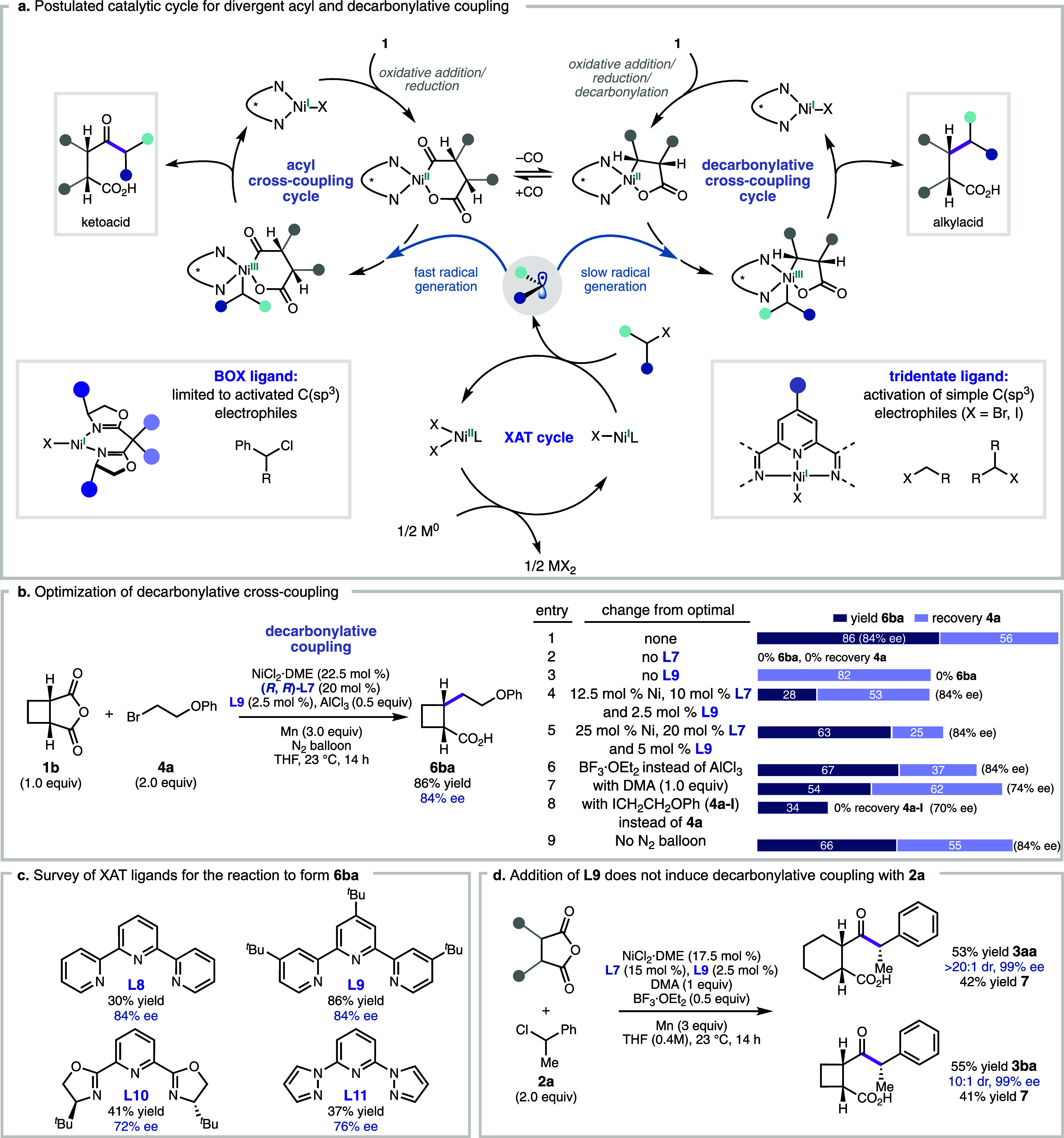
Ni-catalyzed asymmetric reductive cross-coupling reactions provide rapid and modular access to enantioenriched building blocks from simple electrophile precursors. Reductive coupling reactions that can diverge through a common organometallic intermediate to two distinct families of enantioenriched products are particularly versatile but underdeveloped. Here, we describe the development of a bis(oxazoline) ligand that enables the desymmetrization of -anhydrides. When secondary benzylic electrophiles are employed, doubly stereoselective acyl cross-coupling proceeds to give ketone products with catalyst control over three newly formed stereogenic centers. Alternatively, the use of primary alkyl halides in the presence of an additional halogen atom transfer catalyst results in decarbonylative alkylation to give enantioenriched β-alkyl acids. Analysis of reaction rates for a range of both catalysts and substrates supports the notion that tuning the different electrophile activation steps with the two catalysts is required for enhanced reaction performance. These studies illustrate how reaction design can diverge a common Ni-acyl intermediate to either acyl or decarbonylative coupling products and highlight how dual ligand systems can be used to engage unactivated alkyl halides in Ni-catalyzed asymmetric reductive coupling.
镍催化的不对称还原交叉偶联反应能够从简单的亲电前体快速且模块化地获得对映体富集的结构单元。能够通过一个共同的有机金属中间体歧化为两类不同的对映体富集产物的还原偶联反应特别通用,但尚未得到充分发展。在此,我们描述了一种双(恶唑啉)配体的开发,该配体能够实现酸酐的去对称化。当使用仲苄基亲电试剂时,双立体选择性酰基交叉偶联反应进行,以在催化剂控制下生成具有三个新形成的立体中心的酮产物。或者,在额外的卤素原子转移催化剂存在下使用伯烷基卤化物会导致脱羰烷基化反应,生成对映体富集的β-烷基酸。对一系列催化剂和底物的反应速率分析支持了这样一种观点,即需要用这两种催化剂调节不同的亲电试剂活化步骤以提高反应性能。这些研究说明了反应设计如何将一个共同的镍酰基中间体歧化为酰基或脱羰偶联产物,并突出了双配体系统如何用于使未活化的烷基卤化物参与镍催化的不对称还原偶联反应。