Angula Maria A, Ishola Anthony, Tjiurutue Muvari, Sulyok Michael, Krska Rudolf, Ezekiel Chibundu N, Misihairabgwi Jane
Department of Human, Biological, and Translational Medical Sciences, School of Medicine, University of Namibia, Windhoek, Namibia.
Department of Pharmaceutical Sciences, School of Pharmacy, Faculty of Health Sciences and Veterinary Medicine, University of Namibia, Windhoek, Namibia.
Mycotoxin Res. 2025 Feb;41(1):249-265. doi: 10.1007/s12550-024-00580-z. Epub 2025 Jan 14.
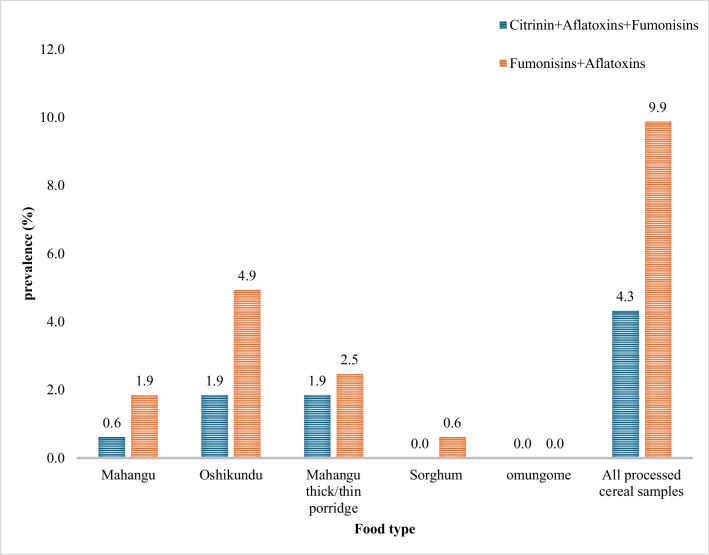
Mycotoxin exposure from contaminated food is a significant global health issue, particularly among vulnerable children. Given limited data on mycotoxin exposure among Namibian children, this study investigated mycotoxin types and levels in foods, evaluated dietary mycotoxin exposure from processed cereal foods in children under age five from rural households in Oshana region, Namibia. Mycotoxins in cereal-based food samples (n = 162) (mahangu flour (n = 35), sorghum flour (n = 13), mahangu thin/thick porridge (n = 54), oshikundu (n = 56), and omungome (n = 4)) were determined by liquid chromatography-tandem mass spectrometry. Aflatoxin B (AFB, 35.8%), zearalenone (27.2%), fumonisin B (FB, 24.1%), citrinin (CIT, 12.4%) and deoxynivalenol (10.5%) were the major mycotoxins quantified. Food samples (35.8% (n = 58) and 6.2% (n = 10)) exceeded the 0.1 µg/kg AFB and 200 µg/kg FB EU limit for children's food, respectively. Several emerging mycotoxins including the neurotoxic 3-nitropropionic acid, moniliformin (MON), and tenuazonic acid were quantified in over 50% of all samples. Co-occurrence of AFB, CIT, and FB detected in 4.9% (n = 8) samples, which could heighten food safety concerns. Regarding exposure assessment and risk characterization, average probable dietary intake for AFB from all ready-to-eat-foods was 0.036 µg/kg bw/day, which resulted in margin of exposures (MOE) of 11 and 0.65 risk cancer cases/year/100,000 people, indicating a risk of chronic aflatoxicosis. High tolerable daily intake values for FB, and MOE for beauvericin and MON exceeded reference values. Consumption of a diversified diet and interventions including timely planting and harvesting, best grain storage, and other standard postharvest food handling practices are needed to mitigate mycotoxin exposure through contaminated cereal foods and to safeguard the health of the rural children in Namibia.
食用受污染食物所接触到的霉菌毒素是一个重大的全球健康问题,在弱势儿童中尤为如此。鉴于纳米比亚儿童霉菌毒素暴露的数据有限,本研究调查了食物中的霉菌毒素类型和含量,评估了纳米比亚奥沙纳地区农村家庭五岁以下儿童食用加工谷物食品时膳食中霉菌毒素的暴露情况。采用液相色谱 - 串联质谱法测定了谷物类食品样本(n = 162)中的霉菌毒素,这些样本包括马汉谷面粉(n = 35)、高粱面粉(n = 13)、马汉谷稀/稠粥(n = 54)、奥希昆杜(n = 56)和奥蒙戈梅(n = 4)。所定量的主要霉菌毒素有黄曲霉毒素B(AFB,35.8%)、玉米赤霉烯酮(27.2%)、伏马菌素B(FB,24.1%)、桔霉素(CIT,12.4%)和脱氧雪腐镰刀菌烯醇(10.5%)。食品样本中分别有35.8%(n = 58)和6.2%(n = 10)超过了欧盟规定的儿童食品中AFB 0.1 μg/kg和FB 200 μg/kg的限量。在超过50%的所有样本中定量出了几种新出现的霉菌毒素,包括神经毒性的3 - 硝基丙酸、串珠镰刀菌素(MON)和细交链孢菌酮酸。在4.9%(n = 8)的样本中检测到AFB、CIT和FB同时存在,这可能会增加食品安全问题。关于暴露评估和风险特征描述,所有即食食品中AFB的平均可能膳食摄入量为0.036 μg/kg体重/天,这导致暴露边际(MOE)为11,每年每10万人中有0.65例癌症风险病例,表明存在慢性黄曲霉毒素中毒风险。FB的每日可耐受摄入量较高,而白僵菌素和MON的MOE超过了参考值。需要食用多样化饮食并采取包括适时种植和收获、最佳谷物储存以及其他标准收获后食品处理措施在内的干预措施,以减轻通过受污染谷物食品接触霉菌毒素的情况,并保障纳米比亚农村儿童的健康。