Zaid Sumaia Mohammed, Hutagalung Fonny Dameaty, Abd Hamid Harris Shah Bin, Taresh Sahar Mohammed
Department of Psychology, Faculty of Art and Humanities, Sana'a University, Sana'a, Yemen.
Department of Educational Psychology and Counselling, University of Malaya, Kuala Lumpur, Malaysia.
BMC Psychol. 2025 Jan 14;13(1):38. doi: 10.1186/s40359-025-02354-3.
Emotions are a fundamental part of life and play a critical role in shaping individuals' experiences Effectively regulating emotions in socially appropriate ways is essential for navigating life successfully. This study investigated the impact of seven sadness regulation strategies on depression and anxiety and examined the mediating role of ER in the relationship between sadness regulation and depression and anxiety.
A cross-sectional design was employed with 350 participants (144 men, 206 women) aged 18 to 35.
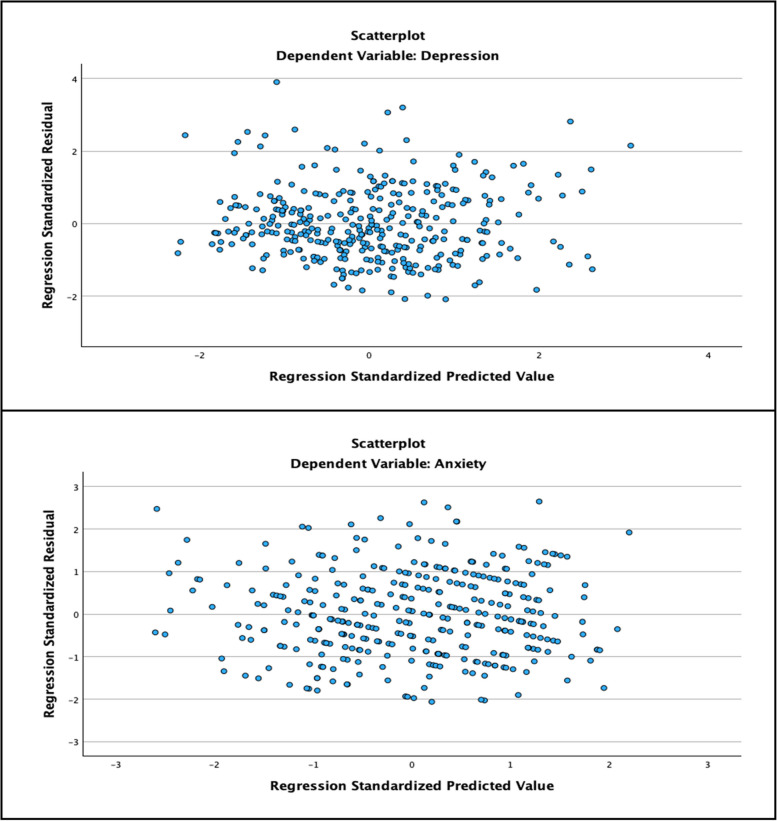
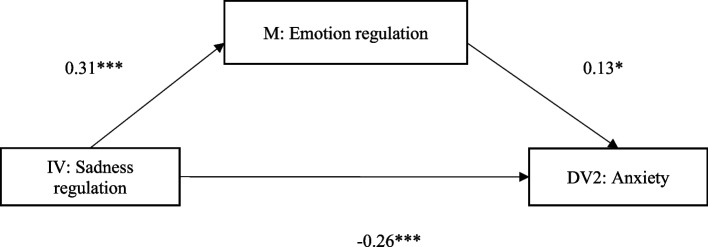
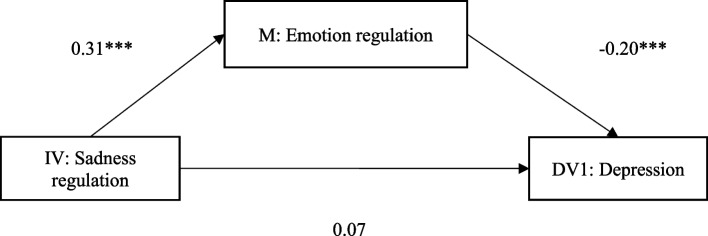
Regression analyses showed that sadness regulation strategies significantly predict both depression and anxiety. For depression, the model explained 18.6% of the variance (F (7,342) = 11.140, p < 0.001), with cognitive reappraisal, religious coping, and seeking support negatively associated, while rumination was positively associated. For anxiety, the model explained 19% of the variance (F(7,342) = 11.484, p < 0.001), with rumination and substance use linked to lower anxiety levels, while other strategies showed no significant associations. Mediation analyses highlighted emotion regulation critical role, with sadness regulation influencing depression indirectly through ER (β = -0.024, 95% CI [-0.040, -0.009]) and accounting for 3.6% of the variance. Sadness regulation also had a direct (β = -0.037, p < 0.001) and indirect effect on anxiety through emotion regulation, explaining 6.1% of the variance.
These findings underscore the importance of adaptive sadness and emotion regulation strategies in mitigating depression and anxiety, offering valuable insights for therapeutic interventions.
情绪是生活的基本组成部分,在塑造个人经历方面起着关键作用。以社会适宜的方式有效调节情绪对于成功应对生活至关重要。本研究调查了七种悲伤调节策略对抑郁和焦虑的影响,并检验了情绪调节(ER)在悲伤调节与抑郁和焦虑关系中的中介作用。
采用横断面设计,共有350名年龄在18至35岁之间的参与者(144名男性,206名女性)。
回归分析表明,悲伤调节策略能显著预测抑郁和焦虑。对于抑郁,该模型解释了18.6%的方差(F(7,342) = 11.140,p < 0.001),其中认知重评、宗教应对和寻求支持呈负相关,而沉思呈正相关。对于焦虑,该模型解释了19%的方差(F(7,342) = 11.484,p < 0.001),沉思和物质使用与较低的焦虑水平相关,而其他策略未显示出显著关联。中介分析突出了情绪调节的关键作用,悲伤调节通过情绪调节间接影响抑郁(β = -0.024,95% CI [-0.040, -0.009]),占方差的3.6%。悲伤调节对焦虑也有直接(β = -0.037,p < 0.001)和间接影响,通过情绪调节解释了6.1%的方差。
这些发现强调了适应性悲伤和情绪调节策略在减轻抑郁和焦虑方面的重要性,为治疗干预提供了有价值的见解。