Schwab Frank, Mekhail Nagy, Patel Kiran V, Langhorst Meredith, Heros Robert D, Gentile Jonathan, Costandi Sherif, Moore Gregory, Gilmore Christopher, Manion Smith, Chakravarthy Krishnan, Meyer S Craig, Bundy Justin V, Tate Jordan L, Sanders Rebecca, Vaid Sandeep, Szentirmai Oszkar, Goree Johnathan, Patel Vikas V, Lehmen Jeff, Desai Mehul J, Pope Jason E, Giuffrida Anthony, Hayek Salim, Virk Sohrab Singh, Paicius Richard, Klemme William R, Levy Robert, Gilligan Christopher
Northwell Health Orthopaedic Institute at Lenox Hill, 130 East 77th Street, Black Hall 7th, 11th, and 12th Floors, New York, NY, 10075, USA.
Cleveland Clinic, Cleveland, OH, USA.
Pain Ther. 2025 Feb;14(1):401-423. doi: 10.1007/s40122-024-00689-0. Epub 2025 Jan 15.
Many interventional strategies are commonly used to treat chronic low back pain (CLBP), though few are specifically intended to target the distinct underlying pathomechanisms causing low back pain. Restorative neurostimulation has been suggested as a specific treatment for mechanical CLBP resulting from multifidus dysfunction. In this randomized controlled trial, we report outcomes from a cohort of patients with CLBP associated with multifidus dysfunction treated with restorative neurostimulation compared to those randomized to a control group receiving optimal medical management (OMM) over 1 year.
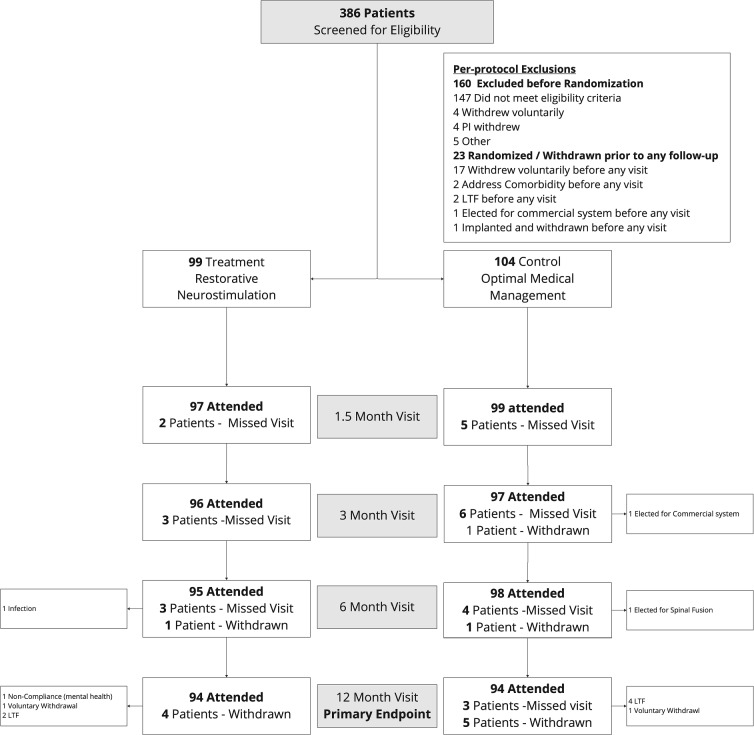
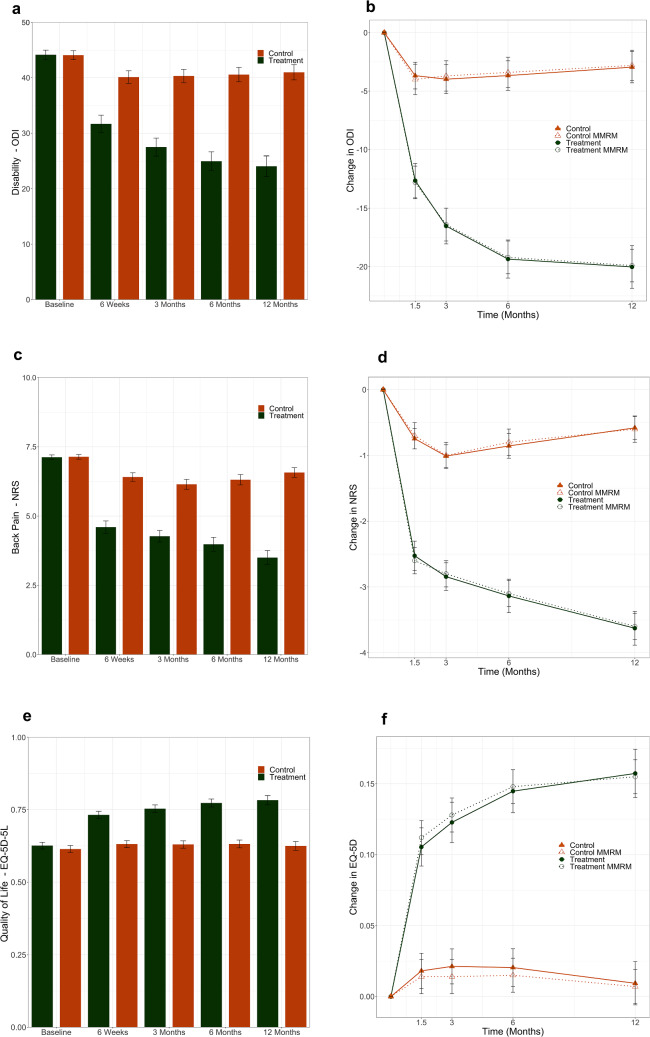
RESTORE is a multicenter, open-label randomized controlled trial. Candidates were assessed for CLBP associated with multifidus dysfunction, with no indication for or history of lumbar spine surgery. Participants were randomized to either restorative neurostimulation with the ReActiv8 system or OMM. The primary endpoint was a comparison of the mean change in the Oswestry Disability Index (ODI) between the treatment and control arms at 1 year, and secondary endpoints included pain (numeric rating scale [NRS]) and health-related quality of life (EuroQol Five-Dimension [EQ-5D-5L]).
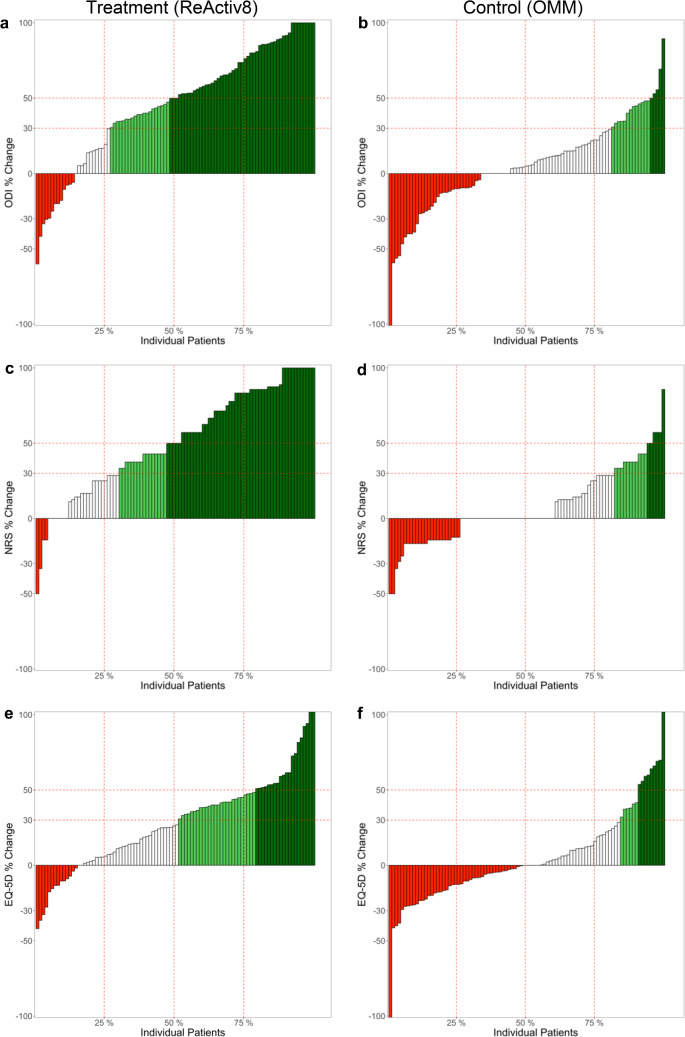
A total of 203 patients, average age 47 years, and with an average 11-year history of low back pain, were included in the analysis. The primary endpoint was a statistically significant demonstration of a clinically relevant mean improvement in the Oswestry Disability Index (ODI) between restorative neurostimulation and OMM arms: ODI (-19.7 ± 1.4 vs. -2.9 ± 1.4; p < 0.001). Additionally, improvements in both the numeric rating scale (NRS) (-3.6 ± 0.2 vs. -0.6 ± 0.2; p < 0.001) and EuroQol Five-Dimension (EQ-5D-5L) (0.155 ± 0.012 vs. 0.008 ± 0.012; p < 0.001) were statistically and clinically significant in the restorative neurostimulation arm compared to the OMM arm.
The RESTORE trial demonstrates that restorative neurostimulation is a safe, reversible, clinically effective, and highly durable option for patients suffering with nonoperative CLBP associated with multifidus dysfunction. This demonstration of treatment superiority over OMM through 1 year is a significant milestone in addressing a major health burden and unmet clinical need.
ClinicalTrials.gov Identifier: NCT04803214.
许多介入策略常用于治疗慢性下腰痛(CLBP),但专门针对导致下腰痛的不同潜在病理机制的策略却很少。恢复性神经刺激已被建议作为治疗多裂肌功能障碍引起的机械性CLBP的一种特定疗法。在这项随机对照试验中,我们报告了一组与多裂肌功能障碍相关的CLBP患者接受恢复性神经刺激治疗的结果,并与随机分配到接受最佳药物治疗(OMM)的对照组患者在1年中的结果进行了比较。
RESTORE是一项多中心、开放标签的随机对照试验。对患有与多裂肌功能障碍相关的CLBP且无腰椎手术指征或病史的患者进行评估。参与者被随机分配接受ReActiv8系统的恢复性神经刺激或OMM。主要终点是比较治疗组和对照组在1年时Oswestry功能障碍指数(ODI)的平均变化,次要终点包括疼痛(数字评分量表[NRS])和健康相关生活质量(欧洲五维健康量表[EQ-5D-5L])。
共有203名患者纳入分析,平均年龄47岁,平均有11年的下腰痛病史。主要终点显示,恢复性神经刺激组和OMM组在Oswestry功能障碍指数(ODI)上有临床相关的显著平均改善:ODI(-19.7±1.4对-2.9±1.4;p<0.001)。此外,与OMM组相比,恢复性神经刺激组在数字评分量表(NRS)(-3.6±0.2对-0.6±0.2;p<0.001)和欧洲五维健康量表(EQ-5D-5L)(0.155±0.012对0.008±0.012;p<0.001)方面的改善在统计学和临床上均具有显著性。
RESTORE试验表明,恢复性神经刺激对于患有与多裂肌功能障碍相关的非手术性CLBP的患者是一种安全、可逆、临床有效的且持久性高的选择。在1年时间里证明了其相对于OMM的治疗优势,这是解决一项重大健康负担和未满足的临床需求方面的一个重要里程碑。
ClinicalTrials.gov标识符:NCT04803214。