Cinarli Fahri Safa, Aydogdu Onur, Aydin Yalcin, Tokgöz Gürkan, Kahraman Abdulselam, Beykumül Ayşegül, Aygoren Caner, Yılmaz Nurkan, Ramirez-Campillo Rodrigo
Faculty of Sport Science, Inonu University, Malatya, Turkey.
Faculty of Health Sciences, Marmara University, Istanbul, Turkey.
BMC Sports Sci Med Rehabil. 2025 Jan 16;17(1):8. doi: 10.1186/s13102-024-01051-9.
Both maximal muscle strength and muscle power are independently important for karatekas. However, the relationship between strength and power in elite male kumite karatekas is under researched. This study aimed to determine the relationship between back-leg-chest (BLC) isometric muscle strength with sprint and jump variables in elite male karatekas.
Male elite/international level (tier 4) kumite karatekas (n = 14; age, 20.79 ± 1.67 year; height, 1.77 ± 0.06 m; weight, 72.21 ± 5.20 kg) were recruited. BLC strength, sprint and jump values were measured with a dynamometer, a photocell, and an application, respectively. Pearson correlation (trivial r < 0.1; small r < 0.3; moderate r < 0.5; large r < 0.7; very large r < 0.9; nearly perfect/perfect r ≥ 0.9) and linear regression analyses were performed to determine the relationship and shared variance between BLC strength, sprint, and jump performance.
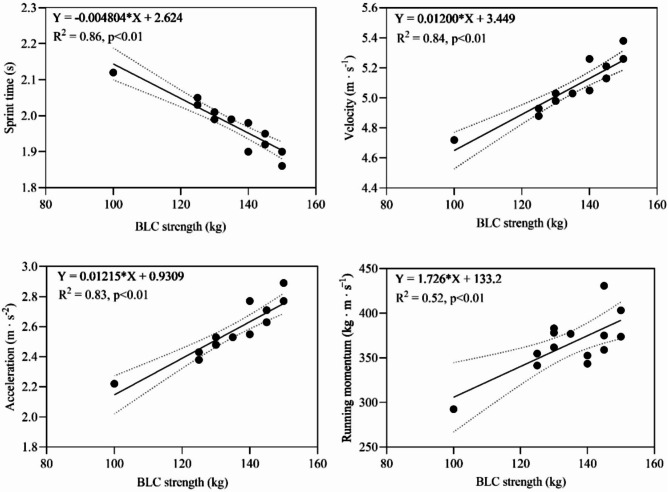
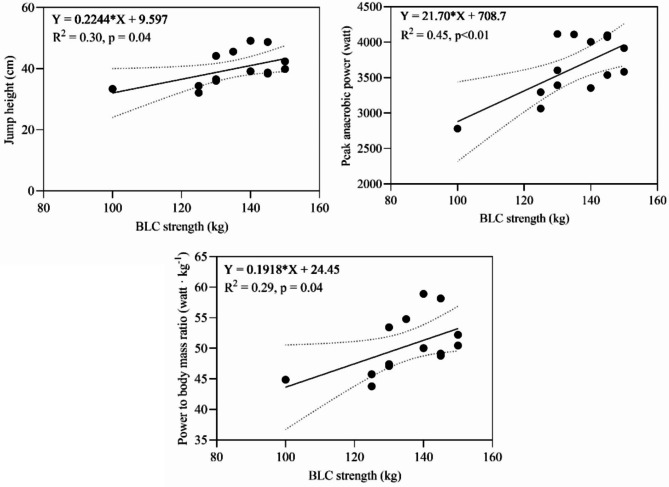
There were large to very large correlations between BLC strength and sprint time (r = - 0.930, p < 0.01), velocity (r = 0.918; p < 0.01), acceleration (r = 0.913; p < 0.01) and running momentum (r = 0.721; p < 0.01). Additionally, BLC strength correlated with jump height (moderate, r = 0.550, p < 0.05), peak anaerobic power (moderate, r = 0.672, p < 0.01) and power to body mass ratio (moderate, r = 0.545, p < 0.05). BLC strength and sprint variables showed an r = 0.52-0.86 (p < 0.01), while BLC strength and jump variables showed an r = 0.29-0.45 (p < 0.05).
BLC strength is related to jump and sprint performance in male elite karate athletes. This relationship underscores the importance of including strength training that targets BLC muscle strength in training programs for coaches and athletes.
最大肌肉力量和肌肉功率对空手道运动员都具有独立的重要性。然而,精英男子组手空手道运动员的力量与功率之间的关系尚缺乏研究。本研究旨在确定精英男子空手道运动员的后腿-胸部(BLC)等长肌肉力量与短跑和跳跃变量之间的关系。
招募了男子精英/国际水平(4级)的组手空手道运动员(n = 14;年龄,20.79 ± 1.67岁;身高,1.77 ± 0.06米;体重,72.21 ± 5.20千克)。分别使用测力计、光电管和一个应用程序测量BLC力量、短跑和跳跃值。进行Pearson相关性分析(微小r < 0.1;小r < 0.3;中等r < 0.5;大r < 0.7;非常大r < 0.9;几乎完美/完美r ≥ 0.9)和线性回归分析,以确定BLC力量、短跑和跳跃表现之间的关系及共同方差。
BLC力量与短跑时间(r = -0.930,p < 0.01)、速度(r = 0.918;p < 0.01)、加速度(r = 0.913;p < 0.01)和跑步动量(r = 0.721;p < 0.01)之间存在大到非常大的相关性。此外,BLC力量与跳跃高度(中等,r = 0.550,p < 0.05)、峰值无氧功率(中等,r = 0.672,p < 0.01)和功率体重比(中等,r = 0.545,p < 0.05)相关。BLC力量与短跑变量的r值为0.52 - 0.86(p < 0.01),而BLC力量与跳跃变量的r值为0.29 - 0.45(p < 0.05)。
BLC力量与男性精英空手道运动员的跳跃和短跑表现相关。这种关系凸显了在教练和运动员的训练计划中纳入针对BLC肌肉力量的力量训练的重要性。