Martins-Ferreira Ricardo, Calafell-Segura Josep, Leal Bárbara, Rodríguez-Ubreva Javier, Martínez-Saez Elena, Mereu Elisabetta, Pinho E Costa Paulo, Laguna Ariadna, Ballestar Esteban
Epigenetics and Immune Disease Group, Josep Carreras Leukaemia Research Institute (IJC), 08916 Badalona, Barcelona, Spain.
Immunogenetics Laboratory, Molecular Pathology and Immunology Department, Instituto de Ciências Biomédicas Abel Salazar, Universidade do Porto (ICBAS-UPorto), 4050-313, Porto, Portugal.
Nat Commun. 2025 Jan 16;16(1):739. doi: 10.1038/s41467-025-56124-1.
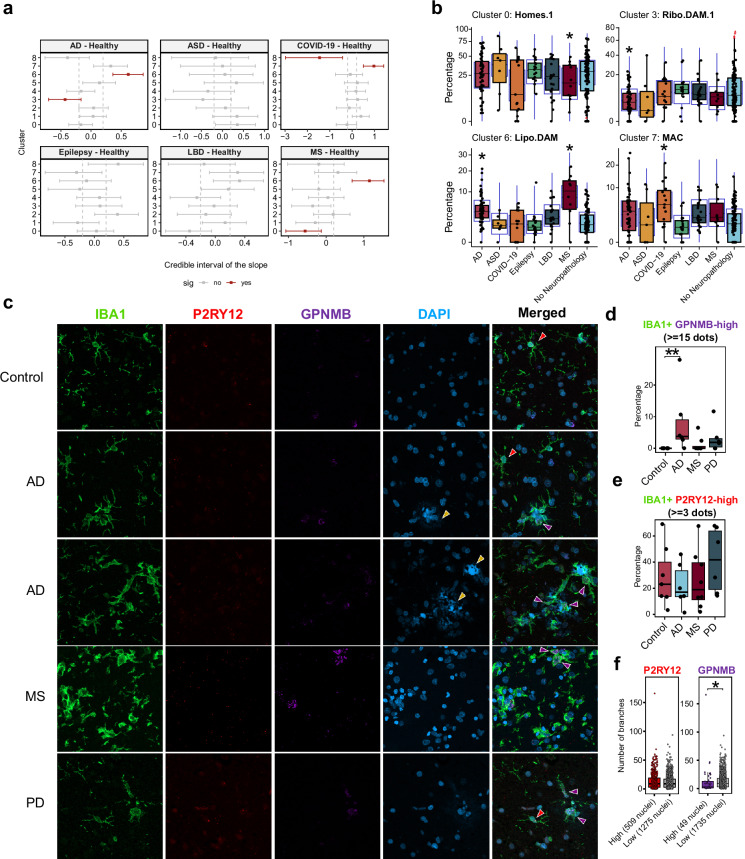
Dysregulated microglia activation, leading to neuroinflammation, is crucial in neurodegenerative disease development and progression. We constructed an atlas of human brain immune cells by integrating nineteen single-nucleus RNA-seq and single-cell RNA-seq datasets from multiple neurodegenerative conditions, comprising 241 samples from patients with Alzheimer's disease, autism spectrum disorder, epilepsy, multiple sclerosis, Lewy body diseases, COVID-19, and healthy controls. The integrated Human Microglia Atlas (HuMicA) included 90,716 nuclei/cells and revealed nine populations distributed across all conditions. We identified four subtypes of disease-associated microglia and disease-inflammatory macrophages, recently described in mice, and shown here to be prevalent in human tissue. The high versatility of microglia is evident through changes in subset distribution across various pathologies, suggesting their contribution in shaping pathological phenotypes. A GPNMB-high subpopulation was expanded in AD and MS. In situ hybridization corroborated this increase in AD, opening the question on the relevance of this population in other pathologies.
小胶质细胞激活失调会导致神经炎症,这在神经退行性疾病的发生和发展中至关重要。我们通过整合来自多种神经退行性疾病的19个单核RNA测序和单细胞RNA测序数据集,构建了人类大脑免疫细胞图谱,这些数据集包括来自阿尔茨海默病、自闭症谱系障碍、癫痫、多发性硬化症、路易体病、COVID-19患者的241个样本以及健康对照。整合后的人类小胶质细胞图谱(HuMicA)包含90,716个细胞核/细胞,并揭示了分布在所有疾病状态下的9个细胞群。我们鉴定出了疾病相关小胶质细胞和疾病炎症巨噬细胞的四种亚型,这些亚型最近在小鼠中有所描述,此处显示在人体组织中也很普遍。小胶质细胞的高度多功能性通过其在各种病理状态下亚群分布的变化得以体现,这表明它们在塑造病理表型方面发挥了作用。一个高表达GPNMB的亚群在阿尔茨海默病和多发性硬化症中有所扩增。原位杂交证实了阿尔茨海默病中的这种增加,这引发了关于该细胞群在其他病理中的相关性的问题。