Jiang Rui, Wu Chengke, Feng Wei, You Kairui, Liu Jian, Zhou Guangmin, Liu Lujing, Cheng Hui-Ming
Institute of Technology for Carbon Neutrality, Shenzhen Institute of Advanced Technology, The Chinese Academy of Sciences, Shenzhen, Guangdong Province, People's Republic of China.
Shenzhen Institute of Advanced Technology, The Chinese Academy of Sciences, Shenzhen, Guangdong Province, People's Republic of China.
Sci Rep. 2025 Jan 17;15(1):2267. doi: 10.1038/s41598-025-86250-1.
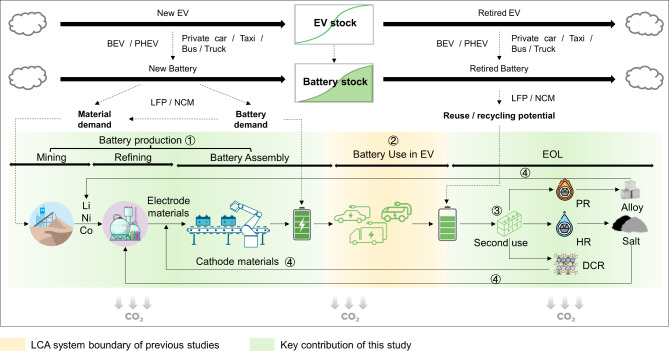
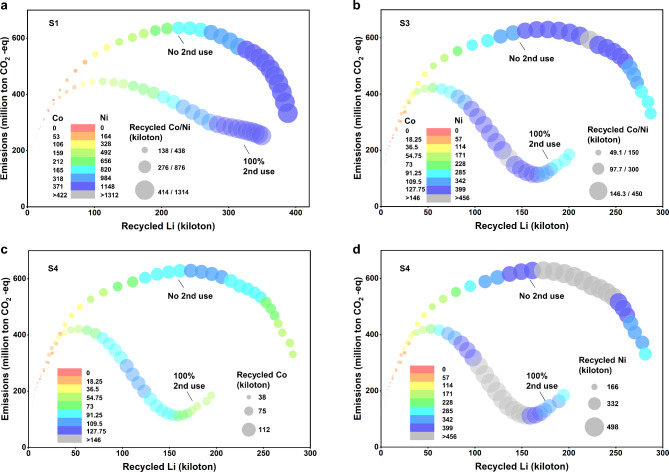
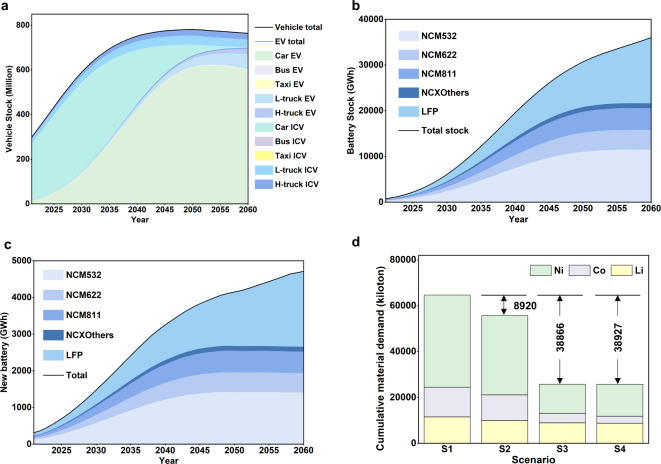
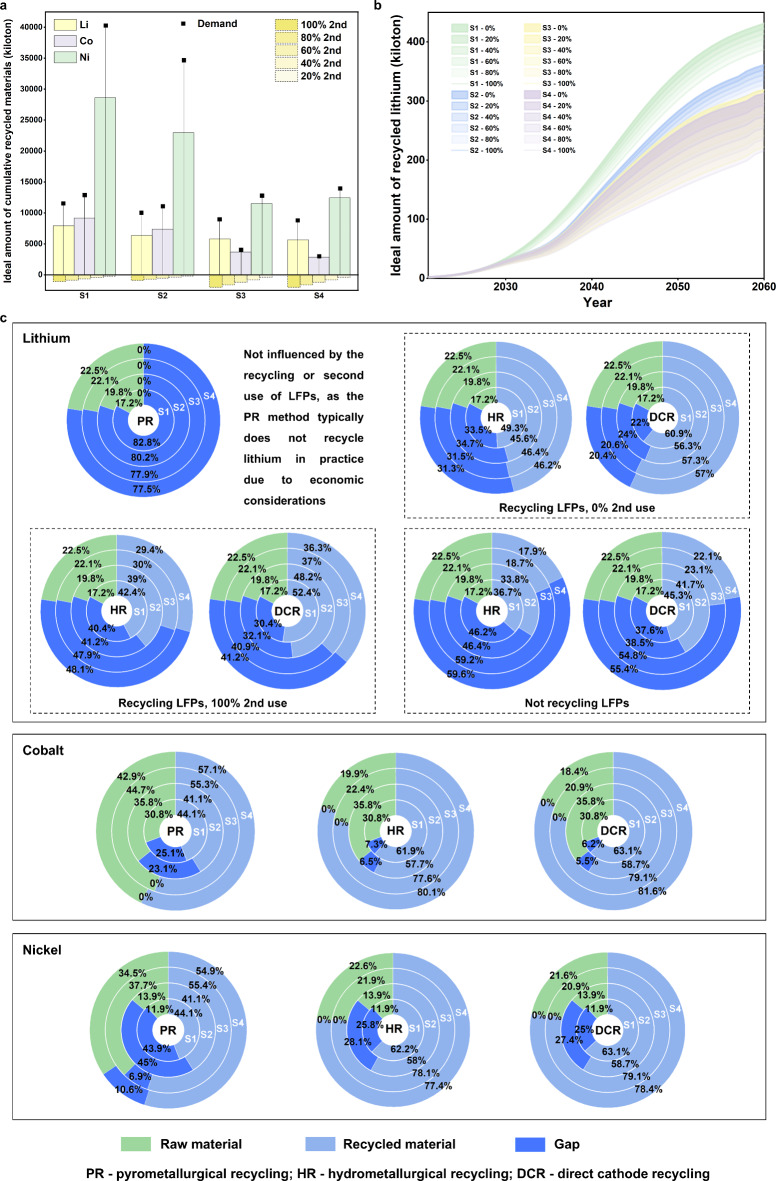
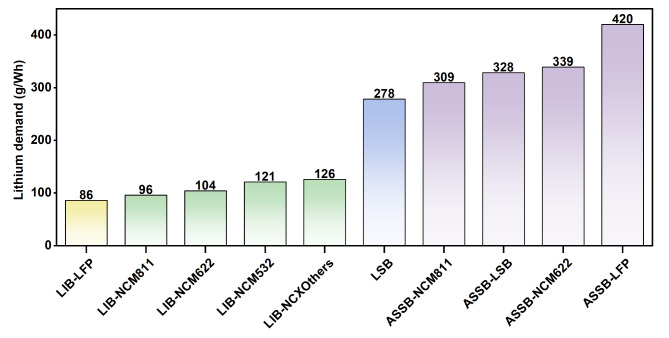
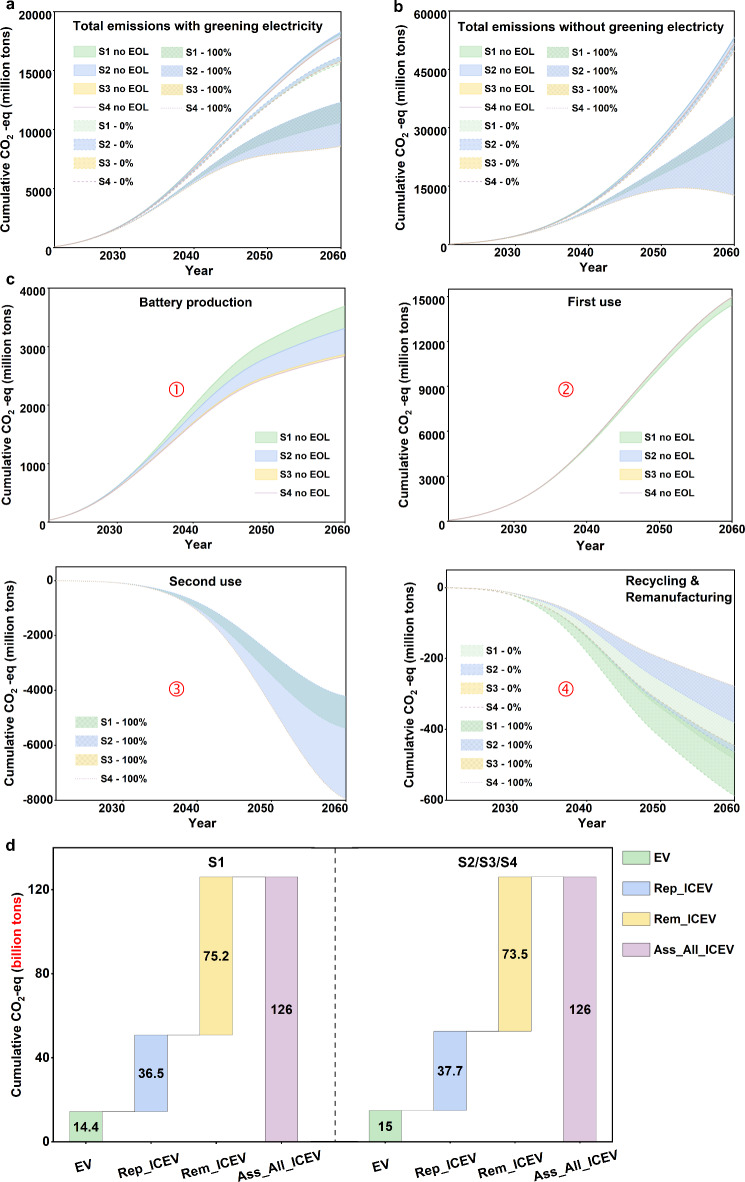
The rapid growth of electric vehicles (EVs) in China challenges raw material demand. This study evaluates the impact of recycling and reusing EV batteries on reducing material demand and carbon emissions. Integrating a national-level vehicle stock turnover model with life-cycle carbon emission assessment, we found that replacing nickel-cobalt-manganese batteries with lithium iron phosphate batteries with battery recycling can reduce lithium, cobalt, and nickel demand between 2021 and 2060 by up to 7.8 million tons (Mt) (67%), 12.4 Mt (96%), and 37.2 Mt (93%), respectively, significantly decreasing reliance on import. Moreover, battery recycling coupled with reuse can reduce carbon emissions by up to 6,532-6,864 Mt (36.0-37.9%), depending on four recycling methods employed. However, this reuse strategy delays battery recycling and risks lithium supply shortage, necessitating trade-offs between carbon reduction and material supply. Future technologies, such as lithium-sulfur and all-solid-state batteries, despite their energy efficiency, might exacerbate lithium shortage, underscoring the crucial need for increased lithium supply.
中国电动汽车(EV)的快速增长对原材料需求构成挑战。本研究评估了电动汽车电池回收再利用对减少材料需求和碳排放的影响。通过将国家级车辆库存周转模型与生命周期碳排放评估相结合,我们发现,在电池回收的情况下,用磷酸铁锂电池取代镍钴锰电池,在2021年至2060年期间可分别减少锂、钴和镍的需求达780万吨(67%)、1240万吨(96%)和3720万吨(93%),显著降低对进口的依赖。此外,根据所采用的四种回收方法,电池回收再利用最多可减少6532 - 6864百万吨(36.0 - 37.9%)的碳排放。然而,这种再利用策略会延迟电池回收,并存在锂供应短缺的风险,因此需要在碳减排和材料供应之间进行权衡。未来的技术,如锂硫电池和全固态电池,尽管它们能源效率高,但可能会加剧锂短缺,凸显了增加锂供应的迫切需求。