Abounan Yao, Wittwer Jérôme, Tine Judicaël Malick, Ndiaye Ibrahima, Ziadeh Salaheddine, Desmonde Sophie, Font Hélène, Verdeli Helen, Ngom Ndeye Fatou, de Rekeneire Nathalie, Jaquet Antoine, Seydi Moussa, Bernard Charlotte
University of Bordeaux, National Institute for Health and Medical Research (INSERM) UMR 1219, Research Institute for Sustainable Development (IRD) EMR 271, Bordeaux Population Health Centre, Bordeaux, France.
Service des Maladies Infectieuses et Tropicales, CHNU de Fann, Dakar, Senegal.
Int J Ment Health Syst. 2025 Jan 17;19(1):4. doi: 10.1186/s13033-024-00654-6.
Group Interpersonal Therapy (IPT), an evidence-based treatment of depression recommended by the WHO mhGAP Intervention Guide, was implemented through a task-shifting approach in Senegal, as a treatment for depressed people living with HIV (PLWH). Since a description of the resources used and the implementation costs incurred is necessary to inform policymakers better, this study aimed to estimate the costs associated with its implementation.
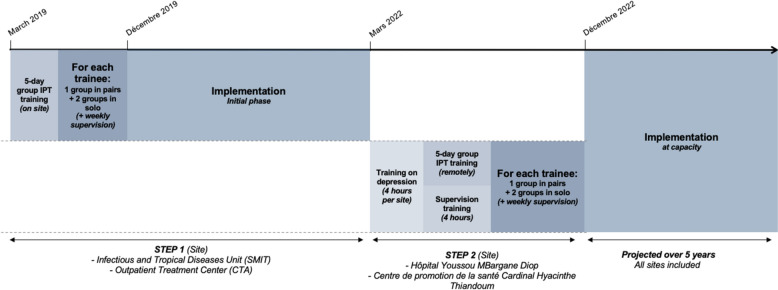
Intervention costs were analyzed using an "ingredients-based costing approach" from the provider's perspective. We identified and described the start-up and implementation costs for the initial phase and a projection over 5 years (implementation at capacity). We estimated total annual costs and cost per beneficiary. We conducted a scenario analysis to highlight some cost uncertainties and their impacts.
The total annual costs were estimated at $4064 for the initial phase and $8161 for the implementation at capacity. The training was the main cost driver representing approximately 60% of the total annual costs. The cost per beneficiary receiving group IPT was estimated at $65 for the implementation at capacity. The scenario analysis also illustrated the importance of parameters like the screening strategy, training activities, and allocation to cover transport costs mobilized by participants.
This cost analysis highlighted the costs and cost allocations required to implement group IPT in Senegal to treat depression in PLWH. This preliminary work should enable policymakers to identify the optimal resources to be mobilized to implement and ensure the sustainability of this therapy in HIV at a country-level program.
团体人际治疗(IPT)是世界卫生组织mhGAP干预指南推荐的一种基于证据的抑郁症治疗方法,在塞内加尔通过任务转移的方式实施,用于治疗感染艾滋病毒的抑郁症患者(PLWH)。由于需要描述所使用的资源和产生的实施成本,以便更好地为政策制定者提供信息,本研究旨在估计与实施IPT相关的成本。
从提供者的角度,使用“基于成分的成本核算方法”分析干预成本。我们确定并描述了初始阶段的启动和实施成本以及5年的预测成本(满负荷实施)。我们估计了年度总成本和每位受益人的成本。我们进行了情景分析,以突出一些成本的不确定性及其影响。
初始阶段的年度总成本估计为4064美元,满负荷实施时为8161美元。培训是主要的成本驱动因素,约占年度总成本的60%。接受团体IPT治疗的每位受益人的成本在满负荷实施时估计为65美元。情景分析还说明了筛查策略、培训活动和用于支付参与者交通费用的分配等参数的重要性。
这项成本分析突出了在塞内加尔实施团体IPT以治疗PLWH抑郁症所需的成本和成本分配。这项初步工作应能使政策制定者确定在国家层面的艾滋病毒项目中实施并确保该治疗可持续性所需调动的最佳资源。