Clemente Filipe Manuel, Ramirez-Campillo Rodrigo, Moran Jason, Zmijewski Piotr, Silva Rui Miguel, Randers Morten Bredsgaard
Escola Superior Desporto e Lazer, Instituto Politécnico de Viana do Castelo, Rua Escola Industrial e Comercial de Nun'Álvares, 4900-347, Viana do Castelo, Portugal.
Sport Physical Activity and Health Research and Innovation Center, Viana do Castelo, Portugal.
Sports Med Open. 2025 Jan 20;11(1):3. doi: 10.1186/s40798-024-00808-3.
A small number of reviews have explored lower- versus higher-volume training in non-athletes, but the growing challenge of congested schedules in team sports highlights the need to synthesize evidence specific to team sport athletes. Thus, the objectives of this systematic review with meta-analysis are twofold: (i) to summarize the primary physiological and physical fitness outcomes of lower-volume versus higher-volume training interventions in team sports players; and (ii) to compare the effects of lower-volume training with higher, considering the training modalities used.
We conducted searches across key databases, including PubMed, Scopus, SPORTDiscus, and Web of Science. We included team sports players with at least a trained or developmental level, focusing on studies comparing different training volumes (lower vs higher) within the same research. Lower volume training was defined in comparison to another load, emphasizing smaller training volume in terms of repetitions, duration, or frequency. The studies had to examine key physical performance adaptations and use two-arm or multi-arm designs. Methodological assessments of the included studies were performed using the Rob2 and ROBINS-I instruments, with evidence certainty evaluated through GRADE.
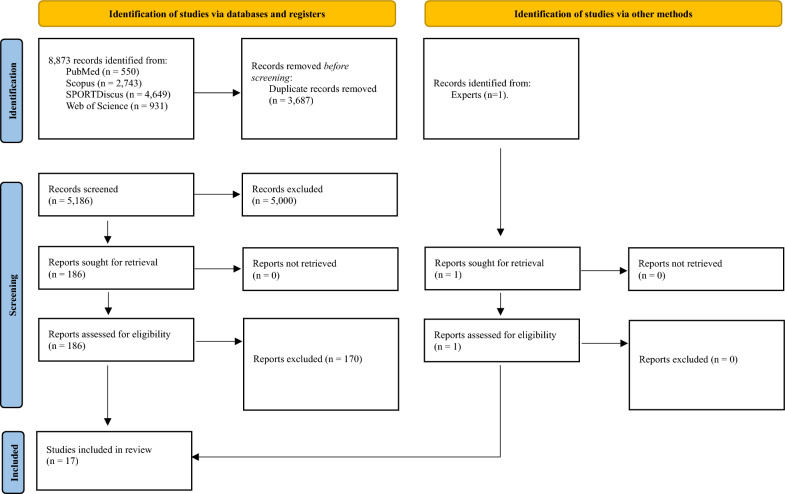
The initial search yielded 5,188 records, with 17 articles deemed eligible for the review. There was a non-significant trend favoring the higher-volume training group over the lower-volume group in resistance-based training when considering all pooled physical fitness outcomes (effect size - 0.05, 95% CI - 0.19 to 0.09, p = 0.506, I = 0.0%). A meta-analysis was not conducted for aerobic-based training due to only two studies being available, with one showing that lower volume training improved maximal oxygen uptake by 3.8% compared to 1.3% for higher volume, while the other indicated that lower training volumes enhanced performance by 1.6% versus 0.8%. The evidence certainty for physical performance outcomes was very low.
In newly introduced resistance training, lower volumes-regardless of repetitions or frequency-can achieve similar fitness gains to higher volumes. More pronounced tapering also appears more effective for supercompensation. However, the variability in study designs and training methods makes it difficult to establish a clear minimal dose. The main contribution of this review is mapping current research, providing a foundation for future studies and training optimization.
少数综述探讨了非运动员进行低训练量与高训练量训练的情况,但团队运动中日程安排日益紧张这一挑战凸显了综合针对团队运动运动员的证据的必要性。因此,本项带有荟萃分析的系统综述的目的有两个:(i)总结团队运动运动员进行低训练量与高训练量训练干预后的主要生理和身体素质结果;(ii)考虑所使用的训练方式,比较低训练量训练与高训练量训练的效果。
我们在包括PubMed、Scopus、SPORTDiscus和Web of Science在内的关键数据库中进行了检索。我们纳入了至少处于训练或发展水平的团队运动运动员,重点关注同一研究中比较不同训练量(低与高)的研究。与另一种负荷相比,低训练量训练被定义为在重复次数、持续时间或频率方面训练量较小。这些研究必须考察关键的身体性能适应性,并采用双臂或多臂设计。使用Rob2和ROBINS - I工具对纳入研究进行方法学评估,并通过GRADE评估证据确定性。
初步检索得到5188条记录,17篇文章被认为符合综述要求。在考虑所有汇总的身体素质结果时,在基于阻力的训练中,高训练量训练组相对于低训练量训练组有一个不显著的趋势(效应量 -0.05,95%置信区间 -0.19至0.09,p = 0.506,I = 0.0%)。由于仅有两项关于有氧训练的研究,因此未对其进行荟萃分析,其中一项研究表明,低训练量训练使最大摄氧量提高了3.8%,而高训练量训练提高了1.3%,另一项研究表明,低训练量训练使成绩提高了1.6%,而高训练量训练提高了0.8%。身体性能结果的证据确定性非常低。
在新引入的阻力训练中,低训练量——无论重复次数或频率如何——都能获得与高训练量相似的体能提升。更明显的减量对于超量恢复似乎也更有效。然而,研究设计和训练方法的差异使得难以确定明确的最小剂量。本综述的主要贡献在于梳理当前研究,为未来研究和训练优化提供基础。