Roth Lilly, Nuerk Hans-Christoph, Cramer Felix, Daroczy Gabriella
Department of Psychology, University of Tübingen, Tübingen, Germany.
LEAD Graduate School & Research Network, University of Tübingen, Tübingen, Germany.
Psychol Res. 2025 Jan 20;89(1):50. doi: 10.1007/s00426-024-02069-x.
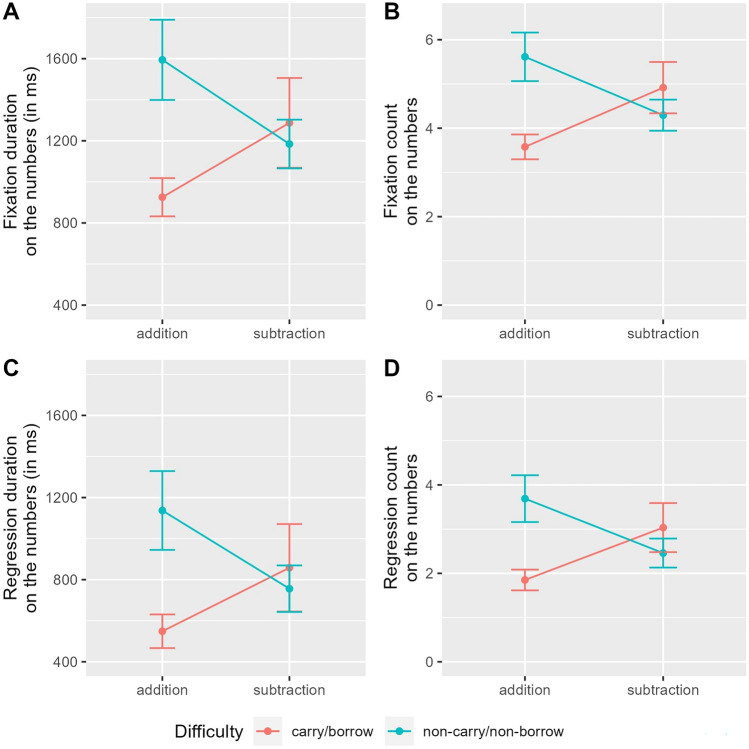
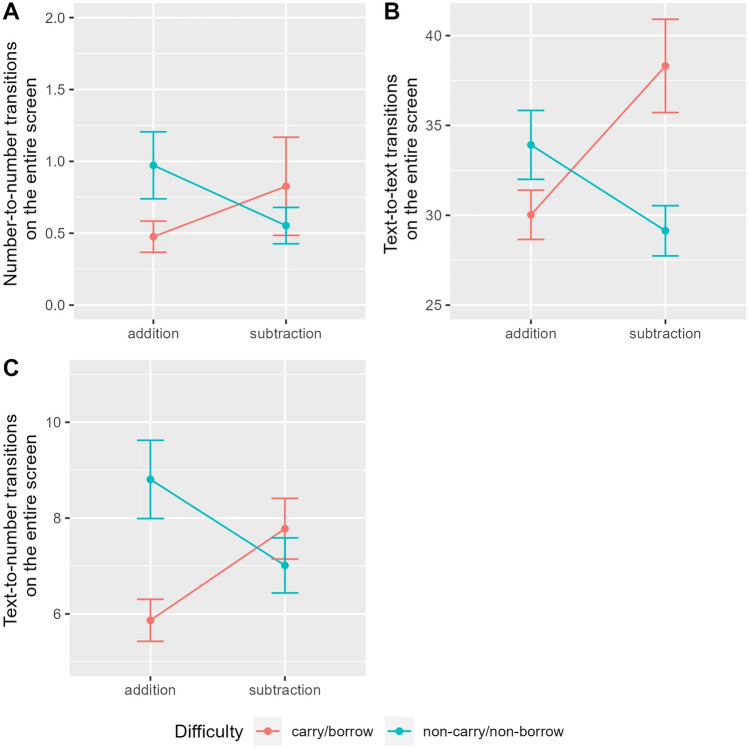
Solving arithmetic word problems requires individuals to create a correct mental representation, and this involves both text processing and number processing. The latter comprises understanding the semantic meaning of numbers (i.e., their magnitudes) and potentially executing the appropriate mathematical operation. However, it is not yet clear whether number processing occurs after text processing or both take place simultaneously. We hypothesize that number processing occurs early and simultaneously with other problem-solving processes such as text processing. To test this hypothesis, we created non-solvable word problems that do not require any number processing and we manipulated the calculation difficulty using carry/borrow vs. non-carry/non-borrow within addition and subtraction problems. According to a strictly sequential model, this manipulation should not matter, because when problems are non-solvable, no calculation is required. In contrast, according to an interactive model, attention to numbers would be higher when word problems require a carry/borrow compared to a non-carry/non-borrow operation. Eye-tracking was used to measure attention to numbers and text in 63 adults, operationalized by static (duration and count of fixations and regressions) and dynamic measures (count of transitions). An interaction between difficulty and operation was found for all static and dynamic eye-tracking variables as well as for response times and error rates. The observed number processing in non-solvable word problems, which indicates that it occurs simultaneously with text processing, is inconsistent with strictly sequential models.
解决算术文字问题需要个体创建正确的心理表征,这涉及文本处理和数字处理。后者包括理解数字的语义含义(即它们的大小)并可能执行适当的数学运算。然而,数字处理是在文本处理之后发生,还是两者同时进行,目前尚不清楚。我们假设数字处理很早就会发生,并且与其他解决问题的过程(如文本处理)同时进行。为了验证这一假设,我们创建了无需任何数字处理的不可解文字问题,并在加减法问题中使用进位/借位与非进位/非借位来操纵计算难度。根据严格的顺序模型,这种操纵应该无关紧要,因为当问题不可解时,不需要进行计算。相反,根据交互模型,与非进位/非借位运算相比,当文字问题需要进位/借位时,对数字的关注度会更高。我们使用眼动追踪技术来测量63名成年人对数字和文本的关注程度,通过静态指标(注视和回视的持续时间及次数)和动态指标(转换次数)来实现。在所有静态和动态眼动追踪变量以及反应时间和错误率方面,都发现了难度与运算之间的交互作用。在不可解文字问题中观察到的数字处理表明它与文本处理同时发生,这与严格的顺序模型不一致。