Gray Penelope, Wang Jiangrong, Nordqvist Kleppe Sara, Elfström K Miriam, Dillner Joakim
Center for Cervical Cancer Elimination, Department of Clinical Science, Intervention and Technology, Karolinska Institutet.
Cancer Screening Unit, Regional Cancer Center of Stockholm-Gotland, Stockholm, Sweden.
J Infect Dis. 2025 Apr 15;231(4):e638-e649. doi: 10.1093/infdis/jiaf032.
Most countries in the world have launched human papillomavirus (HPV) vaccination programs, and declining HPV prevalences are reported. We aimed to disentangle the influences of calendar time, birth cohort, and age by analyzing HPV prevalences in the population-based cervical screening program using age-period-cohort modeling.
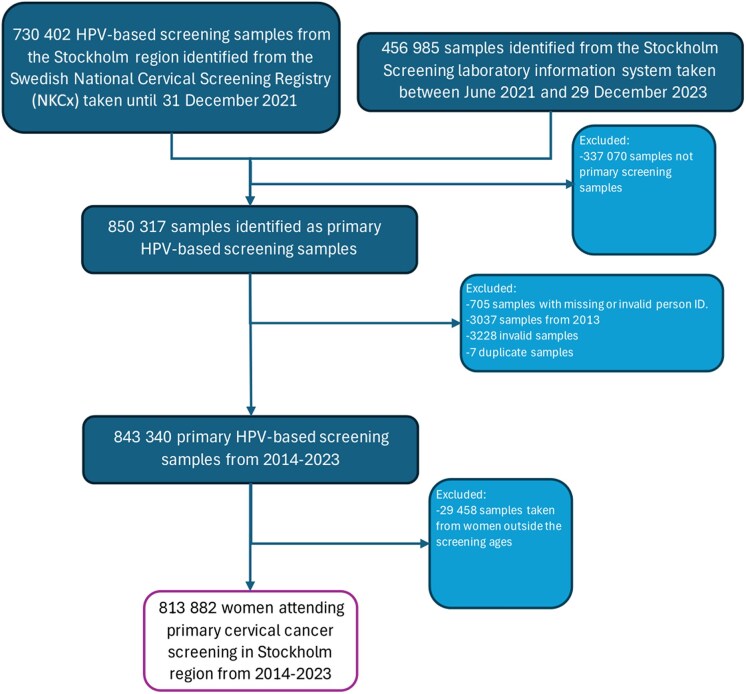
All 813 882 primary HPV-based cervical screening tests from women aged 23-64 years between 2014 and 2023 in the capital region of Sweden were identified in the Swedish National Cervical Screening Registry. The odds ratio (OR) of HPV-16/18 infection was estimated comparing birth cohorts to the unvaccinated 1984-born using an age-period-cohort model. The impact of changing HPV prevalences on the number needed to screen (NNS) to detect and prevent 1 cervical cancer case was calculated.
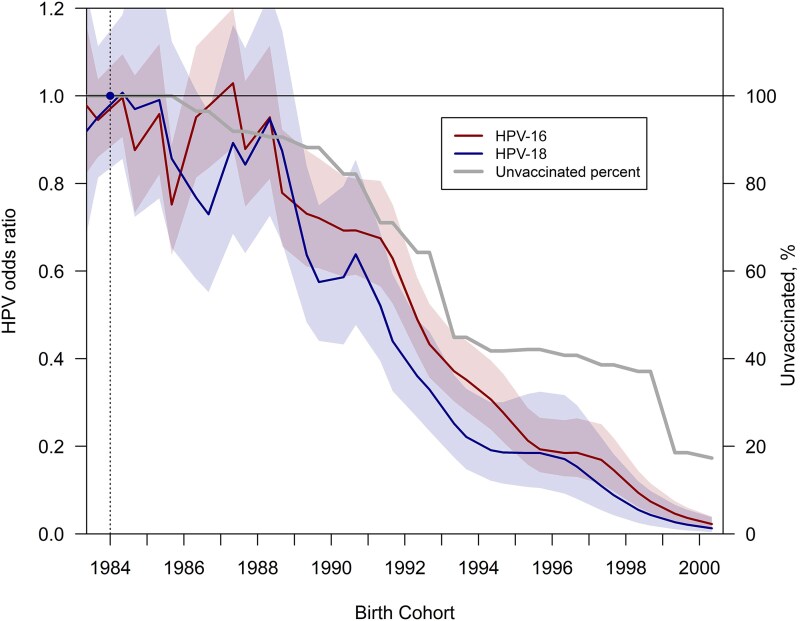
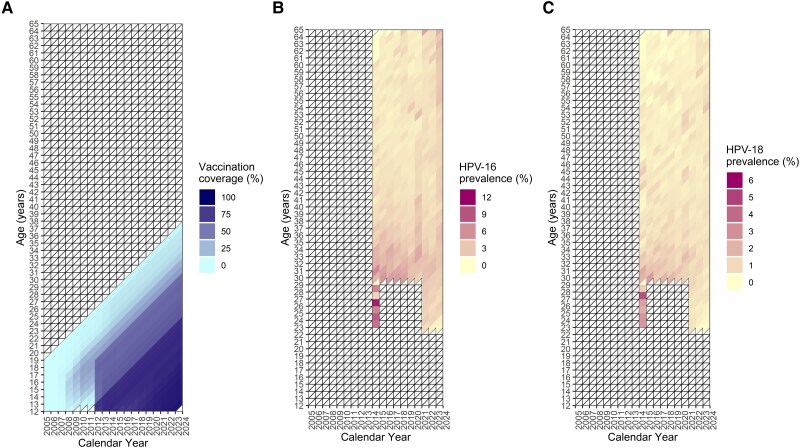
HPV vaccination coverage was 82%-83% among women born in 1999-2000. Before 2019, the HPV-16/18 prevalence was highest among the youngest women. During 2020-2023 the prevalence consistently decreased among the birth cohorts offered organized school-based vaccination. There was a 98% decline in HPV-16 prevalence (OR, 0.02 [95% confidence interval {CI}, .01-.04]) and a 99% decline in HPV-18 prevalence (OR, 0.01 [95% CI, .00-.04]) among the 2000-born compared to the 1984-born. The declining HPV-16/18 prevalences resulted in major increases in the NNS to detect and to prevent 1 case of cervical cancer.
The declines of HPV-16/18 were considerably larger than the vaccination coverage, suggesting herd immunity. The changing epidemiology of HPV types impacts screening needs, necessitating updated screening programs.
世界上大多数国家都已启动人乳头瘤病毒(HPV)疫苗接种计划,且有报告称HPV流行率在下降。我们旨在通过使用年龄-时期-队列模型分析基于人群的宫颈筛查计划中的HPV流行率,来厘清日历时间、出生队列和年龄的影响。
在瑞典国家宫颈筛查登记处中识别出2014年至2023年间瑞典首都地区23至64岁女性的所有813882次基于HPV的初次宫颈筛查检测。使用年龄-时期-队列模型,将出生队列与1984年出生的未接种疫苗者进行比较,估计HPV-16/18感染的比值比(OR)。计算HPV流行率变化对检测和预防1例宫颈癌病例所需筛查人数(NNS)的影响。
1999 - 2000年出生的女性中HPV疫苗接种覆盖率为82% - 83%。2019年之前,最年轻女性中的HPV-16/18流行率最高。在2020 - 2023年期间,接受有组织的学校疫苗接种的出生队列中的流行率持续下降。与1984年出生者相比,2000年出生者中HPV-16流行率下降了98%(OR,0.02 [95%置信区间{CI},0.01 - 0.04]),HPV-18流行率下降了99%(OR,0.01 [95% CI,0.00 - 0.04])。HPV-16/18流行率的下降导致检测和预防1例宫颈癌病例的NNS大幅增加。
HPV-16/18流行率的下降幅度远大于疫苗接种覆盖率,表明存在群体免疫。HPV类型流行病学的变化影响筛查需求,需要更新筛查计划。