Center for Cervical Cancer Prevention, Karolinska University Laboratory, Karolinska University Hospital and Department of Laboratory Medicine, Karolinska Institutet, Stockholm, Sweden.
Regional Cancer Center of Stockholm-Gotland, Cancer Screening Unit, Sweden.
PLoS Med. 2021 Aug 23;18(8):e1003748. doi: 10.1371/journal.pmed.1003748. eCollection 2021 Aug.
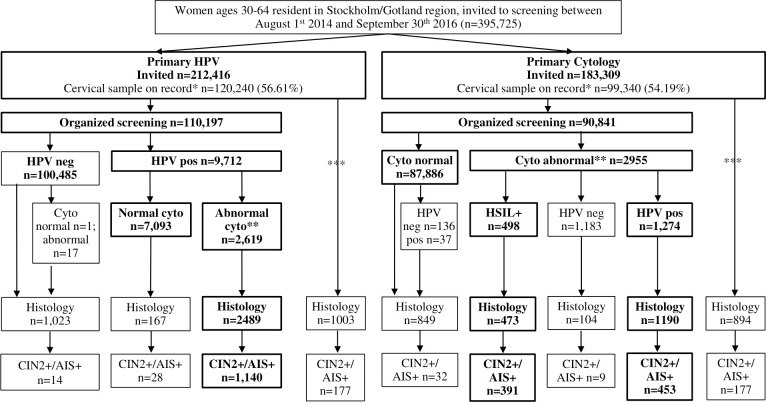
Clinical trials in the research setting have demonstrated that primary human papillomavirus (HPV)-based screening results in greater protection against cervical cancer compared with cytology, but evidence from real-life implementation was missing. To evaluate the effectiveness of HPV-based cervical screening within a real-life screening program, the organized, population-based cervical screening program in the capital region of Sweden offered either HPV- or cytology-based screening in a randomized manner through a randomized healthcare policy (RHP).
A total of 395,725 women aged 30 to 64 years that were invited for their routine cervical screening visit were randomized without blinding to either cytology-based screening with HPV triage (n = 183,309) or HPV-based screening, with cytology triage (n = 212,416 women) between September 1, 2014 and September 30, 2016 and follow-up through June 30, 2017. The main outcome was non-inferior detection rate of cervical intraepithelial neoplasia grade 2 or worse (CIN2+). Secondary outcomes included superiority in CIN2+ detection, screening attendance, and referral to histology. In total, 120,240 had a cervical screening sample on record in the study period in the HPV arm and 99,340 in the cytology arm and were followed for the outcomes of interest. In per-protocol (PP) analyses, the detection rate of CIN2+ was 1.03% (95% confidence interval (CI) 0.98 to 1.10) in the HPV arm and 0.93% (0.87 to 0.99) in the cytology arm (p for non-inferiority <0.0001; odds ratio (OR) 1.11 (95% CI 1.02 to 1.22)). There were 46 cervical cancers detected in the HPV arm (0.04% (0.03 to 0.06)) and 48 cancers detected in the cytology arm (0.05% (0.04 to 0.07)) (p for non-inferiority <0.0001; OR 0.79 (0.53 to 1.18)). Intention-to-screen (ITS) analyses found few differences. In the HPV arm, there was a modestly increased attendance after new invitations (68.56% (68.31 to 68.80) vs. 67.71% (67.43 to 67.98); OR 1.02 (1.00 to 1.03)) and increased rate of referral with completed biopsy (3.89% (3.79 to 4.00) vs. 3.53% (3.42 to 3.65); OR 1.10 (1.05 to 1.15)). The main limitations of this analysis are that only the baseline results are presented, and there was an imbalance in invitations between the study arms.
In this study, we observed that a real-life RHP of primary HPV-based screening was acceptable and effective when evaluated against cytology-based screening, as indicated by comparable participation, referral, and detection rates.
ClinicalTrials.gov NCT01511328.
临床试验研究表明,与细胞学相比,基于原发性人乳头瘤病毒(HPV)的筛查可更有效地预防宫颈癌,但缺乏实际实施的证据。为了评估基于 HPV 的宫颈筛查在实际筛查计划中的有效性,瑞典首都地区有组织的、基于人群的宫颈筛查计划通过一项随机医疗保健政策(RHP)以随机方式提供基于 HPV 或基于细胞学的筛查。
共有 395725 名年龄在 30 至 64 岁之间的女性受邀参加常规宫颈筛查,她们在 2014 年 9 月 1 日至 2016 年 9 月 30 日之间无盲法随机分为细胞学为基础的 HPV 分流筛查组(n=183309)或 HPV 为基础的筛查组,同时进行细胞学分流(n=212416 名女性),并随访至 2017 年 6 月 30 日。主要结局是非 2 级宫颈上皮内瘤变(CIN2+)的检测率。次要结局包括 CIN2+检测的优越性、筛查参与率和转诊至组织学检查的情况。共有 120240 名女性在 HPV 臂和 99340 名女性在细胞学臂的研究期间有宫颈筛查样本记录,并对感兴趣的结局进行了随访。在符合方案(PP)分析中,HPV 臂的 CIN2+检出率为 1.03%(95%置信区间(CI)0.98 至 1.10),细胞学臂为 0.93%(0.87 至 0.99)(非劣效性检验 P<0.0001;比值比(OR)为 1.11(95%CI 1.02 至 1.22))。HPV 臂检测到 46 例宫颈癌(0.04%(0.03 至 0.06)),细胞学臂检测到 48 例癌症(0.05%(0.04 至 0.07))(非劣效性检验 P<0.0001;OR 0.79(0.53 至 1.18))。意向性筛查(ITS)分析发现差异不大。在 HPV 臂中,新邀请后的参与率略有增加(68.56%(68.31 至 68.80)与 67.71%(67.43 至 67.98);OR 1.02(1.00 至 1.03)),并且完成活检的转诊率增加(3.89%(3.79 至 4.00)与 3.53%(3.42 至 3.65);OR 1.10(1.05 至 1.15))。本分析的主要局限性是仅呈现了基线结果,并且研究臂之间的邀请存在不平衡。
本研究表明,在实际环境中,基于原发性 HPV 的筛查与基于细胞学的筛查相比是可接受且有效的,这可从参与率、转诊率和检出率方面得到证实。
ClinicalTrials.gov NCT01511328。