Pan Qi, Tao Yiwen, Cai Tengda, Veluchamy Abi, Hebert Harry L, Zhu Peixi, Haque Mainul, Dottorini Tania, Colvin Lesley A, Smith Blair H, Meng Weihua
Nottingham Ningbo China Beacons of Excellence Research and Innovation Institute, University of Nottingham Ningbo China, Ningbo, 315100, China.
Division of Population Health and Genomics, Ninewells Hospital and Medical School, University of Dundee, Dundee, DD2 4BF, UK.
Sci Rep. 2025 Jan 22;15(1):2812. doi: 10.1038/s41598-025-85871-w.
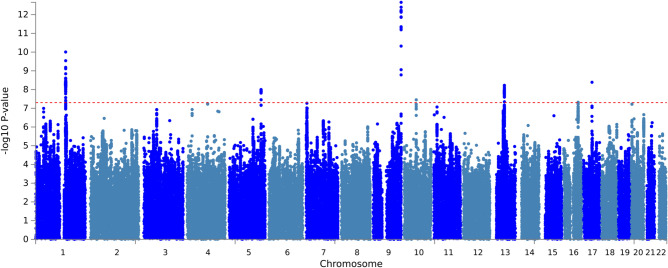
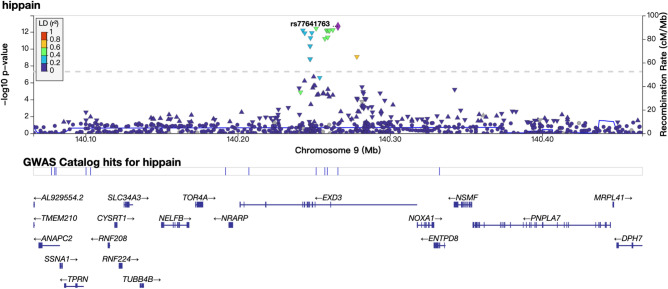
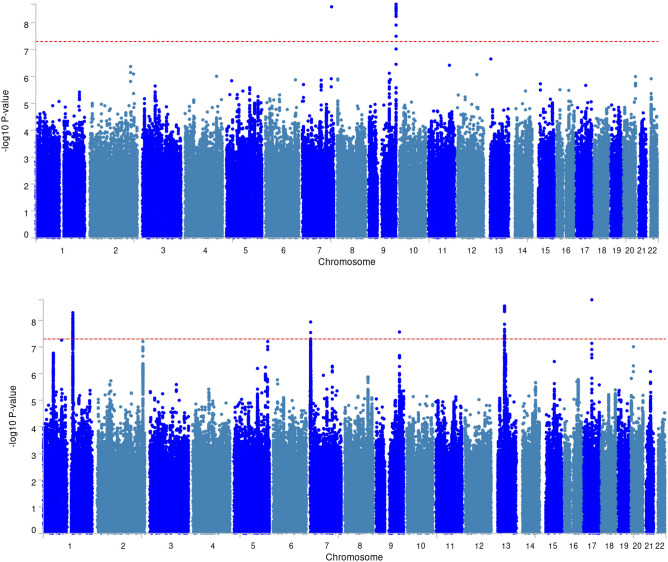
Hip pain is a common musculoskeletal complaint that leads many people to seek medical attention. We conducted a primary genome-wide association study (GWAS) on the hip pain phenotype within the UK Biobank cohort. Sex-stratified GWAS analysis approach was also performed to explore sex specific variants associated with hip pain. We found seven different loci associated with hip pain at GWAS significance level, with the most significant single nucleotide polymorphism (SNP) being rs77641763 within the EXD3 (p value = 2.20 × 10). We utilized summary statistics from the FinnGen cohort and a previous GWAS meta-analysis on hip osteoarthritis as replication cohorts. Four loci (rs509345, rs73581564, rs9597759, rs2018384) were replicated with a p value less than 0.05. Sex-stratified GWAS analyses revealed a unique locus within the CUL1 gene (rs4726995, p = 2.56 × 10) in males, and three unique loci in females: rs1651359966 on chromosome 7 (p = 1.15 × 10), rs552965738 on chromosome 9 (p = 2.72 × 10), and rs1978969 on chromosome 13 (p = 2.87 × 10). This study has identified seven genetic loci associated with hip pain. Sex-stratified analysis also revealed sex specific variants associated with hip pain in males and females. This study has provided a foundation for advancing research of hip pain and hip osteoarthritis.
髋部疼痛是一种常见的肌肉骨骼疾病,导致许多人寻求医疗帮助。我们在英国生物银行队列中对髋部疼痛表型进行了一项全基因组关联研究(GWAS)。还采用了性别分层的GWAS分析方法,以探索与髋部疼痛相关的性别特异性变异。我们在GWAS显著性水平上发现了7个与髋部疼痛相关的不同基因座,最显著的单核苷酸多态性(SNP)是EXD3基因内的rs77641763(p值 = 2.20 × 10)。我们利用芬兰基因队列的汇总统计数据以及先前关于髋骨关节炎的GWAS荟萃分析作为重复队列。4个基因座(rs509345、rs73581564、rs9597759、rs2018384)得到了重复验证,p值小于0.05。性别分层的GWAS分析显示,男性的CUL1基因内有一个独特的基因座(rs4726995,p = 2.56 × 10),女性有三个独特的基因座:7号染色体上的rs1651359966(p = 1.15 × 10)、9号染色体上的rs552965738(p = 2.72 × 10)和13号染色体上的rs1978969(p = 2.87 × 10)。这项研究确定了7个与髋部疼痛相关的基因座。性别分层分析还揭示了男性和女性中与髋部疼痛相关的性别特异性变异。这项研究为推进髋部疼痛和髋骨关节炎的研究奠定了基础。