Balzarini Rhonda N, Sharma Anya, Muise Amy
Department of Psychology, Texas State University, San Marcos, TX 78666, USA.
Kinsey Institute, Indiana University, Bloomington, IN 47405, USA.
Behav Sci (Basel). 2025 Jan 14;15(1):67. doi: 10.3390/bs15010067.
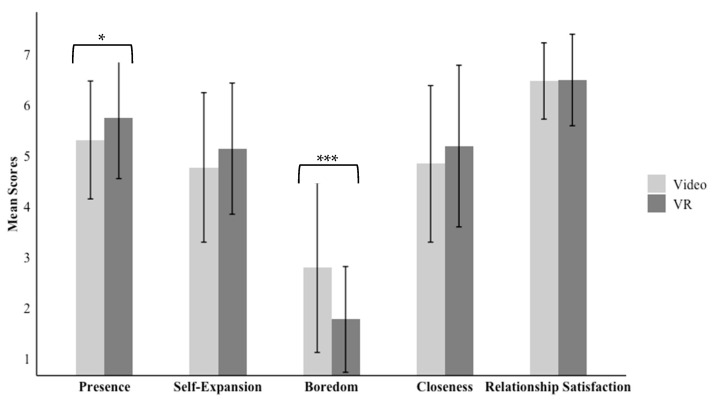
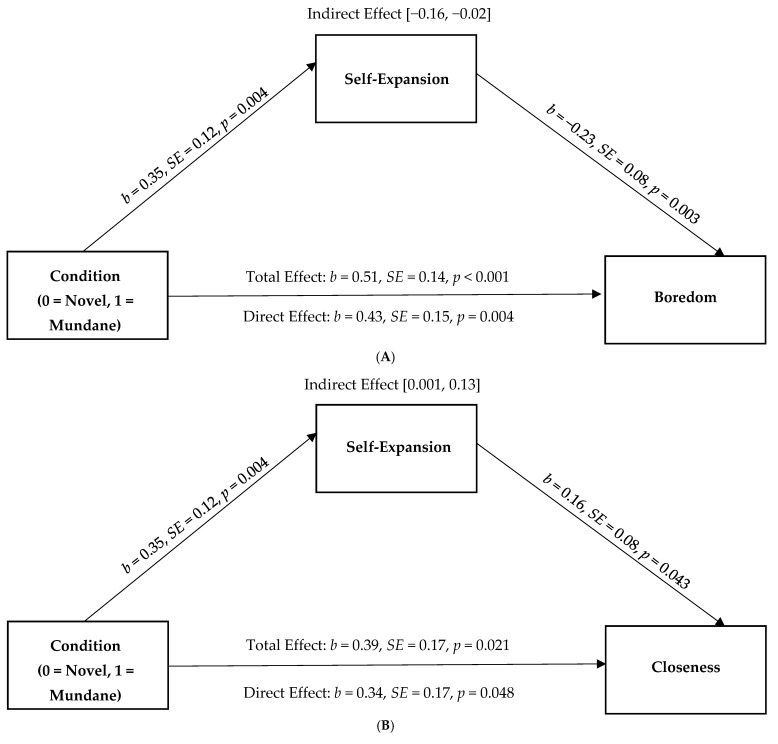
According to self-expansion theory, sharing novel experiences with a romantic partner can help prevent boredom and maintain relationship quality. However, in today's globalized modern world, partners spend less time together and are more likely to live apart than in previous generations, limiting opportunities for shared novel experiences. In two in-lab experiments, we tested whether shared novel activities in virtual reality (VR) could facilitate self-expansion, reduce boredom, and enhance relationship quality. In Study 1, couples ( = 183) engaged in a shared novel and exciting activity in either VR or over video. Participants in the VR condition reported greater presence (i.e., felt like they were in the same space as their partner) and were less bored during the interaction compared to the video condition, though no main effects emerged for reports of self-expansion or relationship quality (relationship satisfaction and closeness). Consistent with predictions, people who reported more presence, in turn, reported greater self-expansion, less boredom, and greater relationship quality. In Study 2, couples ( = 141) engaged in a novel and exciting or a mundane experience in VR. Results were mixed such that participants in the novel VR condition reported less boredom and greater closeness post-interaction, though no effects emerged for self-expansion or relationship satisfaction. In exploratory analyses accounting for immersion, couples who engaged in the novel virtual experience reported more self-expansion, less boredom, and greater closeness. The findings suggest that virtual interactions may have less potential than in-person interaction to promote self-expansion but offer interesting future directions given VR's ability to enhance presence beyond video interactions.
根据自我扩展理论,与浪漫伴侣分享新奇经历有助于预防厌倦并维持关系质量。然而,在当今全球化的现代世界中,与前几代人相比,伴侣们在一起的时间更少,而且更有可能分开生活,这限制了共同体验新奇经历的机会。在两项实验室实验中,我们测试了虚拟现实(VR)中的共同新奇活动是否能促进自我扩展、减少厌倦并提升关系质量。在研究1中,183对情侣参与了在VR中或通过视频进行的一项共同新奇且刺激的活动。与视频组相比,VR组的参与者报告有更强的身临其境感(即感觉自己与伴侣处于同一空间),并且在互动过程中不那么无聊,不过在自我扩展或关系质量(关系满意度和亲密程度)的报告方面没有出现主效应。与预测一致的是,报告有更强身临其境感的人,相应地报告有更大的自我扩展、更少的厌倦以及更高的关系质量。在研究2中,141对情侣在VR中参与了一次新奇刺激或平淡无奇的体验。结果喜忧参半,即新奇VR组的参与者在互动后报告有更少的厌倦和更高的亲密程度,不过在自我扩展或关系满意度方面没有出现效应。在考虑沉浸感的探索性分析中,参与新奇虚拟体验的情侣报告有更多的自我扩展、更少的厌倦以及更高的亲密程度。研究结果表明,虚拟互动促进自我扩展的潜力可能不如面对面互动,但鉴于VR增强身临其境感的能力超过视频互动,它提供了有趣的未来研究方向。