El Basbasse Yasmin, Packheiser Julian, Peterburs Jutta, Maymon Christopher, Güntürkün Onur, Grimshaw Gina, Ocklenburg Sebastian
Department of Biopsychology, Faculty of Psychology, Institute of Cognitive Neuroscience, Ruhr-University Bochum, Universitätsstrasse 150, 44780 Bochum, Germany.
Netherlands Institute for Neuroscience, Social Brain Lab, 1105 BA Amsterdam, The Netherlands.
R Soc Open Sci. 2023 May 31;10(5):221239. doi: 10.1098/rsos.221239. eCollection 2023 May.
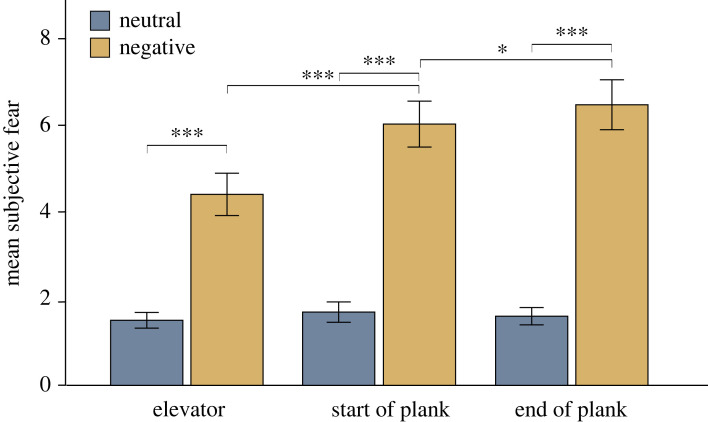
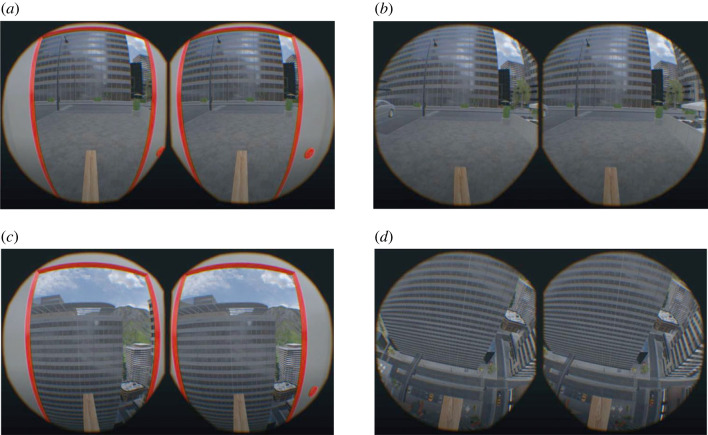
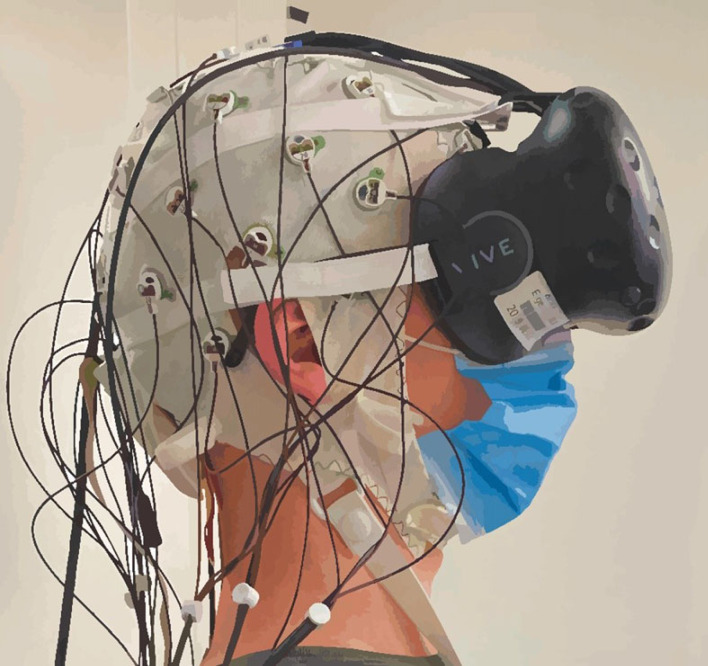
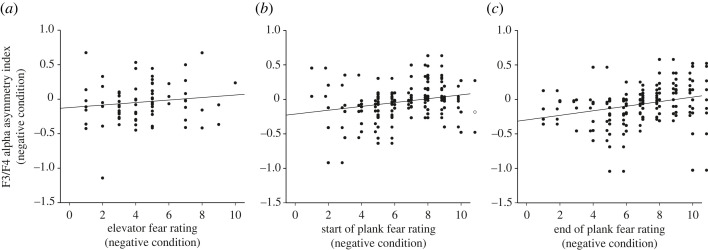
Most studies on emotion processing induce emotions through images or films. However, this method lacks ecological validity, limiting generalization to real-life emotion processing. More realistic paradigms using virtual reality (VR) may be better suited to investigate authentic emotional states and their neuronal correlates. This pre-registered study examines the neuronal underpinnings of naturalistic fear, measured using mobile electroencephalography (EEG). Seventy-five healthy participants walked across a virtual plank which extended from the side of a skyscraper-either 80 storeys up (the negative condition) or at street level (the neutral condition). Subjective ratings showed that the negative condition induced feelings of fear. Following the VR experience, participants passively viewed negative and neutral images from the international affective picture system (IAPS) outside of VR. We compared frontal alpha asymmetry between the plank and IAPS task and across valence of the conditions. Asymmetry indices in the plank task revealed greater right-hemispheric lateralization during the negative VR condition, relative to the neutral VR condition and to IAPS viewing. Within the IAPS task, no significant asymmetries were detected. In summary, our findings indicate that immersive technologies such as VR can advance emotion research by providing more ecologically valid ways to induce emotion.
大多数关于情绪处理的研究通过图像或电影来诱发情绪。然而,这种方法缺乏生态效度,限制了对现实生活中情绪处理的推广。使用虚拟现实(VR)的更现实范式可能更适合研究真实的情绪状态及其神经关联。这项预先注册的研究使用移动脑电图(EEG)测量了自然主义恐惧的神经基础。75名健康参与者走过一块从摩天大楼侧面伸出的虚拟木板——要么在80层楼高的地方(消极条件),要么在街道层面(中性条件)。主观评分显示消极条件诱发了恐惧情绪。在虚拟现实体验之后,参与者在虚拟现实之外被动观看了国际情感图片系统(IAPS)中的消极和中性图像。我们比较了木板任务和IAPS任务之间以及不同条件效价下的额叶α波不对称性。木板任务中的不对称指数显示,与中性虚拟现实条件和观看IAPS相比,在消极虚拟现实条件下右半球的偏侧化程度更高。在IAPS任务中,未检测到显著的不对称性。总之,我们的研究结果表明,虚拟现实等沉浸式技术可以通过提供更具生态效度的方式来诱发情绪,从而推动情绪研究。