Moreno Rueda Luz Yurany, Wang Hua, Akagi Keiko, Dang Minghao, Vora Amishi, Qin Li, Lee Hans C, Patel Krina K, Lin Pei, Mery David E, Zhan Fenghuang, Shaughnessy John D, Yi Qing, Song Yang, Jiang Bo, Gillison Maura L, Thomas Sheeba K, Weber Donna M, Diao Lixia, Wang Jing, Kuiatse Isere, Manasanch Elisabet E, Symer David E, Orlowski Robert Z
Department of Lymphoma and Myeloma, The University of Texas MD Anderson Cancer Center, Houston, TX, USA.
Department of Thoracic-Head & Neck Medical Oncology, The University of Texas MD Anderson Cancer Center, Houston, TX, USA.
Cell Rep Med. 2025 Feb 18;6(2):101925. doi: 10.1016/j.xcrm.2024.101925. Epub 2025 Jan 23.
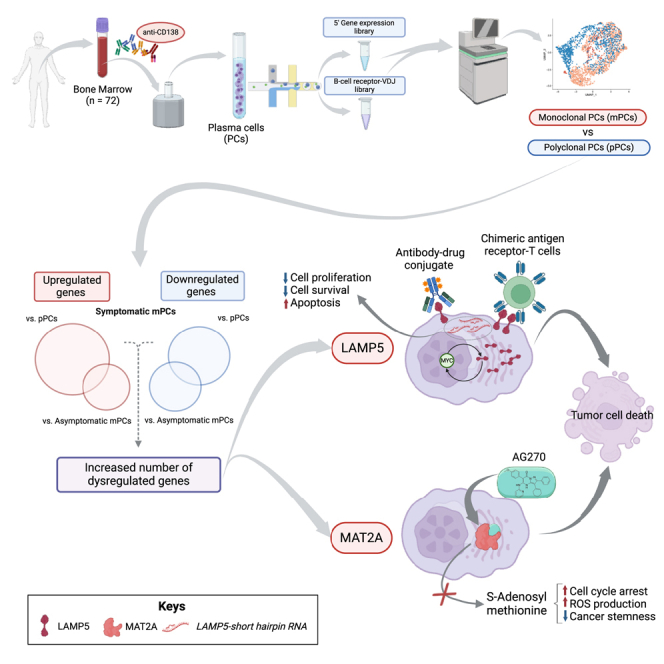
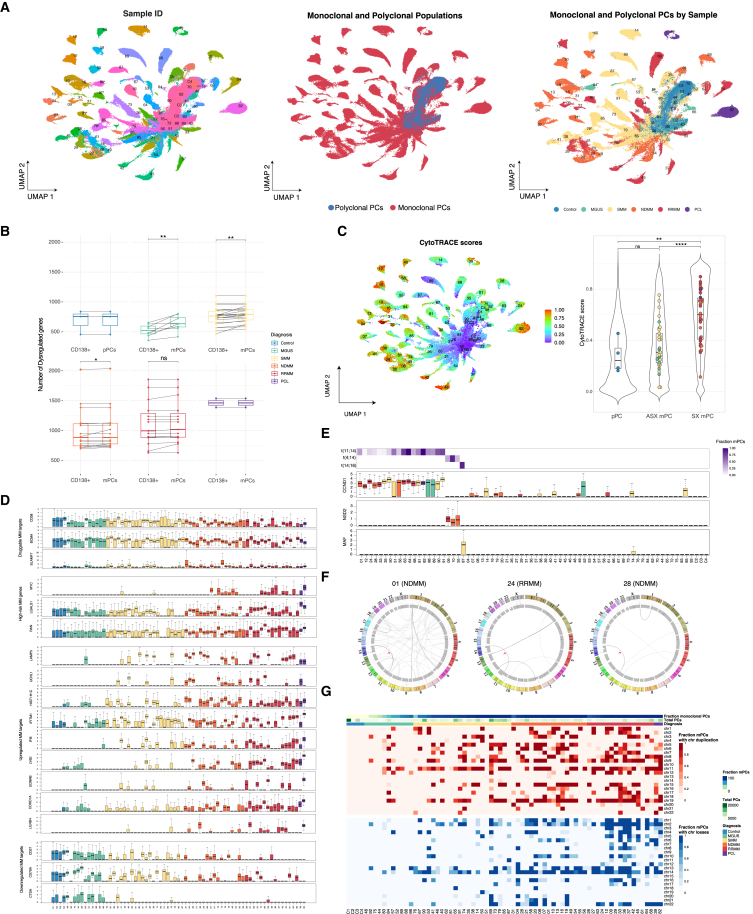
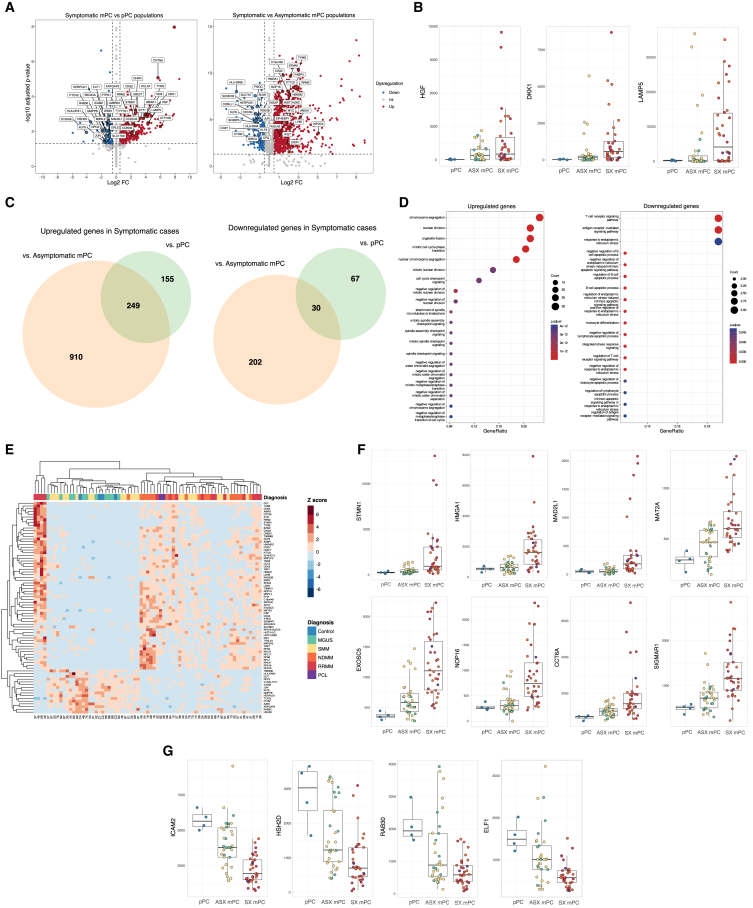
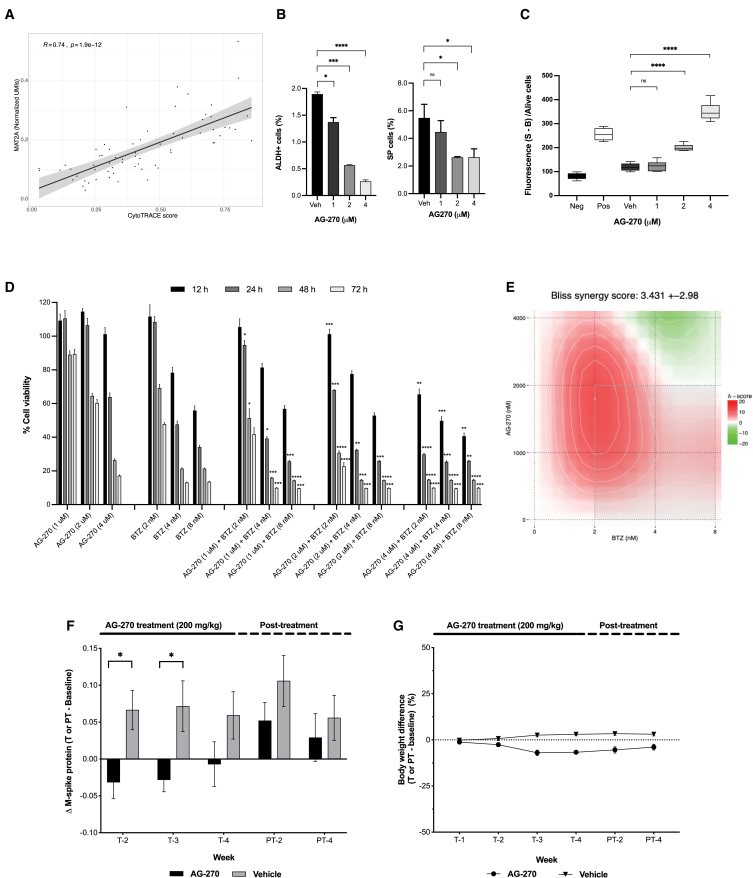
Multiple myeloma is a clonal plasma cell (PC) dyscrasia that arises from precursors and has been studied utilizing approaches focused on CD138 cells. By combining single-cell RNA sequencing (scRNA-seq) with scB-cell receptor sequencing (scBCR-seq), we differentiate monoclonal/neoplastic from polyclonal/normal PCs and find more dysregulated genes, especially in precursor patients, than we would have by analyzing bulk PCs. To determine whether this approach can identify oncogenes that contribute to disease pathobiology, mitotic arrest deficient-2 like-1 (MAD2L1) and S-adenosylmethionine synthase isoform type-2 (MAT2A) are validated as targets with drug-like molecules that suppress myeloma growth in preclinical models. Moreover, functional studies show a role of lysosomal-associated membrane protein family member-5 (LAMP5), which is uniquely expressed in neoplastic PCs, in tumor progression and aggressiveness via interactions with c-MYC. Finally, a monoclonal antibody recognizing cell-surface LAMP5 shows efficacy as an antibody-drug conjugate and in a chimeric antigen receptor-guided T-cell format. These studies provide additional insights into myeloma biology and identify potential targeted therapeutic approaches that can be applied to reverse myeloma progression.
多发性骨髓瘤是一种起源于前体细胞的克隆性浆细胞发育异常疾病,此前一直通过聚焦于CD138细胞的方法进行研究。通过将单细胞RNA测序(scRNA-seq)与scB细胞受体测序(scBCR-seq)相结合,我们能够区分单克隆/肿瘤性浆细胞与多克隆/正常浆细胞,并发现了更多失调基因,尤其是在前体患者中,这比分析整体浆细胞所发现的失调基因更多。为了确定这种方法是否能够识别出对疾病病理生物学有贡献的致癌基因,有丝分裂阻滞缺陷2样1(MAD2L1)和S-腺苷甲硫氨酸合成酶同工型2(MAT2A)被验证为靶点,使用在临床前模型中能够抑制骨髓瘤生长的类药物分子。此外,功能研究表明,溶酶体相关膜蛋白家族成员5(LAMP5)在肿瘤进展和侵袭性中发挥作用,它在肿瘤性浆细胞中独特表达,并通过与c-MYC相互作用来实现这一功能。最后,一种识别细胞表面LAMP5的单克隆抗体在作为抗体药物偶联物以及嵌合抗原受体引导的T细胞形式时均显示出疗效。这些研究为骨髓瘤生物学提供了更多见解,并确定了可用于逆转骨髓瘤进展的潜在靶向治疗方法。