Ng Chun Wai, Wong Kwong-Kwok, Lawson Barrett C, Ferri-Borgogno Sammy, Mok Samuel C
Department of Gynecologic Oncology and Reproductive Medicine, Unit 1362, The University of Texas MD Anderson Cancer Center, 1515 Holcombe Blvd, Houston, TX, 77030, USA.
Department of Anatomical Pathology, The University of Texas MD Anderson Cancer Center, Houston, TX, 77030, USA.
J Transl Med. 2025 Jan 24;23(1):113. doi: 10.1186/s12967-024-06007-8.
The ability to predict the prognosis of patients with ovarian cancer can greatly improve disease management. However, the knowledge on the mechanism of the prediction is limited. We sought to deconvolute the attention feature learnt by a deep learning convolutional neural networks trained with whole-slide images (WSIs) of hematoxylin-and-eosin (H&E)-stained tumor samples using spatial transcriptomic data.
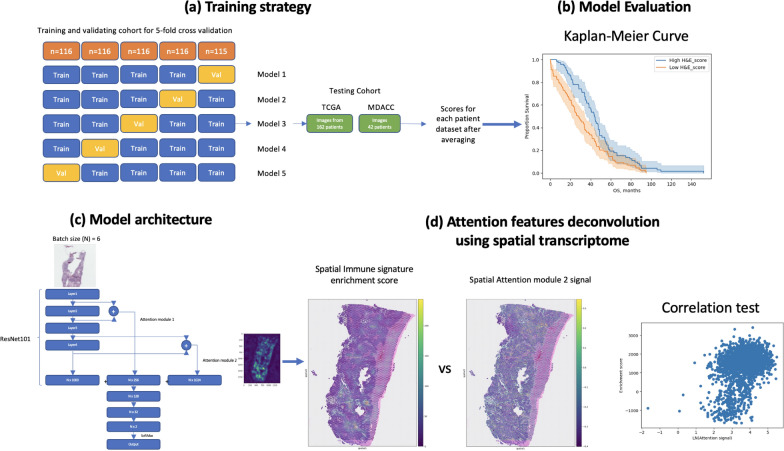
In this study, 773 WSIs of H&E-stained tumor sections from 335 patients with treatment naïve high-grade serous ovarian cancer who were included in The Cancer Genome Atlas (TCGA) Pan-Cancer study were used to train, and validate, and to test a ResNet101 CNN model modified with attention mechanism. WSIs from patients in an independent cohort were used to further evaluate the model.
The prognostic value of the predicted H&E-based survival scores from the trained model on patient survival was evaluated. The attention signals learnt by the model were then examined their correlation with immune signatures using spatial transcriptome. After validating the model with the testing datasets, pathway enrichment analysis showed that the H&E-based survival score significantly correlated with certain immune signatures and this was validated spatially using spatial transcriptome data generated from ovarian cancer FFPE samples by correlating the selected signature and attention signal.
In conclusion, attention mechanism might be useful to identify regions for their specific immune activities. This could guide future pathological study for the useful immunological features that are important in modulating the prognosis of ovarian cancer patients.
预测卵巢癌患者预后的能力可极大地改善疾病管理。然而,关于预测机制的知识有限。我们试图利用空间转录组数据对通过苏木精和伊红(H&E)染色的肿瘤样本的全切片图像(WSIs)训练的深度学习卷积神经网络所学习到的注意力特征进行解卷积。
在本研究中,来自癌症基因组图谱(TCGA)泛癌研究中335例未经治疗的高级别浆液性卵巢癌患者的773张H&E染色肿瘤切片的WSIs用于训练、验证和测试经注意力机制修改的ResNet101卷积神经网络(CNN)模型。来自独立队列患者的WSIs用于进一步评估该模型。
评估了训练模型基于H&E预测的生存分数对患者生存的预后价值。然后使用空间转录组检查模型学习到的注意力信号与免疫特征的相关性。在用测试数据集验证模型后,通路富集分析表明基于H&E的生存分数与某些免疫特征显著相关,并且通过将所选特征与注意力信号相关联,使用从卵巢癌福尔马林固定石蜡包埋(FFPE)样本生成的空间转录组数据在空间上进行了验证。
总之,注意力机制可能有助于识别具有特定免疫活性的区域。这可为未来病理研究提供指导,寻找对调节卵巢癌患者预后重要的有用免疫特征。