Rad Sima Kianpour, Yeo Kenny K L, Li Runhao, Wu Fangmeinuo, Liu Saifei, Nourmohammadi Saeed, Murphy William M, Tomita Yoko, Price Timothy J, Ingman Wendy V, Townsend Amanda R, Smith Eric
Solid Tumour Group, Basil Hetzel Institute for Translational Health Research, The Queen Elizabeth Hospital, Central Adelaide Local Health Network, Woodville South, Adelaide, SA 5011, Australia.
Adelaide Medical School, The University of Adelaide, Adelaide, SA 5005, Australia.
Biomolecules. 2025 Jan 3;15(1):55. doi: 10.3390/biom15010055.
Triple-negative breast cancer (TNBC) is an aggressive subtype with limited treatment options and high resistance to chemotherapy. Doxorubicin is commonly used, but its efficacy is limited by variable sensitivity and resistance. Bacopaside II, a saponin compound, has shown anti-cancer potential. This study evaluates the effects of doxorubicin and bacopaside II, both individually and in combination, across TNBC subtypes to explore mechanisms of resistance and enhanced drug efficacy.
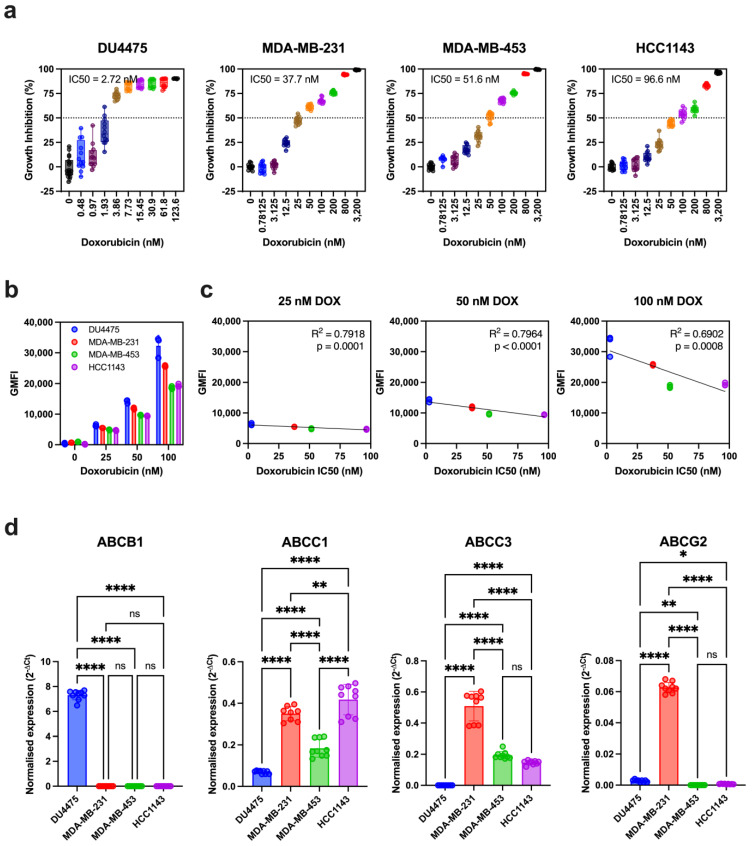
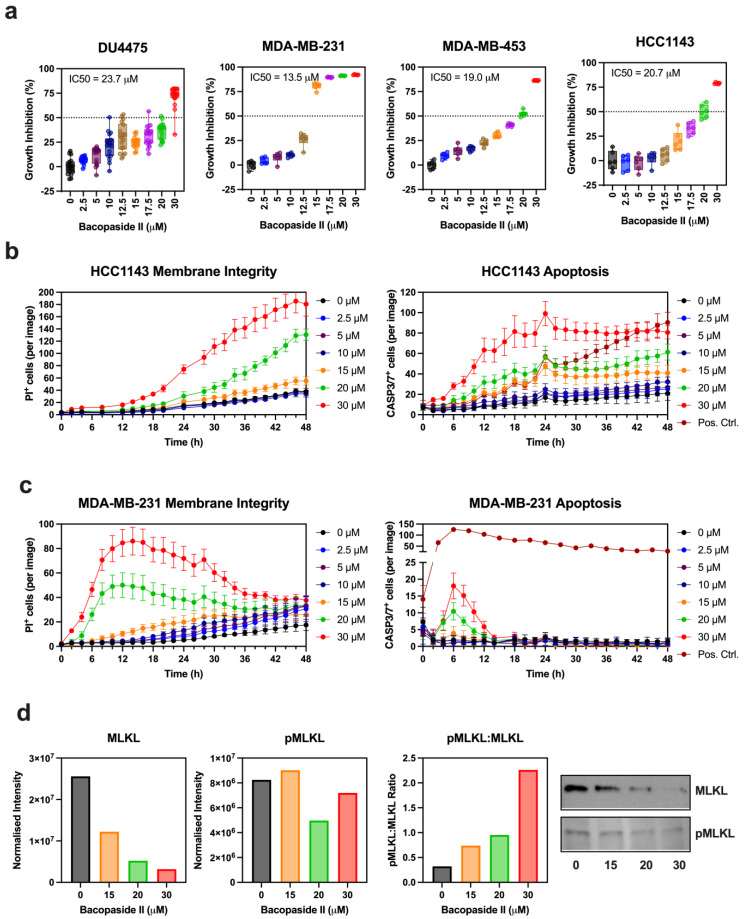
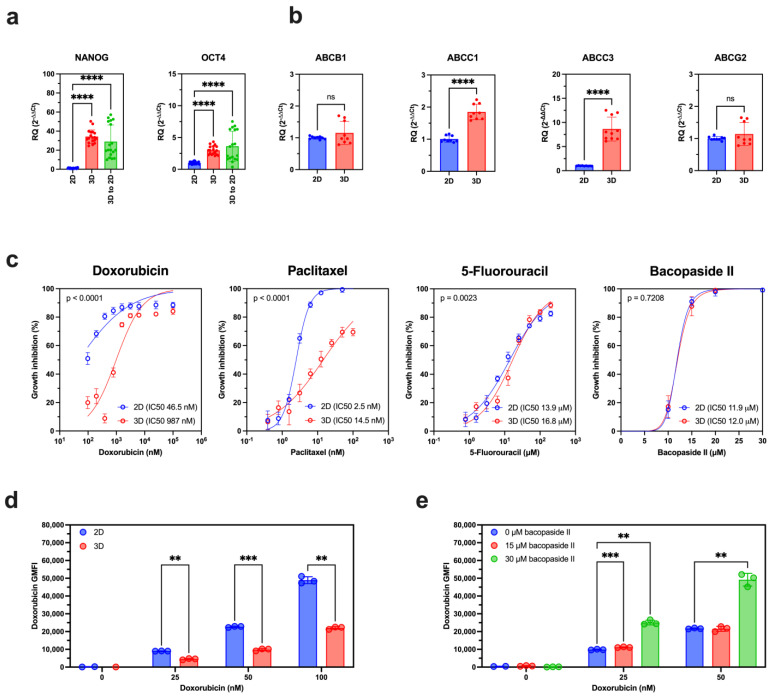
The growth-inhibitory effects of doxorubicin and bacopaside II were assessed in four TNBC cell lines. IC50 values were determined using dose-response assays, and doxorubicin accumulation was measured via spectral flow cytometry. ATP-binding cassette (ABC) transporter expression (, , , and ) was analyzed for correlations with drug sensitivity. In silico docking assessed the binding affinity of bacopaside II to ABC transporters. A 3D culture model simulated drug-resistant TNBC, and combination effects were evaluated with live-cell imaging.
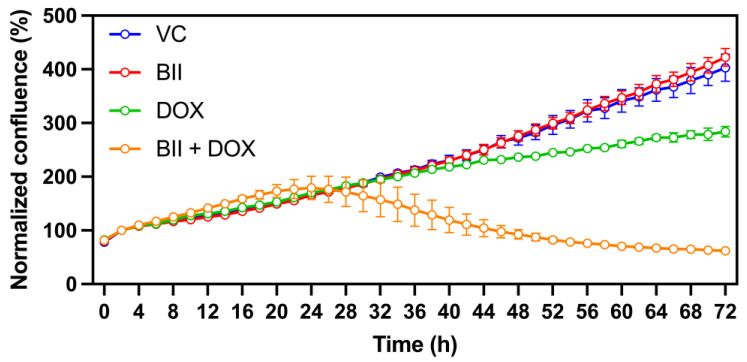
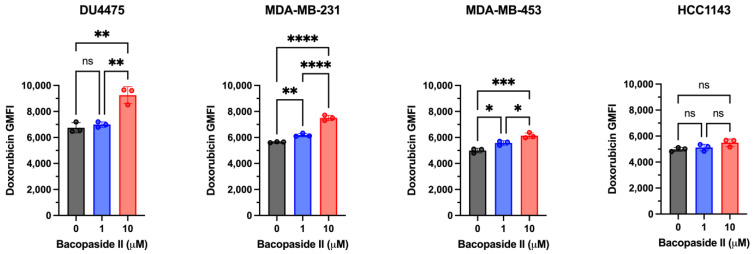
Doxorubicin sensitivity varied across TNBC molecular subtypes, correlating to intracellular accumulation. Bacopaside II inhibited growth across subtypes, inducing apoptosis in sensitive cells and necrosis in resistant cells. Bacopaside II increased doxorubicin accumulation, independent of P-glycoprotein (), possibly through interactions with other ABC transporters. In drug-resistant 3D cultures, bacopaside II maintained efficacy and enhanced doxorubicin accumulation, counteracting ABC transporter-mediated resistance. The doxorubicin and bacopaside II combination showed synergistic growth inhibition.
Bacopaside II enhances doxorubicin efficacy in TNBC by increasing drug accumulation and overcoming ABC transporter-mediated resistance, suggesting its potential as an adjuvant in TNBC treatment. These findings support further investigation of bacopaside II, particularly for resistant TNBC subtypes.
三阴性乳腺癌(TNBC)是一种侵袭性亚型,治疗选择有限且对化疗高度耐药。多柔比星是常用药物,但其疗效受敏感性和耐药性差异的限制。胡颓子苷II是一种皂苷化合物,已显示出抗癌潜力。本研究评估多柔比星和胡颓子苷II单独及联合应用对TNBC各亚型的影响,以探索耐药机制和增强药物疗效。
在四种TNBC细胞系中评估多柔比星和胡颓子苷II的生长抑制作用。使用剂量反应测定法确定IC50值,并通过光谱流式细胞术测量多柔比星的蓄积量。分析ATP结合盒(ABC)转运蛋白表达(、、和)与药物敏感性的相关性。计算机对接评估胡颓子苷II与ABC转运蛋白的结合亲和力。三维培养模型模拟耐药性TNBC,并通过活细胞成像评估联合作用。
多柔比星敏感性在TNBC分子亚型间存在差异,与细胞内蓄积相关。胡颓子苷II抑制各亚型的生长,在敏感细胞中诱导凋亡,在耐药细胞中诱导坏死。胡颓子苷II增加多柔比星的蓄积,独立于P-糖蛋白(),可能通过与其他ABC转运蛋白相互作用实现。在耐药三维培养物中,胡颓子苷II维持疗效并增强多柔比星的蓄积,抵消ABC转运蛋白介导的耐药性。多柔比星与胡颓子苷II联合显示出协同生长抑制作用。
胡颓子苷II通过增加药物蓄积和克服ABC转运蛋白介导的耐药性增强多柔比星在TNBC中的疗效,表明其作为TNBC治疗辅助药物的潜力。这些发现支持进一步研究胡颓子苷II,特别是针对耐药性TNBC亚型。