Gong Wei, Lubawy Jan, Marciniak Paweł, Smagghe Guy, Słocińska Małgorzata, Liu Dongdong, Liu Tongxian, Gui Shunhua
Guizhou Provincial Key Laboratory for Agricultural Pest Management of the Mountainous Region, Institute of Entomology, Guizhou University, Guiyang 550025, China.
Department of Animal Physiology and Developmental Biology, Faculty of Biology, Institute of Experimental Biology, Adam Mickiewicz University in Poznań, 61-0614 Poznań, Poland.
Int J Mol Sci. 2025 Jan 15;26(2):691. doi: 10.3390/ijms26020691.
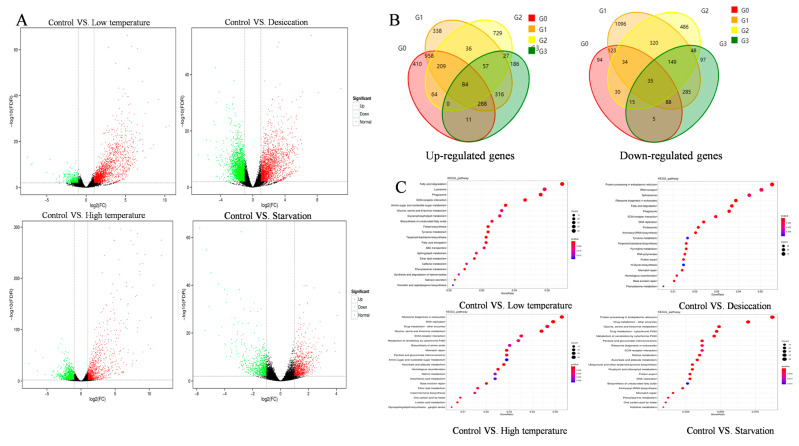
The fall armyworm, , is one of the most notorious pest insects, causing damage to more than 350 plant species, and is feared worldwide as an invasive pest species since it exhibits high adaptivity against environmental stress. Here, we therefore investigated its transcriptome responses to four different types of stresses, namely cold, heat, no water and no food. We used brain samples as our interest was in the neuroendocrine responses, while previous studies used whole bodies of larvae or moths. In general, the responses were complex and encompassed a vast array of neuropeptides (NPs) and biogenic amines (BAs). The NPs were mainly involved in ion homeostasis regulation (ITP and ITPL) and metabolic pathways (AKH, ILP), and this was accompanied by changes in BA (DA, OA) biosynthesis. Cold and no-water stress changed the NP gene expression with the same patterns of expression but clearly separated from each other, and the most divergent pattern of expression was shown after no-food stress. In conclusion, our data provide a foundation in an important model and pest insect with candidate NPs and BAs and other marker candidate genes in response to environmental stress, and also potential new targets to manage pest insects.
草地贪夜蛾是最臭名昭著的害虫之一,会对350多种植物造成损害,并且由于其对环境压力具有高度适应性,作为一种入侵害虫而令全球担忧。因此,我们在此研究了其对四种不同类型胁迫的转录组反应,即寒冷、炎热、无水和无食物。我们使用脑部样本,因为我们关注的是神经内分泌反应,而之前的研究使用的是幼虫或蛾子的整个身体。总体而言,这些反应很复杂,涉及大量神经肽(NPs)和生物胺(BAs)。神经肽主要参与离子稳态调节(ITP和ITPL)和代谢途径(AKH、ILP),同时伴随着生物胺(DA、OA)生物合成的变化。寒冷和无水胁迫改变神经肽基因表达的模式相同,但彼此明显分开,无食物胁迫后显示出最不同的表达模式。总之,我们的数据为一种重要的模式害虫昆虫提供了基础,其中包含应对环境胁迫的候选神经肽和生物胺以及其他标记候选基因,也为害虫治理提供了潜在的新靶点。