• 文献检索
  • 文档翻译
  • 深度研究
  • 学术资讯
  • Suppr Zotero 插件Zotero 插件
  • 邀请有礼
  • 套餐&价格
  • 历史记录
应用&插件
Suppr Zotero 插件Zotero 插件浏览器插件Mac 客户端Windows 客户端微信小程序
定价
高级版会员购买积分包购买API积分包
服务
文献检索文档翻译深度研究API 文档MCP 服务
关于我们
关于 Suppr公司介绍联系我们用户协议隐私条款
关注我们

Suppr 超能文献

核心技术专利:CN118964589B侵权必究
粤ICP备2023148730 号-1Suppr @ 2026

文献检索

告别复杂PubMed语法,用中文像聊天一样搜索,搜遍4000万医学文献。AI智能推荐,让科研检索更轻松。

立即免费搜索

文件翻译

保留排版,准确专业,支持PDF/Word/PPT等文件格式,支持 12+语言互译。

免费翻译文档

深度研究

AI帮你快速写综述,25分钟生成高质量综述,智能提取关键信息,辅助科研写作。

立即免费体验

一种基于改进型DenseNet121的自动宫颈细胞分类模型。

An automatic cervical cell classification model based on improved DenseNet121.

作者信息

Zhang Yue, Ning Chunyu, Yang Wenjing

机构信息

Department of Biomedical Engineering, School of Life Science and Technology, Changchun University of Science and Technology, Changchun, 130022, China.

出版信息

Sci Rep. 2025 Jan 25;15(1):3240. doi: 10.1038/s41598-025-87953-1.

DOI:10.1038/s41598-025-87953-1
PMID:39863704
原文链接:https://pmc.ncbi.nlm.nih.gov/articles/PMC11762993/
Abstract

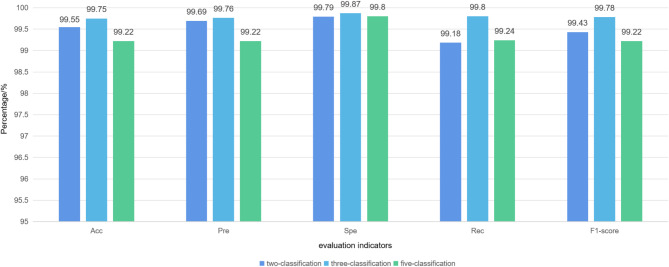
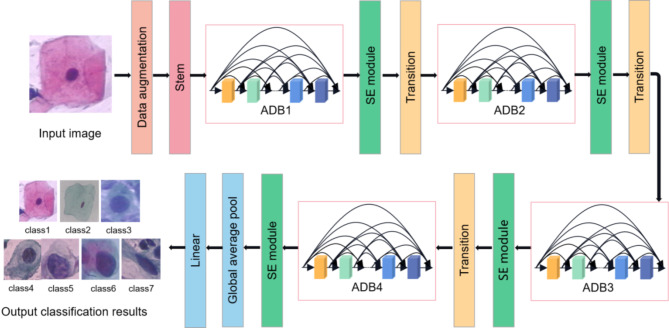
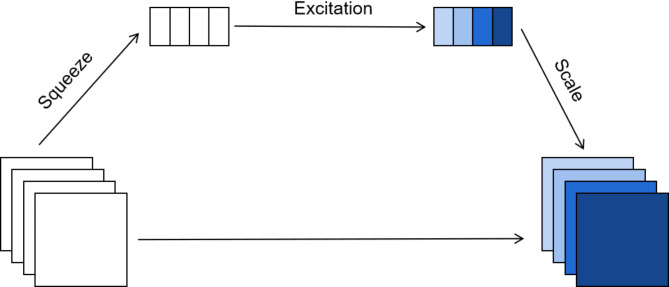
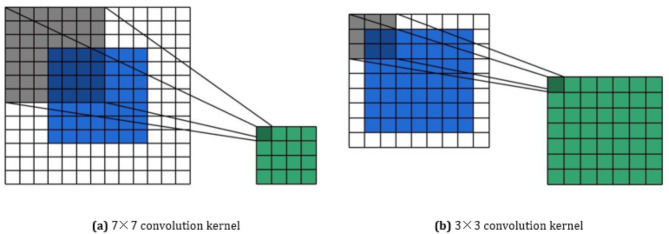
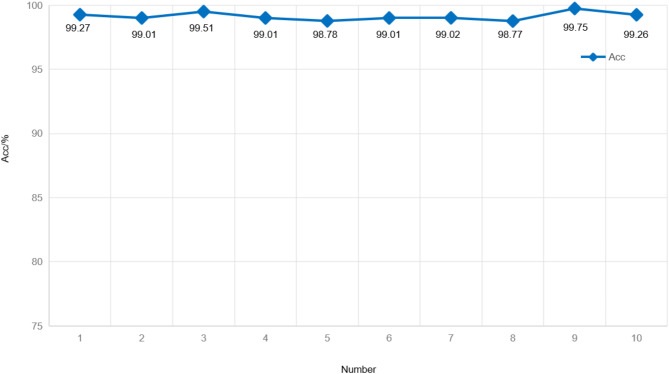
The cervical cell classification technique can determine the degree of cellular abnormality and pathological condition, which can help doctors to detect the risk of cervical cancer at an early stage and improve the cure and survival rates of cervical cancer patients. Addressing the issue of low accuracy in cervical cell classification, a deep convolutional neural network A2SDNet121 is proposed. A2SDNet121 takes DenseNet121 as the backbone network. Firstly, the SE module is embedded in DenseNet121 to increase the model's focus on the nucleus region, which contains important diagnostic information, and reduce the focus on redundant information. Secondly, the sizes of the convolutional kernel and pooling window of the Stem layer are adjusted to adapt to the characteristics of the cervical cell images, so that the model can extract the local detailed information more effectively. Finally, the Atrous Dense Block (ADB) is constructed, and four ADB modules are integrated into DenseNet121 to enable the model to acquire global and local salient feature information. The accuracy of A2SDNet121 for two and seven-classification tasks on the Herlev dataset is 99.75% and 99.14%, respectively. The accuracy for two, three, and five-classification tasks on the SIPaKMeD dataset reaches 99.55%, 99.75% and 99.22%, respectively. Compared with other state-of-the-art algorithms, the A2SDNet121 model performs better in the multi-classification task of cervical cells, which can significantly improve the accuracy and efficiency of cervical cancer screening.

摘要

宫颈细胞分类技术能够确定细胞异常程度和病理状况,这有助于医生在早期检测出宫颈癌风险,并提高宫颈癌患者的治愈率和生存率。针对宫颈细胞分类准确性低的问题,提出了一种深度卷积神经网络A2SDNet121。A2SDNet121以DenseNet121作为骨干网络。首先,在DenseNet121中嵌入SE模块,以增强模型对包含重要诊断信息的细胞核区域的关注,并减少对冗余信息的关注。其次,调整Stem层的卷积核大小和池化窗口大小,以适应宫颈细胞图像的特征,使模型能够更有效地提取局部细节信息。最后,构建空洞密集块(ADB),并将四个ADB模块集成到DenseNet121中,使模型能够获取全局和局部显著特征信息。A2SDNet121在Herlev数据集上进行二分类和七分类任务的准确率分别为99.75%和99.14%。在SIPaKMeD数据集上进行二分类、三分类和五分类任务的准确率分别达到99.55%、99.75%和99.22%。与其他现有算法相比,A2SDNet121模型在宫颈细胞多分类任务中表现更优,能够显著提高宫颈癌筛查的准确性和效率。
https://cdn.ncbi.nlm.nih.gov/pmc/blobs/1a09/11762993/f8a9427688fb/41598_2025_87953_Fig16_HTML.jpg
https://cdn.ncbi.nlm.nih.gov/pmc/blobs/1a09/11762993/c6d555ba51f9/41598_2025_87953_Fig1_HTML.jpg
https://cdn.ncbi.nlm.nih.gov/pmc/blobs/1a09/11762993/e1e935bcd291/41598_2025_87953_Fig2_HTML.jpg
https://cdn.ncbi.nlm.nih.gov/pmc/blobs/1a09/11762993/a9f690621a89/41598_2025_87953_Fig3_HTML.jpg
https://cdn.ncbi.nlm.nih.gov/pmc/blobs/1a09/11762993/e357c8c4e244/41598_2025_87953_Fig4_HTML.jpg
https://cdn.ncbi.nlm.nih.gov/pmc/blobs/1a09/11762993/466163dde3f6/41598_2025_87953_Fig5_HTML.jpg
https://cdn.ncbi.nlm.nih.gov/pmc/blobs/1a09/11762993/26a04998d2dc/41598_2025_87953_Fig6_HTML.jpg
https://cdn.ncbi.nlm.nih.gov/pmc/blobs/1a09/11762993/9203f4980842/41598_2025_87953_Fig7_HTML.jpg
https://cdn.ncbi.nlm.nih.gov/pmc/blobs/1a09/11762993/4c10359a3ddf/41598_2025_87953_Fig8_HTML.jpg
https://cdn.ncbi.nlm.nih.gov/pmc/blobs/1a09/11762993/e46354eb532e/41598_2025_87953_Fig9_HTML.jpg
https://cdn.ncbi.nlm.nih.gov/pmc/blobs/1a09/11762993/ce691cc65abb/41598_2025_87953_Fig10_HTML.jpg
https://cdn.ncbi.nlm.nih.gov/pmc/blobs/1a09/11762993/500891ca57cc/41598_2025_87953_Fig11_HTML.jpg
https://cdn.ncbi.nlm.nih.gov/pmc/blobs/1a09/11762993/e95e9772331b/41598_2025_87953_Fig12_HTML.jpg
https://cdn.ncbi.nlm.nih.gov/pmc/blobs/1a09/11762993/56a3cb1108f5/41598_2025_87953_Fig13_HTML.jpg
https://cdn.ncbi.nlm.nih.gov/pmc/blobs/1a09/11762993/b7633f646a14/41598_2025_87953_Fig14_HTML.jpg
https://cdn.ncbi.nlm.nih.gov/pmc/blobs/1a09/11762993/cb32f109bb0c/41598_2025_87953_Fig15_HTML.jpg
https://cdn.ncbi.nlm.nih.gov/pmc/blobs/1a09/11762993/f8a9427688fb/41598_2025_87953_Fig16_HTML.jpg
https://cdn.ncbi.nlm.nih.gov/pmc/blobs/1a09/11762993/c6d555ba51f9/41598_2025_87953_Fig1_HTML.jpg
https://cdn.ncbi.nlm.nih.gov/pmc/blobs/1a09/11762993/e1e935bcd291/41598_2025_87953_Fig2_HTML.jpg
https://cdn.ncbi.nlm.nih.gov/pmc/blobs/1a09/11762993/a9f690621a89/41598_2025_87953_Fig3_HTML.jpg
https://cdn.ncbi.nlm.nih.gov/pmc/blobs/1a09/11762993/e357c8c4e244/41598_2025_87953_Fig4_HTML.jpg
https://cdn.ncbi.nlm.nih.gov/pmc/blobs/1a09/11762993/466163dde3f6/41598_2025_87953_Fig5_HTML.jpg
https://cdn.ncbi.nlm.nih.gov/pmc/blobs/1a09/11762993/26a04998d2dc/41598_2025_87953_Fig6_HTML.jpg
https://cdn.ncbi.nlm.nih.gov/pmc/blobs/1a09/11762993/9203f4980842/41598_2025_87953_Fig7_HTML.jpg
https://cdn.ncbi.nlm.nih.gov/pmc/blobs/1a09/11762993/4c10359a3ddf/41598_2025_87953_Fig8_HTML.jpg
https://cdn.ncbi.nlm.nih.gov/pmc/blobs/1a09/11762993/e46354eb532e/41598_2025_87953_Fig9_HTML.jpg
https://cdn.ncbi.nlm.nih.gov/pmc/blobs/1a09/11762993/ce691cc65abb/41598_2025_87953_Fig10_HTML.jpg
https://cdn.ncbi.nlm.nih.gov/pmc/blobs/1a09/11762993/500891ca57cc/41598_2025_87953_Fig11_HTML.jpg
https://cdn.ncbi.nlm.nih.gov/pmc/blobs/1a09/11762993/e95e9772331b/41598_2025_87953_Fig12_HTML.jpg
https://cdn.ncbi.nlm.nih.gov/pmc/blobs/1a09/11762993/56a3cb1108f5/41598_2025_87953_Fig13_HTML.jpg
https://cdn.ncbi.nlm.nih.gov/pmc/blobs/1a09/11762993/b7633f646a14/41598_2025_87953_Fig14_HTML.jpg
https://cdn.ncbi.nlm.nih.gov/pmc/blobs/1a09/11762993/cb32f109bb0c/41598_2025_87953_Fig15_HTML.jpg
https://cdn.ncbi.nlm.nih.gov/pmc/blobs/1a09/11762993/f8a9427688fb/41598_2025_87953_Fig16_HTML.jpg

相似文献

1
An automatic cervical cell classification model based on improved DenseNet121.一种基于改进型DenseNet121的自动宫颈细胞分类模型。
Sci Rep. 2025 Jan 25;15(1):3240. doi: 10.1038/s41598-025-87953-1.
2
Molecular feature-based classification of retroperitoneal liposarcoma: a prospective cohort study.基于分子特征的腹膜后脂肪肉瘤分类:一项前瞻性队列研究。
Elife. 2025 May 23;14:RP100887. doi: 10.7554/eLife.100887.
3
THz image recognition of moldy wheat based on multi-scale context and feature pyramid.基于多尺度上下文和特征金字塔的霉变小麦太赫兹图像识别
Front Plant Sci. 2025 Jun 4;16:1490384. doi: 10.3389/fpls.2025.1490384. eCollection 2025.
4
Assessing the comparative effects of interventions in COPD: a tutorial on network meta-analysis for clinicians.评估慢性阻塞性肺疾病干预措施的比较效果:面向临床医生的网状Meta分析教程
Respir Res. 2024 Dec 21;25(1):438. doi: 10.1186/s12931-024-03056-x.
5
Prognostic factors for return to work in breast cancer survivors.乳腺癌幸存者恢复工作的预后因素。
Cochrane Database Syst Rev. 2025 May 7;5(5):CD015124. doi: 10.1002/14651858.CD015124.pub2.
6
Cervical stitch (cerclage) for preventing preterm birth in singleton pregnancy.宫颈环扎术用于预防单胎妊娠早产。
Cochrane Database Syst Rev. 2017 Jun 6;6(6):CD008991. doi: 10.1002/14651858.CD008991.pub3.
7
The Changing Epidemiology of Type 1 Diabetes: A Global Perspective.1型糖尿病不断变化的流行病学:全球视角
Diabetes Obes Metab. 2025 Jun 19. doi: 10.1111/dom.16501.
8
Automated Multi-grade Brain Tumor Classification Using Adaptive Hierarchical Optimized Horse Herd BiLSTM Fusion Network in MRI Images.基于自适应分层优化马群双向长短期记忆融合网络的MRI图像自动多分级脑肿瘤分类
Interdiscip Sci. 2025 Jun 18. doi: 10.1007/s12539-025-00708-4.
9
Arrhythmia classification based on multi-input convolutional neural network with attention mechanism.基于带有注意力机制的多输入卷积神经网络的心律失常分类
PLoS One. 2025 Jun 17;20(6):e0326079. doi: 10.1371/journal.pone.0326079. eCollection 2025.
10
Defining disease severity in atopic dermatitis and psoriasis for the application to biomarker research: an interdisciplinary perspective.特应性皮炎和银屑病的疾病严重程度定义:应用于生物标志物研究的跨学科视角。
Br J Dermatol. 2024 Jun 20;191(1):14-23. doi: 10.1093/bjd/ljae080.

引用本文的文献

1
Deep learning-based classification of multiple fundus diseases using ultra-widefield images.基于深度学习的超广角图像对多种眼底疾病的分类
Front Cell Dev Biol. 2025 Jul 17;13:1630667. doi: 10.3389/fcell.2025.1630667. eCollection 2025.

本文引用的文献

1
Correction to: Precision matters: the value of PET/CT and PET/MRI in the clinical management of cervical cancer.对《精准至关重要:PET/CT与PET/MRI在宫颈癌临床管理中的价值》的勘误
Strahlenther Onkol. 2025 May;201(5):519. doi: 10.1007/s00066-024-02330-7.
2
Enhancing advanced cervical cell categorization with cluster-based intelligent systems by a novel integrated CNN approach with skip mechanisms and GAN-based augmentation.利用基于聚类的智能系统,通过具有跳跃机制和基于 GAN 的增强功能的新型集成 CNN 方法,提高高级宫颈细胞分类的准确性。
Sci Rep. 2024 Nov 23;14(1):29040. doi: 10.1038/s41598-024-80260-1.
3
Retinal fundus image super-resolution based on generative adversarial network guided with vascular structure prior.
基于生成对抗网络和血管结构先验的视网膜眼底图像超分辨率重建。
Sci Rep. 2024 Oct 1;14(1):22786. doi: 10.1038/s41598-024-74186-x.
4
Precision matters: the value of PET/CT and PET/MRI in the clinical management of cervical cancer.精准至关重要:PET/CT与PET/MRI在宫颈癌临床管理中的价值
Strahlenther Onkol. 2025 May;201(5):507-518. doi: 10.1007/s00066-024-02294-8. Epub 2024 Sep 27.
5
Global cancer statistics 2022: GLOBOCAN estimates of incidence and mortality worldwide for 36 cancers in 185 countries.2022 年全球癌症统计数据:全球 185 个国家和地区 36 种癌症的发病率和死亡率全球估计数。
CA Cancer J Clin. 2024 May-Jun;74(3):229-263. doi: 10.3322/caac.21834. Epub 2024 Apr 4.
6
Deep integrated fusion of local and global features for cervical cell classification.基于局部和全局特征的深度集成融合用于宫颈细胞分类。
Comput Biol Med. 2024 Mar;171:108153. doi: 10.1016/j.compbiomed.2024.108153. Epub 2024 Feb 14.
7
Cell classification with worse-case boosting for intelligent cervical cancer screening.用于智能宫颈癌筛查的基于最坏情况提升的细胞分类
Med Image Anal. 2024 Jan;91:103014. doi: 10.1016/j.media.2023.103014. Epub 2023 Oct 29.
8
Nucleus segmentation and classification using residual SE-UNet and feature concatenation approach incervical cytopathology cell images.使用基于残差 SE-UNet 和特征拼接方法的细胞核分割和分类技术在宫颈细胞学图像中的应用。
Technol Cancer Res Treat. 2023 Jan-Dec;22:15330338221134833. doi: 10.1177/15330338221134833.
9
Cervical cell classification with deep-learning algorithms.基于深度学习算法的宫颈细胞分类。
Med Biol Eng Comput. 2023 Mar;61(3):821-833. doi: 10.1007/s11517-022-02745-3. Epub 2023 Jan 10.
10
Cervical Cell Image Classification-Based Knowledge Distillation.基于宫颈细胞图像分类的知识蒸馏
Biomimetics (Basel). 2022 Nov 10;7(4):195. doi: 10.3390/biomimetics7040195.