Otsuki Naoko, Mameno Tomoaki, Kanie Yuya, Wada Masahiro, Shinzawa Maki, Ikebe Kazunori, Yamamoto Ryohei
Health and Counseling Center, Osaka University.
Community-based Integrated Care Science, School of Nursing, Osaka Metropolitan University.
J Epidemiol. 2025 Jul 5;35(7):313-320. doi: 10.2188/jea.JE20240165. Epub 2025 Jun 3.
Several studies reported an association between the number of teeth and the incidence of hip fractures in observational studies, mainly in middle-aged adults. This retrospective cohort study aimed to clarify the association between the number of teeth and the incidence of hip fractures.
In this retrospective cohort study, a total of 256,772 participants aged 75 years or older who underwent public dental checkups in Japan were evaluated. Exposure in this study was the number of teeth, with a maximum number of 28, excluding third molars. Outcome measures were the incidence of hip fractures needing surgery, using the Japanese procedure codes in medical claims.
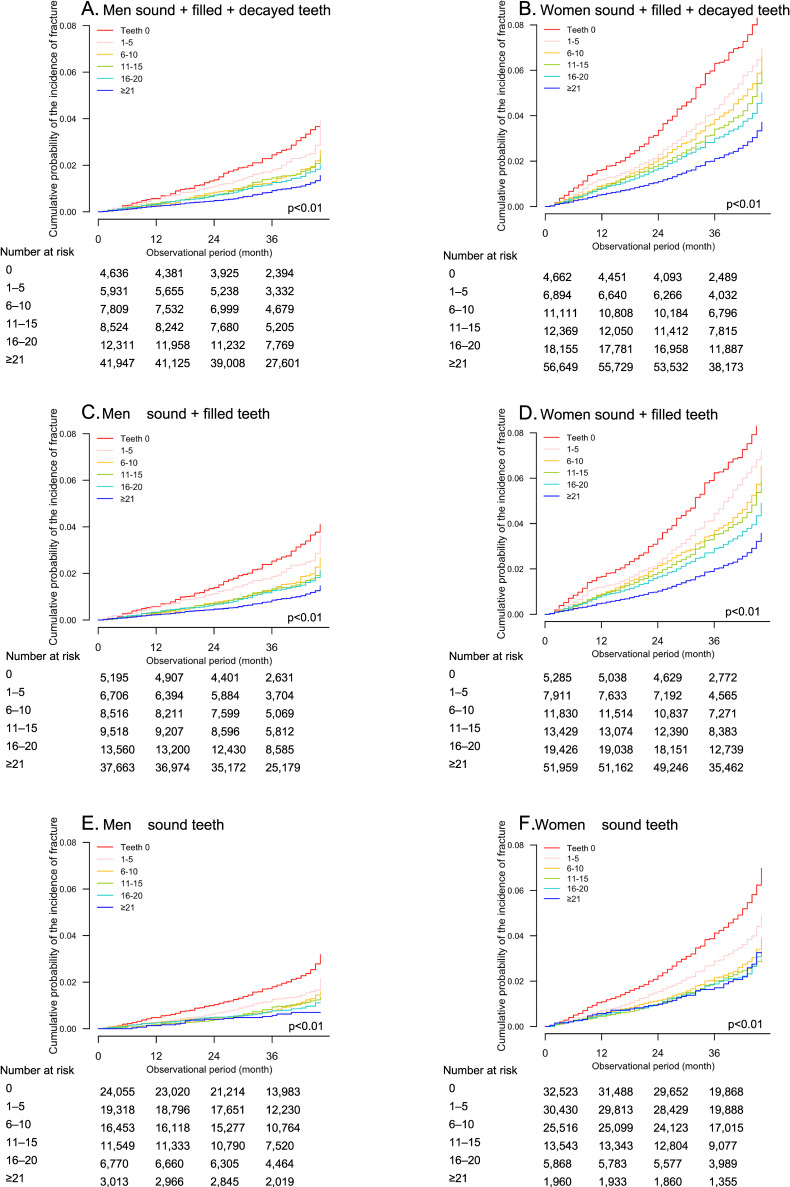
A total of 190,998 participants met the inclusion criteria and were available for analysis. Adjusted Fine and Gray models identified a significant association between the number of teeth, including sound, filled, and decayed teeth, and the incidence of hip fractures among women but not for men. The continuous net reclassification improvement of the sound and filled teeth count model increased by 0.078 compared with that of the sound, filled, and decayed teeth count model among women.
The number of sound and filled teeth predicted the risk of hip fractures in women, whereas no association was observed between the number of teeth and hip fractures in men.
多项观察性研究报告了牙齿数量与髋部骨折发生率之间的关联,主要针对中年成年人。这项回顾性队列研究旨在阐明牙齿数量与髋部骨折发生率之间的关联。
在这项回顾性队列研究中,对日本256,772名75岁及以上接受公共牙科检查的参与者进行了评估。本研究中的暴露因素是牙齿数量,最多为28颗,不包括第三磨牙。结局指标是需要手术的髋部骨折发生率,使用医疗索赔中的日本程序代码。
共有190,998名参与者符合纳入标准并可用于分析。调整后的Fine和Gray模型确定,包括健全、填充和龋齿在内的牙齿数量与女性髋部骨折发生率之间存在显著关联,但男性不存在这种关联。与女性健全、填充和龋齿数量模型相比,健全和填充牙齿数量模型的连续净重新分类改善增加了0.078。
健全和填充牙齿的数量可预测女性髋部骨折的风险,而男性牙齿数量与髋部骨折之间未观察到关联。