Yu Qianru, Zhong Hanyi, Zhu Xinhao, Liu Chang, Zhang Xin, Wang Jiao, Li Zongyao, Shi Songchang, Zhao Haoran, Zhou Cixiang, Zhao Qian
Key Lab of Cell Differentiation and Apoptosis of Ministry of Education, Shanghai Jiao Tong University School of Medicine, Shanghai, China.
Ruijin Hospital, Shanghai Jiao Tong University School of Medicine, Shanghai, China.
Front Immunol. 2025 Jan 10;15:1521930. doi: 10.3389/fimmu.2024.1521930. eCollection 2024.
Breast cancer (BC) is the most prevalent malignant tumor in women, with triple-negative breast cancer (TNBC) showing the poorest prognosis among all subtypes. Glycosylation is increasingly recognized as a critical biomarker in the tumor microenvironment, particularly in BC. However, the glycosylation-related genes associated with TNBC have not yet been defined. Additionally, their characteristics and relationship with prognosis have not been deeply investigated.
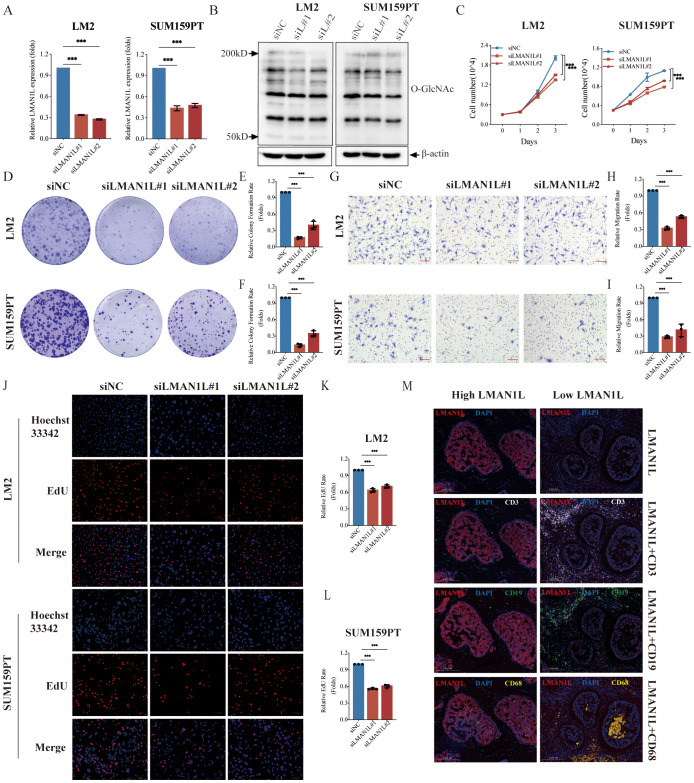
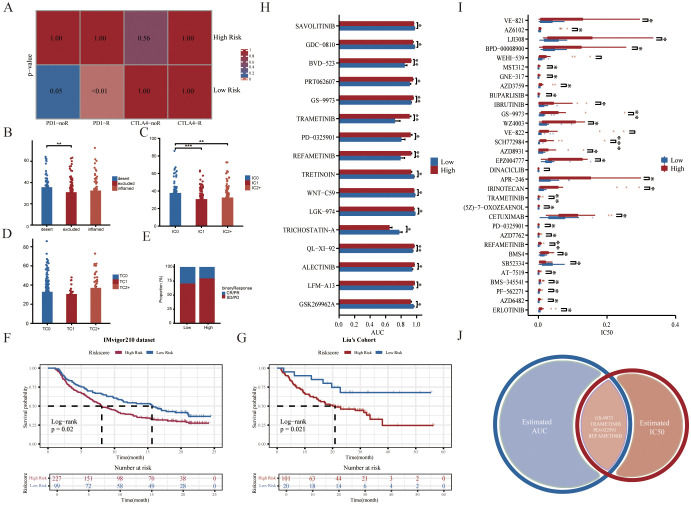
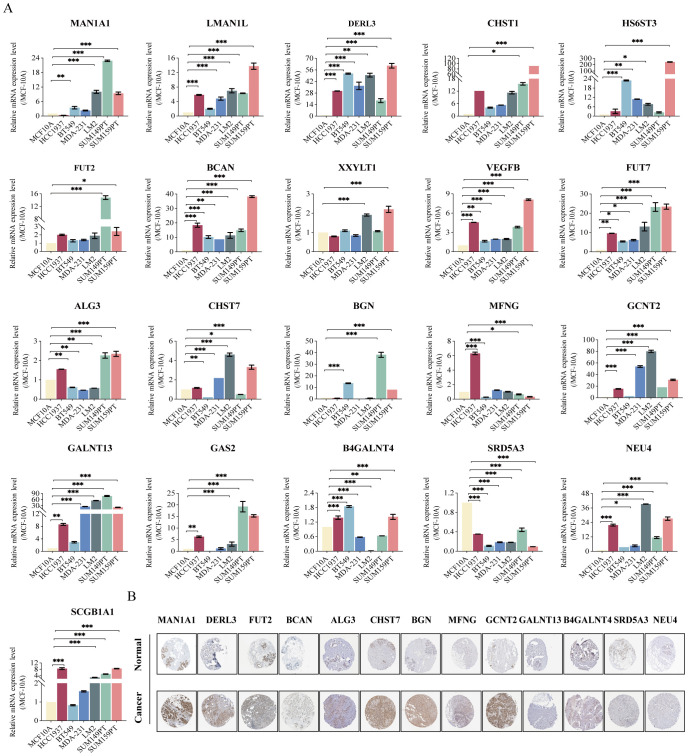
Transcriptomic analyses were used to identify a glycosylation-related signature (GRS) associated with TNBC prognosis. A machine learning-based prediction model was constructed and validated across multiple independent datasets. The model's predictive capability was extended to evaluate the prognosis of TNBC individuals, tumor immune microenvironment and immunotherapy response. (Lectin, Mannose Binding 1 Like) was identified as a novel prognostic marker in TNBC, and its biological effects were validated through experimental assays.
The GRS showed significant prognostic relevance for TNBC patients. The risk model effectively predicted molecular features, including immune cell infiltration and potential responses to immunotherapy. Experimental validation confirmed as a novel glycosylation-related prognostic gene, with low expression significantly inhibiting TNBC cell proliferation and migration.
Our GRS risk model demonstrates robust predictive capability for TNBC prognosis and immunotherapy response. This model offers a promising strategy for personalized treatment and improved clinical outcomes in TNBC.
乳腺癌(BC)是女性中最常见的恶性肿瘤,三阴性乳腺癌(TNBC)在所有亚型中预后最差。糖基化越来越被认为是肿瘤微环境中的关键生物标志物,尤其是在乳腺癌中。然而,与TNBC相关的糖基化相关基因尚未明确。此外,它们的特征及其与预后的关系尚未得到深入研究。
采用转录组分析来识别与TNBC预后相关的糖基化相关特征(GRS)。构建了基于机器学习的预测模型,并在多个独立数据集中进行了验证。该模型的预测能力被扩展到评估TNBC个体的预后、肿瘤免疫微环境和免疫治疗反应。(凝集素,甘露糖结合1样蛋白)被确定为TNBC中的一种新型预后标志物,并通过实验分析验证了其生物学效应。
GRS对TNBC患者具有显著的预后相关性。风险模型有效地预测了分子特征,包括免疫细胞浸润和对免疫治疗的潜在反应。实验验证证实其为一种新型的糖基化相关预后基因,低表达显著抑制TNBC细胞增殖和迁移。
我们的GRS风险模型对TNBC预后和免疫治疗反应具有强大的预测能力。该模型为TNBC的个性化治疗和改善临床结果提供了一种有前景的策略。