Britton Graham J, Mogno Ilaria, Chen-Liaw Alice, Plitt Tamar, Helmus Drew, Bongers Gerold, Brough India, Colmenero Paula, Lam Lilian H, Bullers Samuel J, Penkava Frank, Reyes-Mercedes Pamela, Braun Jonathan, Jacobs Jonathan P, Desch A Nicole, Gevers Dirk, Simmons Sheri, Filer Andrew, Taylor Peter C, Bowness Paul, Huttenhower Curtis, Littman Dan, Dubinsky Marla C, Raza Karim, Tankou Stephanie K, Faith Jeremiah J
Department of Immunology and Immunotherapy, Icahn School of Medicine at Mount Sinai; New York, NY, 10029, USA.
Marc and Jennifer Lipschultz Precision Immunology Institute, Icahn School of Medicine at Mount Sinai; New York, NY, 10029, USA.
bioRxiv. 2025 Jan 18:2025.01.14.633015. doi: 10.1101/2025.01.14.633015.
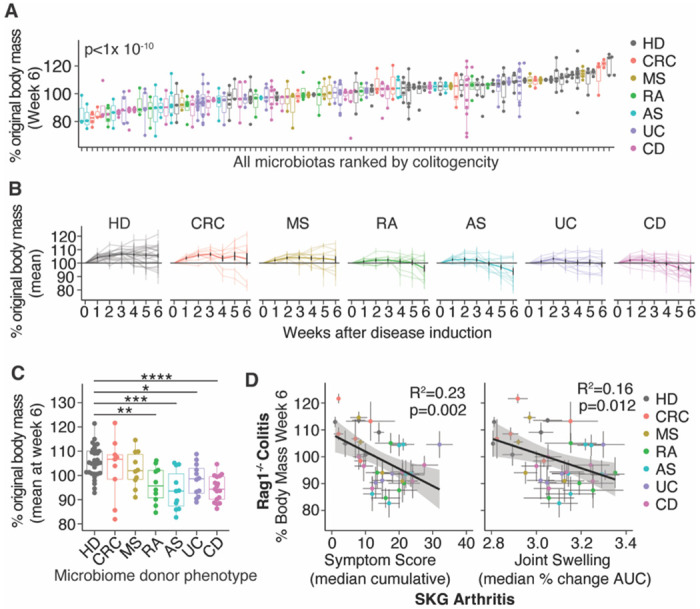
We examine disease-specific and cross-disease functions of the human gut microbiome by colonizing germ-free mice, at risk for inflammatory arthritis, colitis, or neuroinflammation, with over 100 human fecal microbiomes from subjects with rheumatoid arthritis, ankylosing spondylitis, multiple sclerosis, ulcerative colitis, Crohn's disease, or colorectal cancer. We find common inflammatory phenotypes driven by microbiomes from individuals with intestinal inflammation or inflammatory arthritis, as well as distinct functions specific to microbiomes from multiple sclerosis patients. Inflammatory disease in mice colonized with human microbiomes correlated with systemic inflammation, measured by C-reactive protein, in the human donors. These cross-disease patterns of human microbiome pathogenicity mirror features of the inflammatory diseases, including therapeutic targets and the presence or absence of systemic inflammation, suggesting shared and disease-specific mechanisms by which the microbiome is shaped and drives pathogenic inflammatory responses.
我们通过用来自类风湿性关节炎、强直性脊柱炎、多发性硬化症、溃疡性结肠炎、克罗恩病或结直肠癌患者的100多种人类粪便微生物群定殖无菌小鼠(这些小鼠有患炎症性关节炎、结肠炎或神经炎症的风险),来研究人类肠道微生物群的疾病特异性和跨疾病功能。我们发现,来自患有肠道炎症或炎症性关节炎个体的微生物群会驱动常见的炎症表型,以及多发性硬化症患者微生物群特有的不同功能。用人微生物群定殖的小鼠中的炎症性疾病与人类供体中通过C反应蛋白测量的全身炎症相关。人类微生物群致病性的这些跨疾病模式反映了炎症性疾病的特征,包括治疗靶点以及全身炎症的存在与否,这表明微生物群形成并驱动致病性炎症反应的共同机制和疾病特异性机制。