Wang Ling, Zhang Chenrui, Hao Zhiyan, Yao Siqi, Bai Luge, Oliveira Joaquim Miguel, Wang Pan, Zhang Kun, Zhang Chen, He Jiankang, Reis Rui L, Li Dichen
State Key Laboratory for Manufacturing System Engineering, School of Mechanical Engineering, Xi'an Jiaotong University, China.
State Industry-Education Integration Center for Medical Innovations, Xi'an Jiaotong University, China.
Bioact Mater. 2025 Jan 8;47:18-31. doi: 10.1016/j.bioactmat.2024.12.033. eCollection 2025 May.
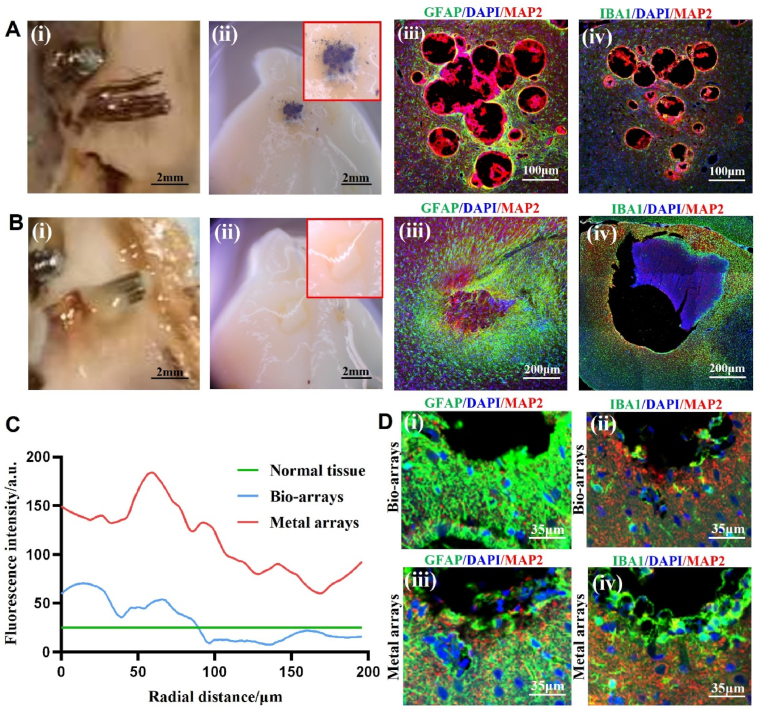
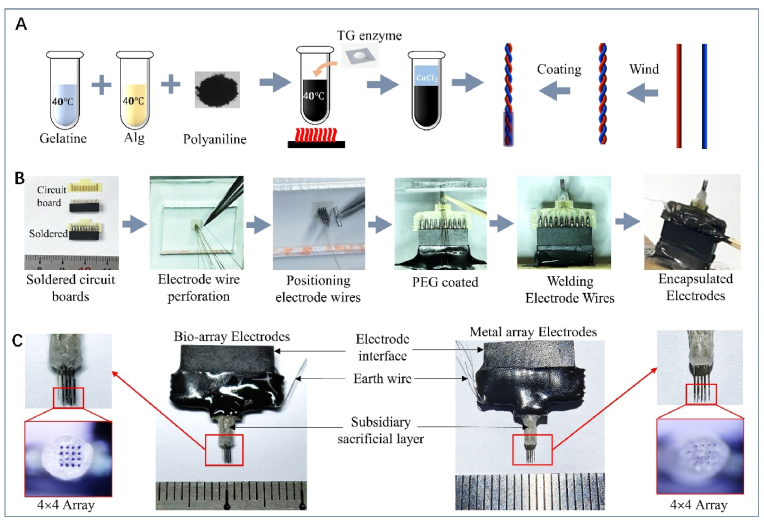
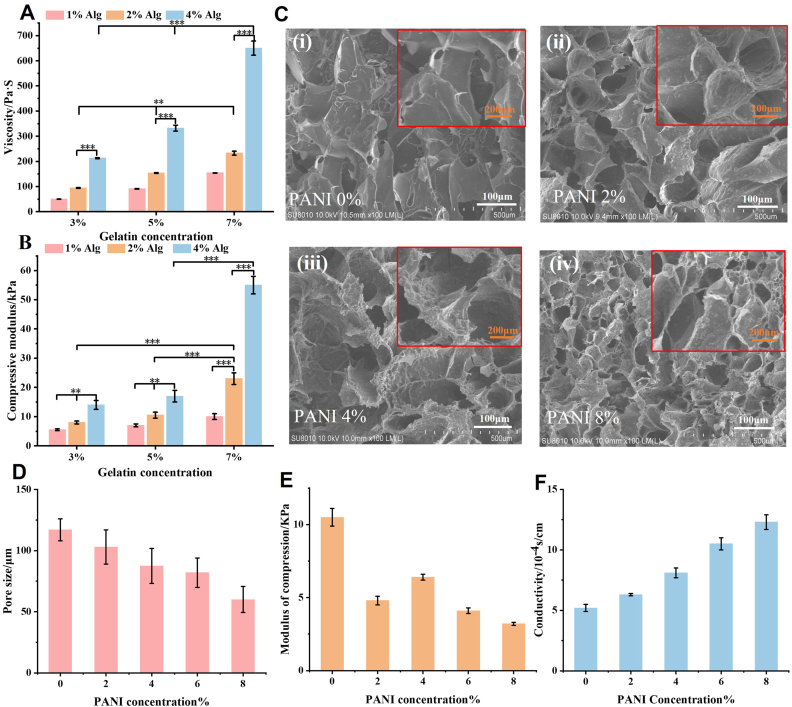
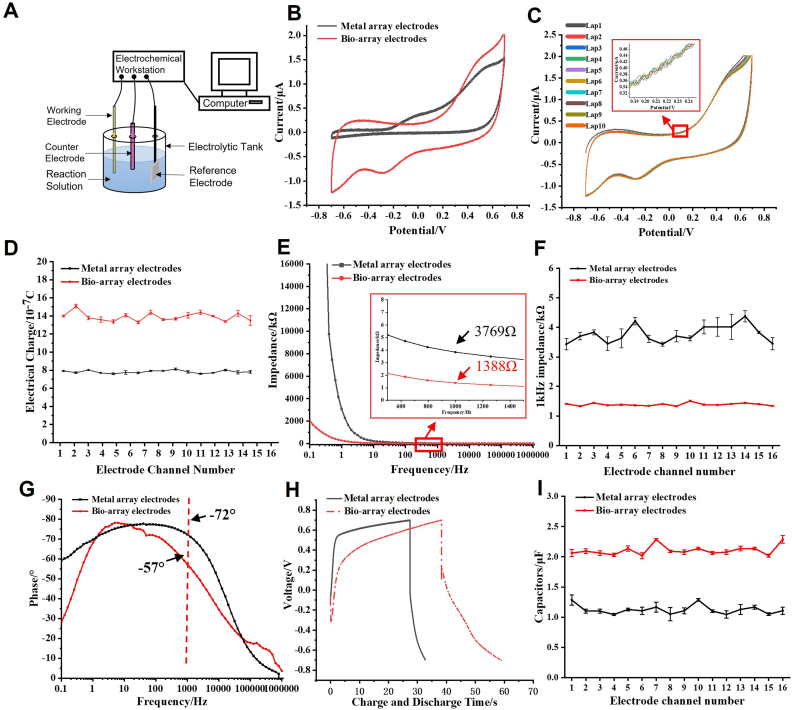
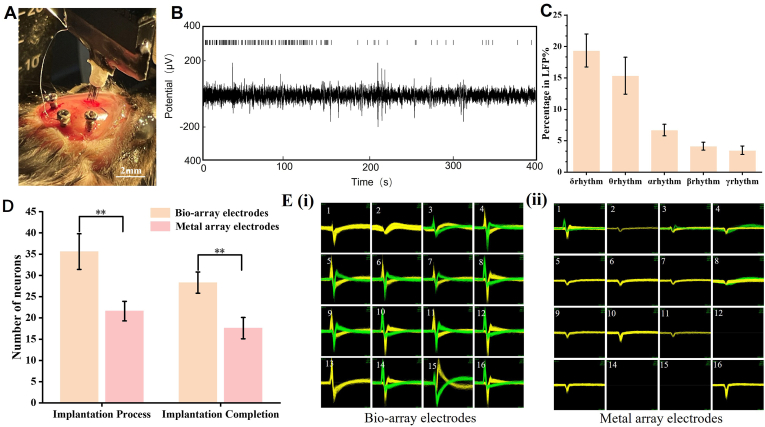
Implantable neural electrodes are key components of brain-computer interfaces (BCI), but the mismatch in mechanical and biological properties between electrode materials and brain tissue can lead to foreign body reactions and glial scarring, and subsequently compromise the long-term stability of electrical signal transmission. In this study, we proposed a new concept for the design and bioaugmentation of implantable electrodes (bio-array electrodes) featuring a heterogeneous gradient structure. Different composite polyaniline-gelatin-alginate based conductive hydrogel formulations were developed for electrode surface coating. In addition, the design, materials, and performance of the developed electrode was optimized through a combination of numerical simulations and physio-chemical characterizations. The long-term biological performance of the bio-array electrodes were investigated using a C57 mouse model. It was found that compared to metal array electrodes, the surface charge of the bio-array electrodes increased by 1.74 times, and the impedance at 1 kHz decreased by 63.17 %, with a doubling of the average capacitance. Long-term animal experiments showed that the bio-array electrodes could consistently record 2.5 times more signals than those of the metal array electrodes, and the signal-to-noise ratio based on action potentials was 2.1 times higher. The study investigated the mechanisms of suppressing the scarring effect by the bioaugmented design, revealing reduces brain damage as a result of the interface biocompatibility between the bio-array electrodes and brain tissue, and confirmed the long-term stability of the bio-array electrodes.
植入式神经电极是脑机接口(BCI)的关键部件,但电极材料与脑组织之间机械和生物学特性的不匹配会导致异物反应和胶质瘢痕形成,进而损害电信号传输的长期稳定性。在本研究中,我们提出了一种具有异质梯度结构的植入式电极(生物阵列电极)的设计和生物增强的新概念。开发了不同的基于聚苯胺 - 明胶 - 海藻酸盐的复合导电水凝胶配方用于电极表面涂层。此外,通过数值模拟和物理化学表征相结合的方式对所开发电极的设计、材料和性能进行了优化。使用C57小鼠模型研究了生物阵列电极的长期生物学性能。结果发现,与金属阵列电极相比,生物阵列电极的表面电荷增加了1.74倍,1kHz时的阻抗降低了63.17%,平均电容增加了一倍。长期动物实验表明,生物阵列电极能够持续记录比金属阵列电极多2.5倍的信号,基于动作电位的信噪比高2.1倍。该研究探讨了生物增强设计抑制瘢痕形成效应的机制,揭示了由于生物阵列电极与脑组织之间的界面生物相容性导致脑损伤减少,并证实了生物阵列电极的长期稳定性。