Shin Minkyu, Lim Joungpyo, An Joohyun, Yoon Jinho, Choi Jeong-Woo
Department of Chemical & Biomolecular Engineering, Sogang University, Seoul, 04170, Republic of Korea.
Department of Biomedical-Chemical Engineering, The Catholic University of Korea, Bucheon, 14662, Republic of Korea.
Nano Converg. 2023 Feb 10;10(1):8. doi: 10.1186/s40580-023-00357-7.
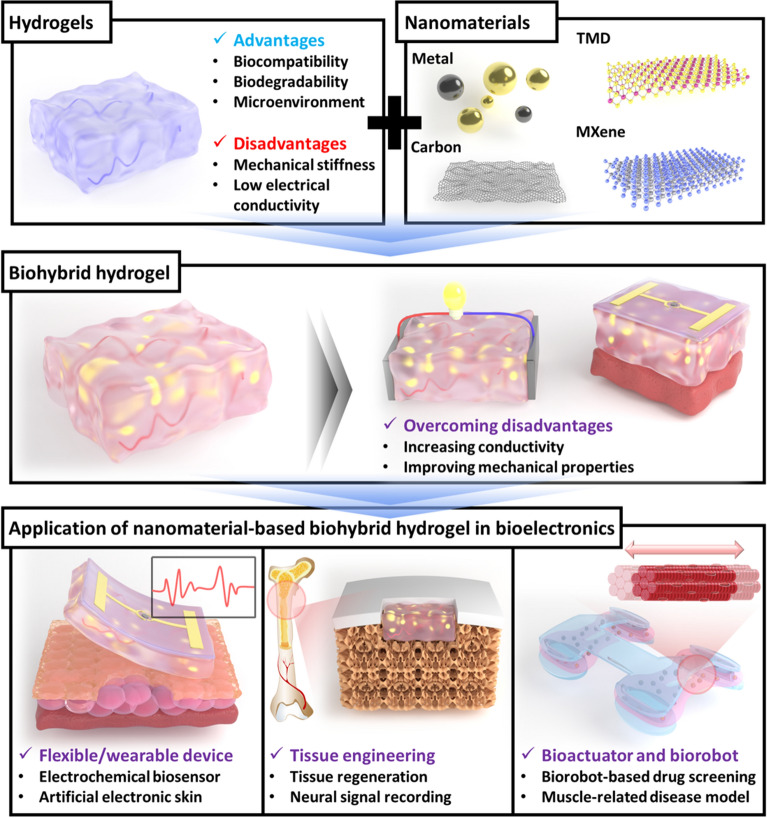
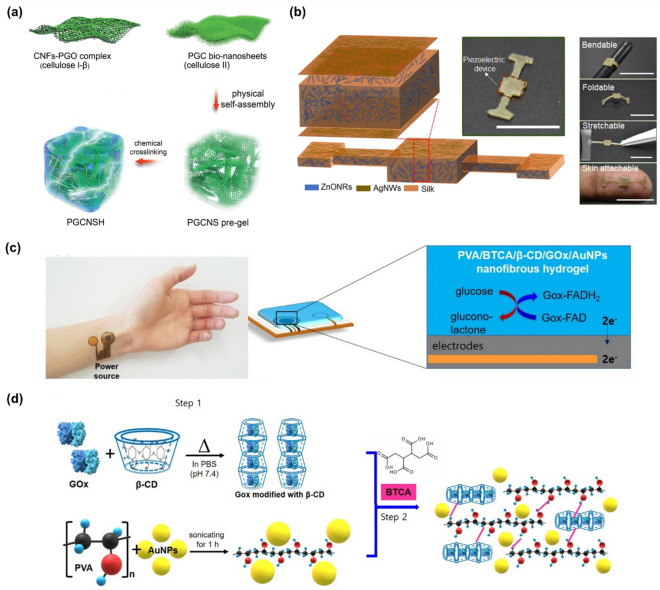
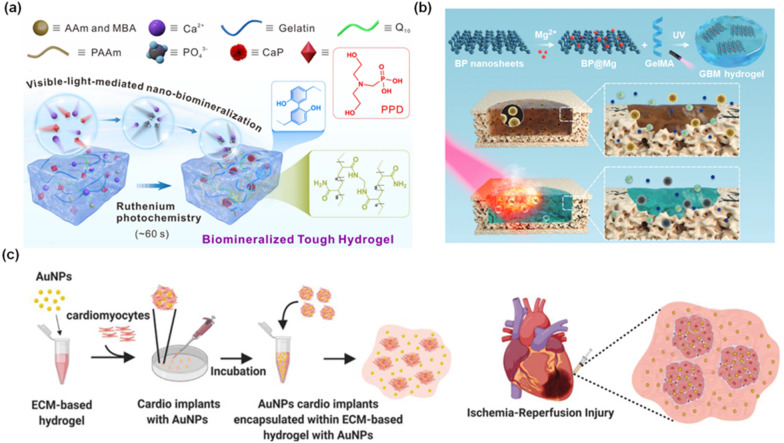
Despite the broadly applicable potential in the bioelectronics, organic/inorganic material-based bioelectronics have some limitations such as hard stiffness and low biocompatibility. To overcome these limitations, hydrogels capable of bridging the interface and connecting biological materials and electronics have been investigated for development of hydrogel bioelectronics. Although hydrogel bioelectronics have shown unique properties including flexibility and biocompatibility, there are still limitations in developing novel hydrogel bioelectronics using only hydrogels such as their low electrical conductivity and structural stability. As an alternative solution to address these issues, studies on the development of biohybrid hydrogels that incorporating nanomaterials into the hydrogels have been conducted for bioelectronic applications. Nanomaterials complement the shortcomings of hydrogels for bioelectronic applications, and provide new functionality in biohybrid hydrogel bioelectronics. In this review, we provide the recent studies on biohybrid hydrogels and their bioelectronic applications. Firstly, representative nanomaterials and hydrogels constituting biohybrid hydrogels are provided, and next, applications of biohybrid hydrogels in bioelectronics categorized in flexible/wearable bioelectronic devices, tissue engineering, and biorobotics are discussed with recent studies. In conclusion, we strongly believe that this review provides the latest knowledge and strategies on hydrogel bioelectronics through the combination of nanomaterials and hydrogels, and direction of future hydrogel bioelectronics.
尽管基于有机/无机材料的生物电子学在生物电子领域具有广泛的应用潜力,但它也存在一些局限性,如硬度大、生物相容性低等。为了克服这些局限性,能够弥合界面并连接生物材料与电子器件的水凝胶已被用于水凝胶生物电子学的开发研究。尽管水凝胶生物电子学已展现出包括柔韧性和生物相容性在内的独特性能,但仅使用水凝胶来开发新型水凝胶生物电子学仍存在局限性,比如其低电导率和结构稳定性。作为解决这些问题的替代方案,已开展了关于将纳米材料融入水凝胶以开发用于生物电子应用的生物杂交水凝胶的研究。纳米材料弥补了水凝胶在生物电子应用中的不足,并在生物杂交水凝胶生物电子学中提供了新的功能。在这篇综述中,我们介绍了关于生物杂交水凝胶及其生物电子应用的最新研究。首先,介绍了构成生物杂交水凝胶的代表性纳米材料和水凝胶,接着,结合近期研究讨论了生物杂交水凝胶在柔性/可穿戴生物电子器件、组织工程和生物机器人等生物电子领域的应用。总之,我们坚信这篇综述通过纳米材料与水凝胶的结合,提供了关于水凝胶生物电子学的最新知识和策略以及未来水凝胶生物电子学的发展方向。