Hassouneh Aya, Danna-Dos-Santos Alessander, Bazuin Bradley, Shebrain Saad, Abdel-Qader Ikhlas
Electrical and Computer Engineering, Western Michigan University, Kalamazoo, MI, USA.
Department of Physical Therapy, Western Michigan University, Kalamazoo, MI, USA.
Digit Biomark. 2024 Dec 16;9(1):23-39. doi: 10.1159/000543165. eCollection 2025 Jan-Dec.
This research is focused on early detection of Alzheimer's disease (AD) using a multiscale feature fusion framework, combining biomarkers from memory, vision, and speech regions extracted from magnetic resonance imaging and positron emission tomography images.
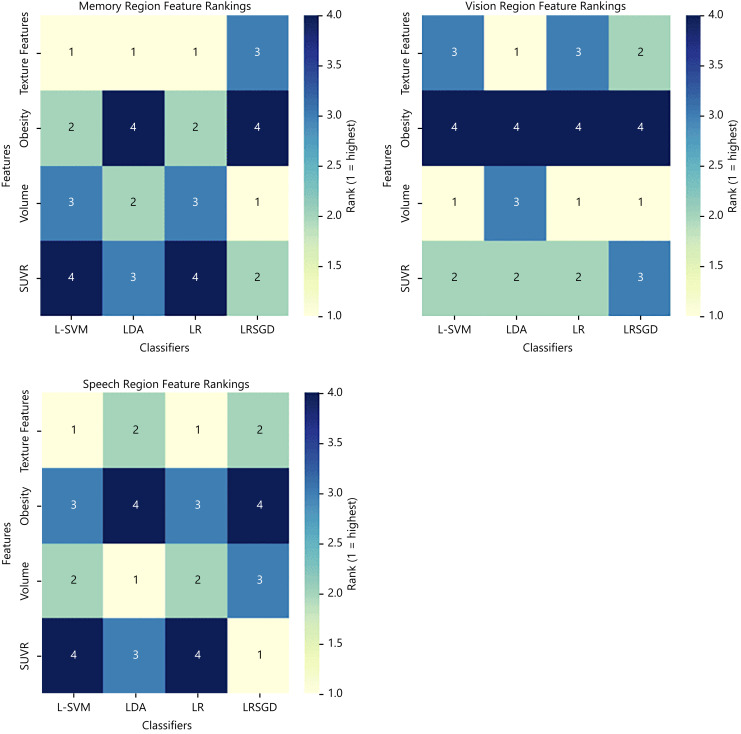
Using 2D gray level co-occurrence matrix (2D-GLCM) texture features, volume, standardized uptake value ratios (SUVR), and obesity from different neuroimaging modalities, the study applies various classifiers, demonstrating a feature importance analysis in each region of interest. The research employs four classifiers, namely linear support vector machine, linear discriminant analysis, logistic regression (LR), and logistic regression with stochastic gradient descent (LRSGD) classifiers, to determine feature importance, leading to subsequent validation using a probabilistic neural network classifier.
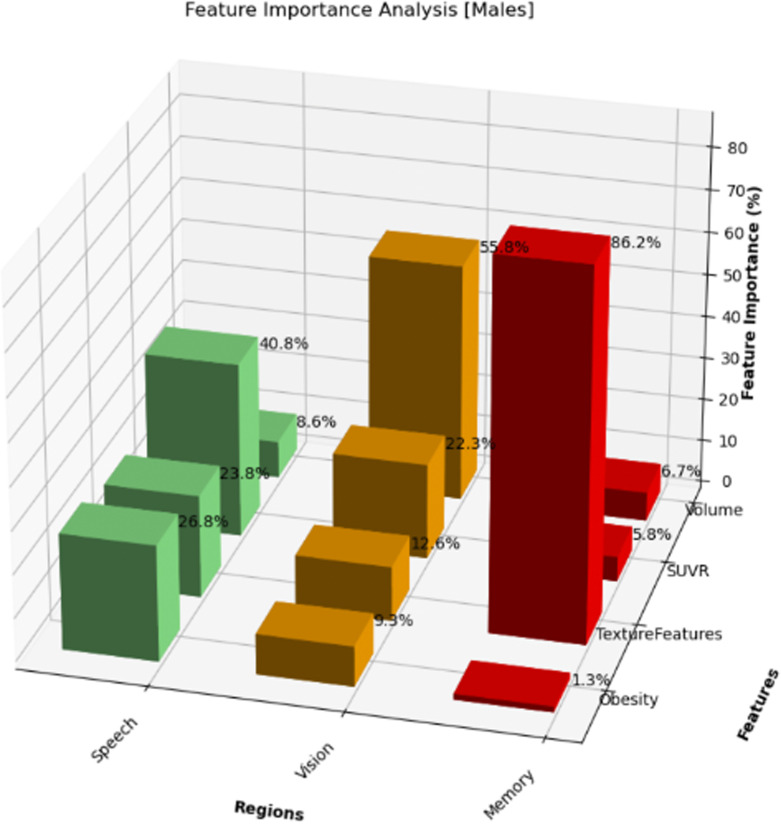
The research highlights the critical role of brain texture features, particularly in memory regions, for AD detection. Significant sex-specific differences are observed, with males showing significance in texture features in memory regions, volume in vision regions, and SUVR in speech regions, while females exhibit significance in texture features in memory and speech regions, and SUVR in vision regions. Additionally, the study analyzes how obesity affects features used in AD prediction models, clarifying its effects on speech and vision regions, particularly brain volume.
The findings contribute valuable insights into the effectiveness of feature fusion, sex-specific differences, and the impact of obesity on AD-related biomarkers, paving the way for future research in early AD detection strategies and cognitive impairment classification.
本研究聚焦于使用多尺度特征融合框架早期检测阿尔茨海默病(AD),该框架结合了从磁共振成像和正电子发射断层扫描图像中提取的记忆、视觉和言语区域的生物标志物。
该研究使用二维灰度共生矩阵(2D-GLCM)纹理特征、体积、标准化摄取值比率(SUVR)以及来自不同神经成像模态的肥胖指标,应用了各种分类器,展示了在每个感兴趣区域的特征重要性分析。该研究采用了四种分类器,即线性支持向量机、线性判别分析、逻辑回归(LR)以及带有随机梯度下降的逻辑回归(LRSGD)分类器来确定特征重要性,随后使用概率神经网络分类器进行验证。
该研究突出了脑纹理特征,尤其是在记忆区域的脑纹理特征,对AD检测的关键作用。观察到显著的性别特异性差异,男性在记忆区域的纹理特征、视觉区域的体积以及言语区域的SUVR方面表现出显著性,而女性在记忆和言语区域的纹理特征以及视觉区域的SUVR方面表现出显著性。此外,该研究分析了肥胖如何影响AD预测模型中使用的特征,阐明了其对言语和视觉区域,特别是脑体积的影响。
这些发现为特征融合的有效性、性别特异性差异以及肥胖对AD相关生物标志物的影响提供了有价值的见解,为早期AD检测策略和认知障碍分类的未来研究铺平了道路。