Deldar Zoha, Gevers-Montoro Carlos, Khatibi Ali, Ghazi-Saidi Ladan
Department of Anatomy, Université du Québec à Trois-Rivières, Trois-Rivières, QC, Canada.
Language and Cognition Laboratory, Department of Communication Disorders, College of Education, University of Nebraska at Kearney, USA.
AIMS Neurosci. 2020 Nov 16;8(1):1-32. doi: 10.3934/Neuroscience.2021001. eCollection 2021.
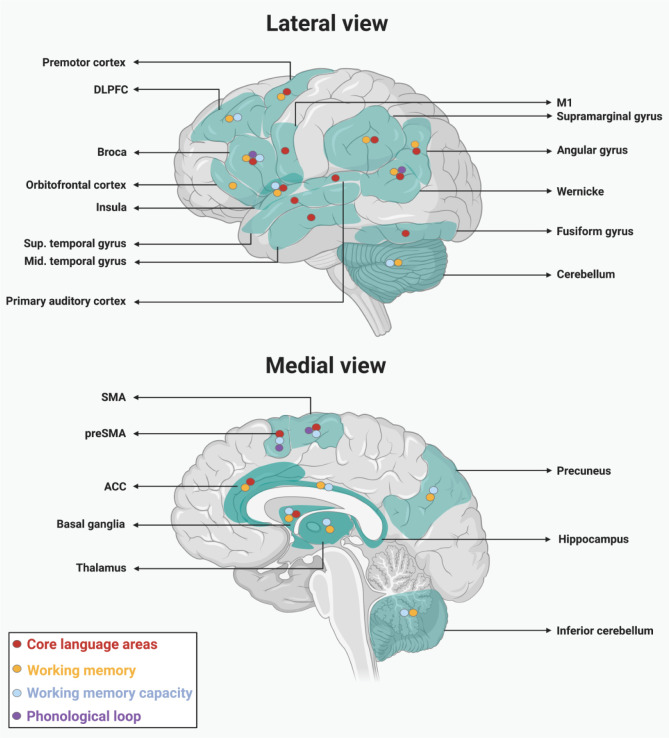
Language processing involves other cognitive domains, including Working Memory (WM). Much detail about the neural correlates of language and WM interaction remains unclear. This review summarizes the evidence for the interaction between WM and language obtained via functional Magnetic Resonance Imaging (fMRI) in the past two decades. The search was limited to PubMed, Google Scholar, Science direct and Neurosynth for working memory, language, fMRI, neuroimaging, cognition, attention, network, connectome keywords. The exclusion criteria consisted of studies including children, older adults, bilingual or multilingual population, clinical cases, music, sign language, speech, motor processing, review papers, meta-analyses, electroencephalography/event-related potential, and positron emission tomography. A total of 20 articles were included and discussed in four categories: language comprehension, language production, syntax, and networks. Studies on neural correlates of WM and language interaction are rare. Language tasks that involve WM activate common neural systems. Activated areas can be associated with cognitive concepts proposed by Baddeley and Hitch (1974), including the phonological loop of WM (mainly Broca and Wernicke's areas), other prefrontal cortex and right hemispheric regions linked to the visuospatial sketchpad. There is a clear, dynamic interaction between language and WM, reflected in the involvement of subcortical structures, particularly the basal ganglia (caudate), and of widespread right hemispheric regions. WM involvement is levered by cognitive demand in response to task complexity. High WM capacity readers draw upon buffer memory systems in midline cortical areas to decrease the WM demands for efficiency. Different dynamic networks are involved in WM and language interaction in response to the task in hand for an ultimate brain function efficiency, modulated by language modality and attention.
语言处理涉及其他认知领域,包括工作记忆(WM)。关于语言与工作记忆交互的神经关联的许多细节仍不清楚。本综述总结了过去二十年中通过功能磁共振成像(fMRI)获得的关于工作记忆与语言交互的证据。搜索仅限于PubMed、谷歌学术、科学Direct和Neurosynth,使用工作记忆、语言、fMRI、神经成像、认知、注意力、网络、连接组等关键词。排除标准包括涉及儿童、老年人、双语或多语人群、临床病例、音乐、手语、言语、运动处理的研究、综述论文、荟萃分析、脑电图/事件相关电位以及正电子发射断层扫描。总共纳入了20篇文章,并分为四类进行讨论:语言理解、语言产生、句法和网络。关于工作记忆与语言交互的神经关联的研究很少。涉及工作记忆的语言任务会激活共同的神经系统。激活区域可能与Baddeley和Hitch(1974)提出的认知概念相关,包括工作记忆的语音回路(主要是布洛卡区和韦尼克区)、其他前额叶皮层以及与视觉空间画板相关的右半球区域。语言和工作记忆之间存在明显的动态交互,这反映在皮质下结构,特别是基底神经节(尾状核)以及广泛的右半球区域的参与上。工作记忆的参与程度受任务复杂性所带来的认知需求的影响。高工作记忆容量的读者会利用中线皮质区域的缓冲记忆系统来降低对效率的工作记忆需求。为了实现最终的脑功能效率,针对手头的任务,不同的动态网络参与到工作记忆与语言的交互中,这受到语言模态和注意力的调节。