Li Qiushuang, Huo Jiabin, Ni Gaofeng, Zhang Fan, Zhang Shizhe, Zhang Xiumin, Wang Rong, Jiao Jinzhen, Yu Zhongtang, Pu Xuanxuan, Yue Yipeng, Ungerfeld Emilio M, Zhang Xiaoli, Wu Jian, Tan Zhiliang, Greening Chris, Wang Min
Key Laboratory for Agro-Ecological Processes in Subtropical Region, Institute of Subtropical Agriculture, Chinese Academy of Sciences, Changsha, Hunan, China.
University of Chinese Academy of Sciences, Beijing, China.
Microbiome. 2025 Jan 28;13(1):28. doi: 10.1186/s40168-024-02018-1.
The microbes residing in ruminant gastrointestinal tracts play a crucial role in converting plant biomass to volatile fatty acids, which serve as the primary energy source for ruminants. This gastrointestinal tract comprises a foregut (rumen) and hindgut (cecum and colon), which differ in structures and functions, particularly with respect to feed digestion and fermentation. While the rumen microbiome has been extensively studied, the cecal microbiome remains much less investigated and understood, especially concerning the assembling microbial communities and overriding pathways of hydrogen metabolism.
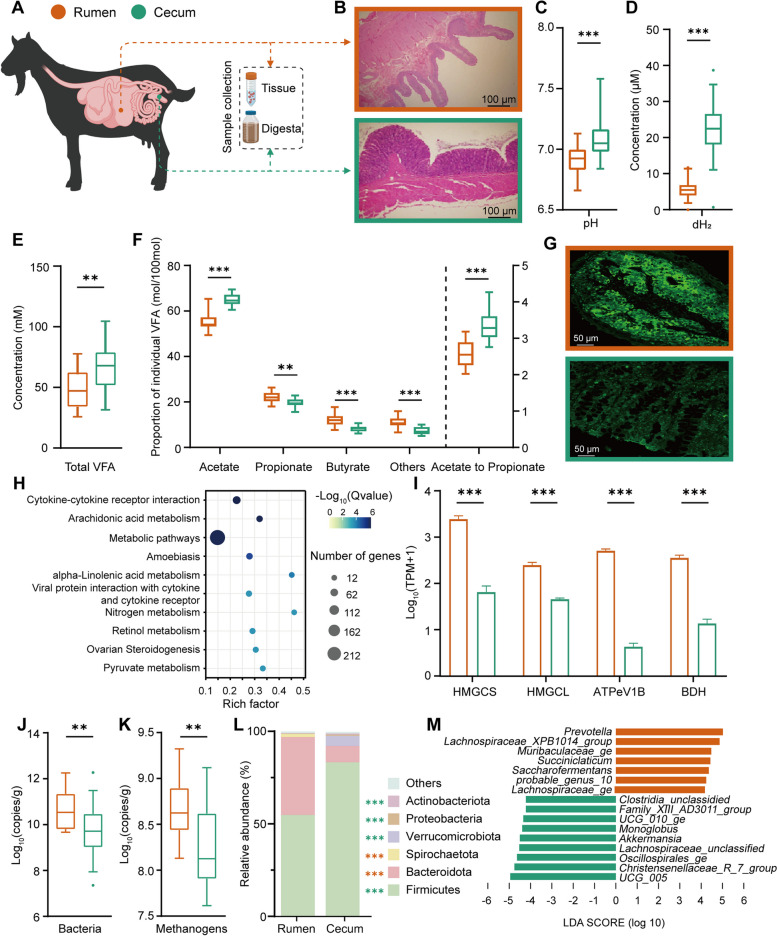
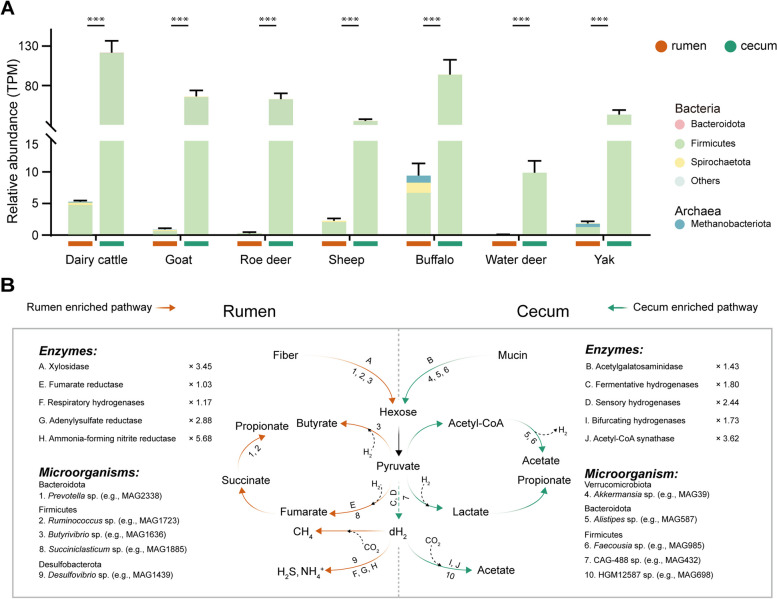
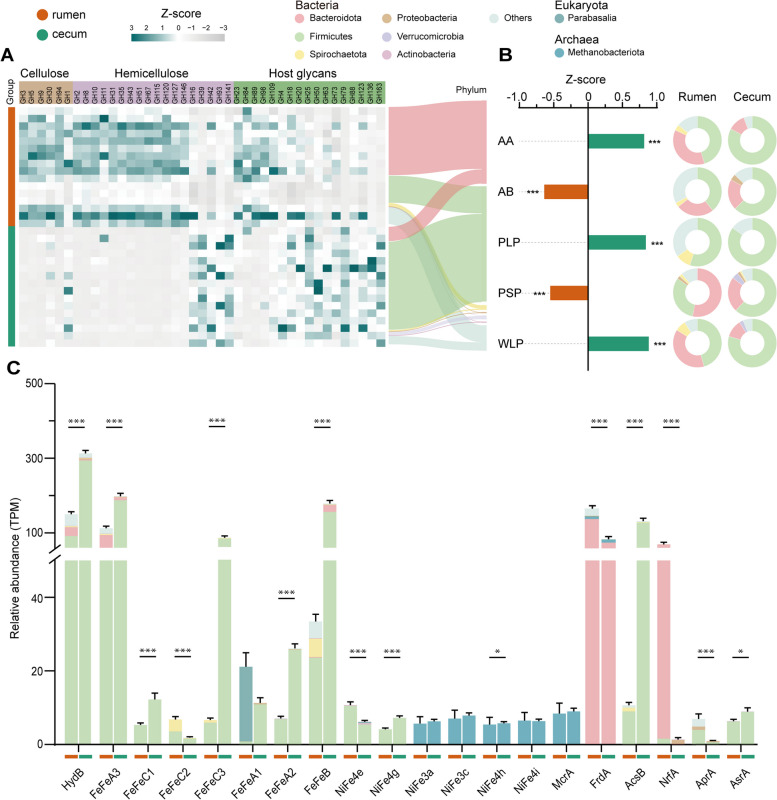
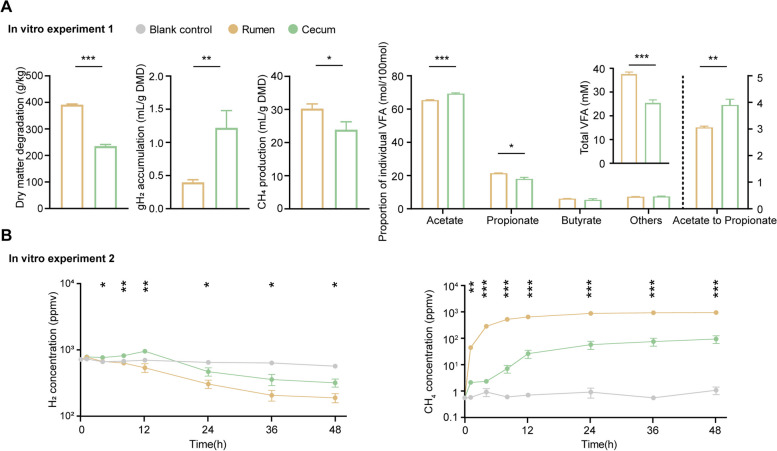
To address this gap, we comparatively investigated the composition, capabilities, and activities of the rumen and the cecum microbiome using goats as an experimental ruminant model. In situ measurements showed significantly higher levels of dissolved hydrogen and acetate in the cecum than in the rumen. Increased dissolved hydrogen indicated distinct processes and reduced coupling between fermentative H production and utilization, whereas higher levels of acetate could be caused by slower VFA absorption through cecal papillae than through the rumen papillae. Microbial profiling indicated that the cecum harbors a greater abundance of mucin-degrading microbes and fermentative hydrogen producers, whereas the rumen contains a higher abundance of fibrolytic fermentative bacteria, hydrogenotrophic respiratory bacteria, and methanogenic archaea. Most strikingly, reductive acetogenic bacteria were 12-fold more abundant in the cecum. Genome-resolved metagenomic analysis unveiled that the cecum acetogens are both phylogenetically and functionally distinct from those found in the rumen. Further supporting these findings, two in vitro experiments demonstrated a marked difference in hydrogen metabolism pathways between the cecum and the rumen, with increased acetate production and reduced methanogenesis in the cecum. Moreover, comparative analysis across multiple ruminant species confirmed a strong enrichment of reductive acetogens in the hindguts, suggesting a conserved functional role.
These findings highlight an enrichment of acetogenesis in a key region of the gastrointestinal tract and reshape our understanding of ruminant hydrogen metabolism and how the H can be managed in accord to livestock methane mitigation efforts. Video Abstract.
反刍动物胃肠道中的微生物在将植物生物质转化为挥发性脂肪酸的过程中起着关键作用,而挥发性脂肪酸是反刍动物的主要能量来源。这种胃肠道由前肠(瘤胃)和后肠(盲肠和结肠)组成,它们在结构和功能上存在差异,尤其是在饲料消化和发酵方面。虽然瘤胃微生物群已得到广泛研究,但盲肠微生物群的研究和了解仍然较少,特别是关于微生物群落的组装和氢代谢的主要途径。
为了填补这一空白,我们以山羊作为实验反刍动物模型,对瘤胃和盲肠微生物群的组成、能力和活性进行了比较研究。原位测量显示,盲肠中溶解氢和乙酸盐的水平显著高于瘤胃。溶解氢的增加表明发酵产氢和利用之间的过程不同且耦合减少,而较高水平的乙酸盐可能是由于通过盲肠乳头吸收挥发性脂肪酸的速度比通过瘤胃乳头慢。微生物分析表明,盲肠中含有更丰富的黏蛋白降解微生物和发酵产氢菌,而瘤胃中含有更丰富的纤维分解发酵细菌、氢营养呼吸细菌和产甲烷古菌。最引人注目的是,盲肠中还原产乙酸细菌的丰度是瘤胃中的12倍。基因组解析宏基因组分析表明,盲肠产乙酸菌在系统发育和功能上均与瘤胃中的产乙酸菌不同。另外两项体外实验进一步支持了这些发现,结果表明盲肠和瘤胃之间的氢代谢途径存在显著差异,盲肠中乙酸盐产量增加,甲烷生成减少。此外,对多个反刍动物物种的比较分析证实,后肠中还原产乙酸菌高度富集,表明其具有保守的功能作用。
这些发现突出了胃肠道关键区域乙酸生成的富集,并重塑了我们对反刍动物氢代谢以及如何根据减少家畜甲烷排放的努力来管理氢的理解。视频摘要。