Zhang Xinying, Xie Jiajie, Yang Zixin, Yu Carisa Kwok Wai, Hu Yaohua, Qin Jing
School of Pharmaceutical Sciences (Shenzhen), Shenzhen Campus of Sun Yat-sen University, Shenzhen, Guangdong 518107, China.
Department of Mathematics, Statistics and Insurance, The Hang Seng University of Hong Kong, Shatin, Hong Kong.
Comput Struct Biotechnol J. 2024 Dec 25;27:307-320. doi: 10.1016/j.csbj.2024.12.020. eCollection 2025.
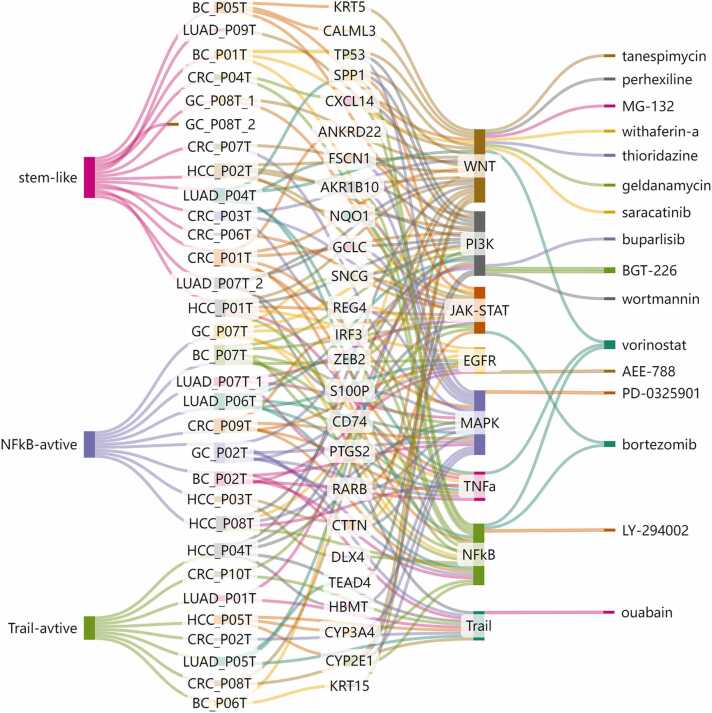
According to global cancer statistics for the year 2022, based on updated estimates from the International Agency for Research on Cancer, there were approximately 20 million new cases of cancer in 2022 alongside 9.7 million related deaths. Lung, breast, colorectal, gastric, and liver cancers are the most common types of cancer. Despite advancements in anticancer drugs and optimised chemotherapy regimens that have improved cure rates for malignant tumours, the presence of tumour heterogeneity has resulted in substantial variations among patients in terms of disease progression, clinical response, sensitivity to therapy, and prognosis, posing significant challenges in attaining optimal therapeutic outcomes for each patient. Here, we collected five single-cell transcriptome datasets from patients with lung, breast, colorectal, gastric, and liver cancers and constructed multiple cancer blueprints of tumour cell heterogeneity. By integrating multiple bioinformatics analyses, we explored the biological differences underlying tumour cell heterogeneity at the single-cell level and identified tumour cell subcluster-specific biomarkers and potential therapeutic drugs for each subcluster. Interestingly, although tumour cell subpopulations exhibit dramatic differences within the same cancer type and between different cancers at both the genomic and transcriptomic levels, some demonstrate similar oncogenic pathway activities and phenotypes. Tumour cell subpopulations from the five cancers listed above were classified into three major groups corresponding to different treatment strategies. The findings of this study not only focus on the differences but also on the similarities among tumour cell subpopulations across different cancers, providing new insights for individualised therapy.
根据国际癌症研究机构的最新估计得出的2022年全球癌症统计数据,2022年约有2000万新增癌症病例,同时有970万人死于癌症相关疾病。肺癌、乳腺癌、结直肠癌、胃癌和肝癌是最常见的癌症类型。尽管抗癌药物和优化的化疗方案取得了进展,提高了恶性肿瘤的治愈率,但肿瘤异质性的存在导致患者在疾病进展、临床反应、对治疗的敏感性和预后方面存在很大差异,这给为每位患者实现最佳治疗效果带来了重大挑战。在此,我们收集了来自肺癌、乳腺癌、结直肠癌、胃癌和肝癌患者的五个单细胞转录组数据集,并构建了多个肿瘤细胞异质性的癌症蓝图。通过整合多种生物信息学分析,我们在单细胞水平上探索了肿瘤细胞异质性背后的生物学差异,并确定了肿瘤细胞亚群特异性生物标志物以及每个亚群的潜在治疗药物。有趣的是,尽管肿瘤细胞亚群在同一癌症类型内以及不同癌症之间在基因组和转录组水平上表现出显著差异,但有些亚群表现出相似的致癌途径活性和表型。上述五种癌症的肿瘤细胞亚群被分为对应不同治疗策略的三大类。本研究的结果不仅关注不同癌症中肿瘤细胞亚群之间的差异,还关注它们之间的相似性,为个性化治疗提供了新的见解。