Jamal Iffat, Smita Shuchi, Raman Ravi Bhushan, Choudhary Vijayanand, Atreya Kshiti, Choudhary Manoj Kumar, Ranjan Alok
Department of Pathology (Hematology section), Indira Gandhi Institute of Medical Sciences, Patna, India.
Department of Pathology, Indira Gandhi Institute of Medical Sciences, Patna, India.
Niger Med J. 2025 Jan 10;65(6):1101-1111. doi: 10.60787/nmj.v65i6.574. eCollection 2024 Nov-Dec.
Bone marrow (BM) in addition to being the origin of primary hematological malignancies is also commonly involved in metastatic solid tumors. Bone marrow examination includes aspiration and biopsy, and it is a well-known procedure not only to diagnose hematological malignancies but also for staging and prognosis of various solid tumors. The presence of metastasis in the bone marrow is of grave prognostic significance and it is imperative to rule out marrow involvement in any malignancy where curative treatment is considered. The study's objectives were to evaluate the clinical, hematological, and biochemical characteristics of patients with BM metastases of solid tumors diagnosed by bone marrow (BM) aspiration and trephine biopsy and to find out the accuracy rate of diagnosing metastatic infiltration between bone marrow aspiration, trephine imprints, and trephine biopsy procedures.
It was a 4.5-year retrospective hospital-based observational study where relevant clinical, biochemical, and hematological parameters including bone marrow aspirate and biopsy were analyzed and compiled from hospital medical records.
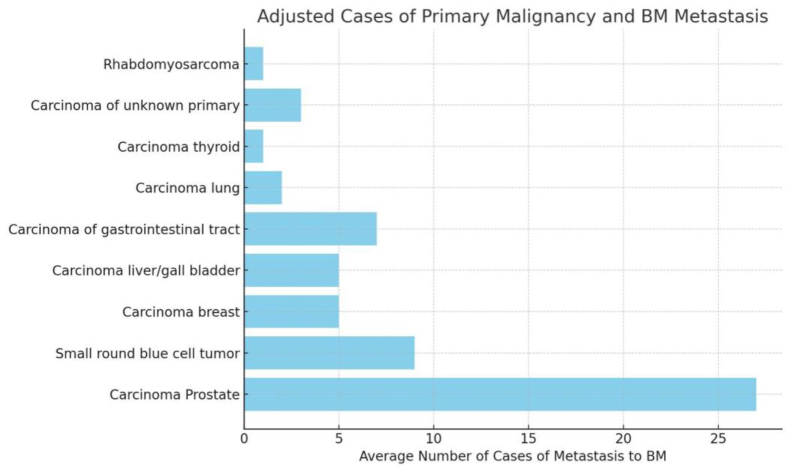
The total number of BMA and trephine biopsies that came during the duration of 4.5 years were 3850 and 2980 respectively. Out of the 3850-bone marrow aspiration and 2980 trephine biopsies received in the dept of Hematology, 305 cases were referred to look for metastatic bone marrow infiltration. Out of these 305 cases, 69 cases showed the presence of metastatic deposits (12.6%). 45 patients (65.2%) were males, and 24 patients (34.7%) were females with M:F ratio of 1.8:1. Most common age group was 51-60 years (31.8%). The most common complaints were fever, body aches, weight loss, and weakness. Clinical examination revealed pallor in 38 out of 69 cases (55%) and organomegaly in 14 cases (20.2%). Microcytic hypochromic anemia (26%) was the most common finding on peripheral blood smear examination followed by pancytopenia (18.8%). The biochemical findings most commonly observed were raised LDH (60.8%), serum PSA (36.3%), and alkaline phosphatase (21.7%).
Trephine biopsy is a sensitive method for detecting marrow metastasis and should be done in all cases being investigated for this purpose. BMA alone may miss marrow metastases in almost half of cases. Trephine imprint cytology is more sensitive than BMA and can provide rapid diagnoses while waiting for trephine biopsy results.
骨髓不仅是原发性血液系统恶性肿瘤的起源,也常被转移性实体瘤累及。骨髓检查包括穿刺和活检,它不仅是诊断血液系统恶性肿瘤的常用方法,也是各种实体瘤分期和预后评估的常用方法。骨髓转移的存在具有严重的预后意义,在考虑进行根治性治疗的任何恶性肿瘤中,排除骨髓受累至关重要。本研究的目的是评估经骨髓穿刺和活检确诊的实体瘤骨髓转移患者的临床、血液学和生化特征,并找出骨髓穿刺、活检印片和活检组织学检查在诊断转移浸润方面的准确率。
这是一项为期4.5年的基于医院的回顾性观察研究,从医院病历中分析和整理了包括骨髓穿刺和活检在内的相关临床、生化和血液学参数。
在4.5年期间进行的骨髓穿刺和活检组织学检查总数分别为3850例和2980例。在血液科接受的3850例骨髓穿刺和2980例活检组织学检查中,有305例被转诊以寻找骨髓转移浸润。在这305例病例中,69例显示存在转移灶(12.6%)。45例患者(65.2%)为男性,24例患者(34.7%)为女性,男女比例为1.8:1。最常见的年龄组为51 - 60岁(31.8%)。最常见的症状是发热、全身疼痛、体重减轻和虚弱。临床检查发现,69例中有38例(55%)面色苍白,14例(20.2%)有脏器肿大。外周血涂片检查最常见的结果是小细胞低色素性贫血(26%),其次是全血细胞减少(18.8%)。最常观察到的生化结果是乳酸脱氢酶升高(60.8%)、血清前列腺特异抗原升高(36.3%)和碱性磷酸酶升高(21.7%)。
活检组织学检查是检测骨髓转移的敏感方法,对于所有为此目的进行检查的病例都应进行。仅骨髓穿刺可能会漏诊近一半病例的骨髓转移。活检印片细胞学比骨髓穿刺更敏感,在等待活检组织学检查结果时可提供快速诊断。