Kim Sung Nyun, Choi Jung-Seok, Park Minkyung, Yoo So Young, Choi Areum, Koo Ja Wook, Kang Ung Gu
Department of Psychiatry, Seoul Medical Center, Seoul, Republic of Korea.
Department of Psychiatry, Samsung Medical Center, Sungkyunkwan University School of Medicine, Seoul, Republic of Korea.
Front Public Health. 2025 Jan 14;12:1494313. doi: 10.3389/fpubh.2024.1494313. eCollection 2024.
This study assessed the effects of transcranial direct current stimulation (tDCS) on cue reactivity and craving for game-related cues using event-related potentials (ERPs) in internet gaming disorder (IGD) patients.
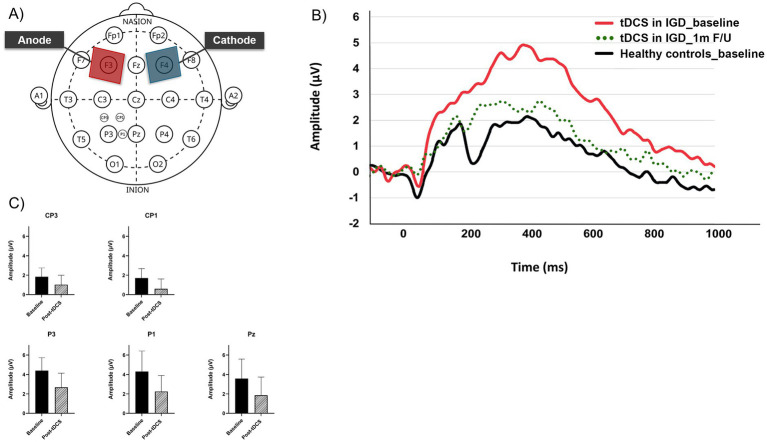
At baseline, a series of game-related and neutral pictures were shown to both IGD and healthy controls (HCs) while ERPs were recorded. Late positive potentials (LPP) were used to investigate cue reactivity. During intervention, IGD patients received 10 sessions (two sessions/day for 5 consecutive days, 2 mA for 20 min/session) of tDCS to the left (anode stimulation) and right (cathode) dorsolateral prefrontal cortex. Subjectively assessed craving and LPP component was analyzed before stimulation and at the 1-month follow-up after tDCS in IGD.
At baseline, patients with IGD showed higher LPP amplitudes for game-related cues in the centro-parietal and parietal regions than HCs. After 10 sessions of tDCS, increased LPP amplitudes decreased significantly at 1-month follow-up., as well as subjective craving for gaming.
These findings suggest that neurophysiological arousal in response to game-related cues in the IGD group could be modulated by the effects of tDCS. LPP was a significant neurophysiological marker of the neuroplastic response of cue reactivity underlying the therapeutic effect of tDCS on IGD. Based on the present findings, tDCS could be expanded to the treatment of other addictive disorders, including substance use disorder and behavioral addictions.
本研究使用事件相关电位(ERP)评估经颅直流电刺激(tDCS)对网络游戏障碍(IGD)患者线索反应性及对游戏相关线索渴望程度的影响。
在基线期,向IGD患者和健康对照者(HCs)展示一系列游戏相关和中性图片的同时记录ERP。采用晚期正电位(LPP)研究线索反应性。在干预期间,IGD患者接受10次tDCS治疗(连续5天,每天2次,每次2毫安,每次20分钟),刺激左侧(阳极)和右侧(阴极)背外侧前额叶皮质。对IGD患者在刺激前和tDCS后1个月随访时主观评估的渴望程度和LPP成分进行分析。
在基线期,IGD患者在中央顶叶和顶叶区域对游戏相关线索的LPP波幅高于HCs。经过10次tDCS治疗后,在1个月随访时LPP波幅增加显著降低,对游戏的主观渴望程度也降低。
这些发现表明,tDCS的作用可调节IGD组中对游戏相关线索的神经生理唤醒。LPP是tDCS对IGD治疗效果背后线索反应性神经可塑性反应的重要神经生理标志物。基于目前的发现,tDCS可扩展至治疗其他成瘾性障碍,包括物质使用障碍和行为成瘾。